

A website is much more than an online brochure, it is a powerful digital sales representative that works 24/7 to attract visitors, build trust, answer questions, and guide customers toward making a purchase. Unlike a traditional sales team, a website is always available, providing a consistent experience to every visitor across all time zones. When designed and optimized effectively, it becomes a strong conversion tool that drives business growth and increases revenue.

Explore the Website design process behind the Kind Energy
Your Website Never Sleeps (But Your Sales Team Does)
A human sales team comes with natural limits such as fixed working hours, time zone restrictions that affect availability, and limited daily capacity that reduces overall output, which can impact consistency and responsiveness:
- Fixed working hours
- Time zone restrictions
- Limited daily capacity
- Fatigue that affects consistency and performance
Your website removes all of these barriers by staying active at all times, operating continuously without interruption across every hour of the day, and ensuring your business remains accessible to every visitor.
It never logs off, never misses a potential lead, and never forgets to follow up when automation is in place. Whether someone visits during peak business hours or late at night, your website is always working in the background.
It Scales Without Breaking
Now imagine hiring a salesperson for every 100 visitors. As traffic grows to 100,000 or even a million visitors a month, this model quickly becomes unrealistic with human teams due to cost, capacity, and operational limits.
Your website removes this bottleneck entirely. It can handle a single visitor or millions at the same time while maintaining the same speed, structure, and user experience. There is no drop in performance as demand increases.
With the right automation in place, it continuously nurtures leads through email flows, chat systems, and personalized journeys, ensuring no opportunity is lost, Platforms like Shopify clearly show this at scale, enabling businesses to grow from small online stores into global brands without changing their core digital “salesperson”, the website itself.
Your Website Is Your First Impression (and Often Your Only Chance)
Research consistently shows that users form an opinion about a brand within seconds of landing on a website. This initial judgment happens almost instantly based on visual design, layout, and overall clarity. It strongly influences whether users trust the brand, continue exploring, or leave immediately. In many cases, this first impression determines the entire customer journey.
Your website controls:
- Trust perception
- Brand credibility
- Pricing acceptance
- Emotional engagement
A poorly designed website can silently kill deals before your sales team ever gets a chance to speak, as visitors lose trust and leave quickly without engaging. It fails to clearly communicate value and creates hesitation at a critical moment. Meanwhile, a well-optimized website works as a silent closure by building trust, guiding decisions, and driving conversions in the background.
It Qualifies Leads Before Humans Even Interact
A strong website functions as a pre-sales filter that prepares and qualifies visitors before any direct interaction with your team. It helps shape intent by guiding users through clear, structured information.
It educates visitors about your offering, answers common objections through content, and naturally filters serious buyers from casual browsers. This ensures that only genuinely interested users move further down the funnel. With tools like HubSpot, websites can capture leads automatically, score prospects based on behavior, and trigger personalized follow-ups in real time.
As a result, your human sales team spends time only on pre-qualified, high-intent leads, which significantly improves efficiency and increases conversion rates.
It Works as a Data-Driven Sales Engine
Unlike human sales conversations, which are often difficult to track and analyze in detail, websites generate precise and actionable data about every visitor interaction. This includes where users come from, what pages they visit, where they drop off, what they click, and how long they stay.
With analytics tools like Google Analytics, businesses can deeply understand user behavior across the entire journey. This makes it easier to identify friction points in the funnel and uncover exactly where potential customers lose interest.
Based on this data, teams can continuously optimize conversion paths and refine messaging to better match real user behavior rather than assumptions. As a result, the website becomes more than just a digital salesperson, it evolves into a learning system that improves performance over time through constant feedback and optimization.
It Persuades Through Structured Storytelling
A great salesperson doesn’t just talk, they guide decisions.
Your website does the same through:
- Landing pages
- Product explanations
- Testimonials and case studies
- Pricing comparisons
- FAQ sections that remove objections
Unlike humans, it delivers the perfect pitch every time, in the exact right order.
It Never Forgets Your Brand Message
Human sales reps can miscommunicate pricing, forget key product details, or unintentionally deviate from the intended messaging. These inconsistencies can lead to confusion and reduce customer confidence.
Your website eliminates this risk by delivering one consistent brand voice across every page and interaction. It maintains a controlled narrative that clearly communicates your value proposition.
It also ensures one unified positioning, so every visitor receives the same accurate and aligned message regardless of when or how they access your business. This level of consistency builds trust at scale and strengthens brand reliability over time.
It Integrates Directly Into Your Revenue System
Modern websites are no longer standalone assets, they are deeply integrated into the entire sales and revenue ecosystem of a business. Every interaction on the website can directly feed into downstream processes that support growth. They connect seamlessly with CRM systems for lead tracking, email automation tools for nurturing prospects, payment gateways for instant transactions, and customer onboarding flows that streamline post-sale experiences.
Platforms like WordPress power millions of such integrated ecosystems, enabling websites to function as the central hub that connects marketing, sales, and operations in one place. Even enterprise-grade systems like Salesforce rely heavily on website-driven lead generation, where digital interactions become the starting point of the entire revenue pipeline.
It Works Even When You’re Not Marketing Actively
Paid ads stop → traffic stops.
Sales calls stop → pipeline slows.
But a well-optimized website continues to operate like a quiet engine in the background, steadily pulling in opportunity without asking for constant attention.
It continues to:
- Rank in search engines, holding visibility for relevant queries long after the content is published
- Attract organic visitors who are actively searching for solutions, not passively being interrupted
- Convert inbound interest through landing pages, clear messaging, and trust signals that guide decisions
- Capture leads through forms, chat tools, and offers even when your team is offline
- Build long-term brand authority by consistently showing up as a reliable answer source in your niche
- Strengthen SEO performance over time as content accumulates relevance, backlinks, and engagement signals
- Reduce dependency on paid acquisition by compounding organic reach instead of renting attention
Unlike campaigns that switch on and off, a strong website behaves more like an asset that matures. Each page indexed, each article published, and each visitor interaction adds to its overall effectiveness. Over time, it stops being just a digital presence and becomes a system that continuously supports discovery, trust-building, and conversion, even when no active marketing is happening at all.
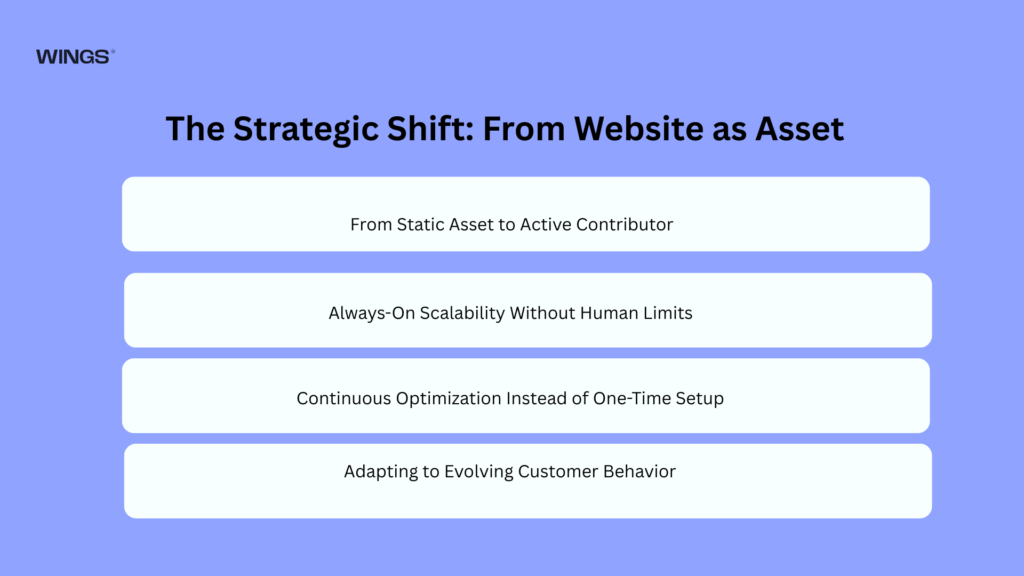
The Strategic Shift: From Website as Asset → Website as Employee
From Static Asset to Active Contributor
Most businesses still treat websites like digital brochures, meant to display information, build credibility, and sit passively until a visitor arrives. In contrast, high-growth companies design websites to actively contribute to business outcomes. They don’t just inform; they guide users, answer objections, qualify leads, and drive conversions in real time, effectively functioning as a sales and support layer that works continuously.
Always-On Scalability Without Human Limits
Unlike traditional employees, a website doesn’t sleep, take breaks, or hit capacity limits. It can engage thousands of users simultaneously, 24/7, without additional cost per interaction. This makes it one of the most scalable “team members” in a business, capable of handling repetitive tasks like FAQs, onboarding, and lead capture while freeing human teams to focus on higher-value work.
Continuous Optimization Instead of One-Time Setup
A website-as-employee mindset recognizes that launch is not the finish line. Just like a real employee improves through feedback and training, a website must be continuously optimized through A/B testing, UX improvements, analytics insights, and messaging refinement. Without this ongoing “training,” performance stagnates and user behavior shifts outpace the experience.
Adapting to Evolving Customer Behavior
Customer expectations are not static, and neither should a website be. Users change how they search, evaluate, and decide over time. A modern website adapts by analyzing behavior patterns, such as drop-offs, click paths, and conversion bottlenecks and evolving its structure, content, and flows accordingly. This ensures it stays aligned with real user intent, not outdated assumptions.

Explore the Website design process behind the Quint.
Conclusion
A website is often the first interaction customers have with a business, making it one of its most valuable sales tools. Instead of simply providing information, an effective website guides visitors toward taking action by building trust, answering questions, and encouraging conversions. Clear messaging, strong calls to action, and an easy-to-use design help turn visitors into leads and customers. While many businesses focus on increasing website traffic, long-term success depends on improving conversions. A well-optimized website acts like a skilled salesperson, leading users through every step of their journey and driving business growth.

Mugesh Kanna
Junior Web developer