


In hyper-competitive landscape, decision-makers don’t have the luxury of time. They are constantly evaluating opportunities, filtering noise, and looking for insights that translate directly into business impact. When they click on a blog titled “Standing Out in a Crowded Market: The Art of Brand Differentiation,” they come with clear expectations: clarity over complexity, strategy over theory, and outcomes over opinions.
This blog is written with that mindset, delivering exactly what leaders, founders, and senior marketers want to understand, apply, and act on.
Why Differentiation Matters More Than Ever

Explore the Branding behind the Crypto & Beans.
The Reality Decision-Makers Face
Before jumping into strategies, it’s important to acknowledge the environment leaders are actually operating in. Differentiation doesn’t fail because decision-makers don’t understand its importance, it fails because the conditions make it difficult to sustain. Most leaders are dealing with internal misalignment, external competition, and increasing customer expectations all at once. They are not choosing to blend in; they are often navigating systems that unintentionally push them toward it. Recognizing this context is essential, because without it, any advice on differentiation feels disconnected from reality.
01. Feature Parity
In many industries, competitors have reached a point where their core offerings look almost identical on the surface. Features that once created separation are now expected as standard, and innovation cycles have shortened to the point where advantages are quickly replicated. As a result, companies continue investing in incremental improvements that rarely translate into perceived value for customers. From the outside, everything appears to work well enough, making it difficult for buyers to distinguish one option from another. When functional differences become invisible, differentiation based purely on product capability begins to lose its impact.
02. Commoditization Pressure
When customers struggle to see meaningful differences between options, price naturally becomes the deciding factor. This puts businesses into a defensive position, where they are forced to compete on discounts rather than value. Over time, this erodes not just margins, but also brand perception, shifting the company from a preferred choice to a replaceable one. Scaling becomes harder because growth relies on volume rather than strong positioning. What starts as a short-term pricing adjustment often evolves into long-term commoditization, making it increasingly difficult to reclaim pricing power.
03. Fragmented Messaging
Within most organizations, different teams communicate value in different ways, often without realizing the disconnect. Marketing may focus on high-level positioning, sales may prioritize immediate conversion points, and product teams may emphasize features and functionality. While each perspective is valid on its own, the lack of alignment creates a fragmented experience for the customer. Instead of receiving a clear and consistent message, the market sees multiple versions of what the company stands for. This inconsistency weakens credibility and makes it harder for customers to confidently understand or trust the brand.
04. Customer Skepticism
Modern buyers are far more informed and far less willing to take claims at face value. They have seen the same language repeated across competitors and have developed a natural resistance to vague or generic messaging. Words like “innovative” or “customer-centric” no longer build confidence because they lack specificity and proof. Instead, customers look for clarity, relevance, and tangible outcomes that directly connect to their needs. If a message feels indistinguishable from others in the market, it is quickly dismissed, regardless of how strong the actual offering may be.
A strong blog or brand strategy must reflect these realities before offering solutions. Decision-makers are not looking for surface-level advice; they are looking for perspectives that acknowledge the complexity they deal with every day. When they feel understood, they are far more open to engaging with new ideas and approaches. Without that foundation, even the best strategies risk being ignored or undervalued.
What Differentiation Really Means
Differentiation is often misunderstood as simply “being different.” But difference alone doesn’t create value.
Effective differentiation is about being meaningfully different in a way that influences customer preference and drives measurable business results.
This means:
- It must matter to your target audience.
- It must be difficult for competitors to replicate quickly.
- It must be consistently communicated and delivered.
Without these elements, differentiation becomes superficial and ineffective.
The Three Pillars of Strong Brand Differentiation
To make differentiation actionable, decision-makers don’t just need ideas, they need a clear and practical framework they can apply across teams. Differentiation becomes effective only when it is structured, repeatable, and consistently communicated. One of the most reliable ways to approach this is through three interconnected pillars that work together rather than in isolation. Each pillar addresses a different dimension of how a brand stands out in the market. When aligned, they create clarity, credibility, and competitive advantage.
01. Value Differentiation: What You Deliver
This is the most fundamental level of differentiation, it defines the actual value your business creates for customers. At this stage, the focus is not on what you offer, but on what your customer gains as a result of choosing you. Strong value differentiation answers questions around speed, efficiency, risk reduction, and problem-solving in a way that is tangible and relevant. It forces businesses to move beyond features and think in terms of outcomes that directly impact the customer’s goals. In a crowded market, the companies that win are those that can clearly articulate not just what they do, but why it matters.
Value differentiation is not about adding more capabilities or listing more features, it is about delivering better, clearer, and more meaningful results. Many companies fall into the trap of overloading their offering with functionality, assuming it will create separation. In reality, customers rarely evaluate every feature; they evaluate the outcome those features enable. A strong value proposition simplifies this into something immediately understandable and compelling. The clearer the outcome, the easier the decision.
For example, instead of saying:
“We offer advanced analytics tools,”
a differentiated value statement would be:
“We help businesses make critical decisions 40% faster with real-time insights.”
The shift may seem subtle, but it fundamentally changes how the value is perceived. It moves the conversation from capability to impact, making the benefit both specific and measurable.
02. Perception Differentiation: How You Are Seen
Even the strongest value proposition has limited impact if it is not clearly perceived by the market. Perception differentiation focuses on how your brand is experienced and interpreted by your audience at every touchpoint. It is shaped by your messaging, visual identity, tone of voice, customer interactions, and overall market positioning. These elements collectively influence whether your brand is understood, remembered, and trusted. Without intentional control over perception, even strong values can become invisible.
Decision-makers recognize that perception often carries as much weight as reality in influencing customer decisions. If customers cannot quickly grasp what makes you different, they will default to familiar or cheaper options. This is why clarity and consistency across all communication channels are critical. Every interaction should reinforce the same core message rather than introduce new or conflicting narratives. Over time, consistent perception builds recognition, and recognition builds preference.
Strong positioning requires making deliberate choices about how you want to be seen in the market. Whether you position yourself as premium or affordable, innovative or dependable, specialized or comprehensive, each choice shapes expectations and attracts a specific type of customer. Trying to appeal to everyone often results in diluted messaging that resonates with no one. The most effective brands commit to a clear identity and reinforce it consistently across every touchpoint.
03. Proof Differentiation: Why You Are Credible
In a market filled with bold claims and polished messaging, proof is what turns attention into trust. Customers today are not easily convinced by statements alone, they expect evidence that validates what is being promised. Proof differentiation is about demonstrating your value in a way that is concrete, measurable, and verifiable. It bridges the gap between what you say and what customers believe. Without proof, even the strongest positioning risks being dismissed as marketing language.
Decision-makers understand that credibility is built through consistent demonstration of results over time. This includes data-backed outcomes, case studies, customer testimonials, and real-world examples that show how your solution performs in practice. The more specific and relevant the proof, the stronger its impact. Generic claims may attract attention, but specific results build confidence and reduce perceived risk for the buyer.
For instance:
Claim: “We improve efficiency”
Proof: “Our clients reduce operational costs by an average of 25% within six months”
This shift from a general statement to a measurable outcome makes the value tangible and believable. Proof transforms perception into conviction, giving customers the confidence to choose you over alternatives.
When these three pillars value, perception, and proof are aligned, differentiation becomes clear, credible, and difficult to replicate. Each pillar reinforces the others, creating a cohesive narrative that is easy for customers to understand and trust. Without this alignment, even strong individual elements can fail to create meaningful impact in the market.
The Role of Strategic Trade-Offs
One of the most overlooked aspects of differentiation is the need to make clear trade-offs. Many organizations try to appeal to a broad audience, offer multiple positioning angles, and cover every possible use case. While this feels safer, it often leads to diluted messaging and weak market presence. Without focus, brands become harder to understand and easier to ignore. Differentiation requires the discipline to prioritize what matters most.
At its core, strong positioning comes from choosing a direction and committing to it. Focusing on a niche audience may reduce reach but increases relevance and connection. Similarly, premium positioning may limit volume but strengthens margins and brand perception. Simplifying offerings can exclude certain customers, but it improves clarity and decision-making. These trade-offs are not drawbacks; they are what create sharp, memorable positioning.
The key insight is simple: differentiation is as much about what you choose not to do as what you choose to do. Brands that avoid these decisions often end up blending in, while those that embrace them create clearer, stronger, and more defensible identities.
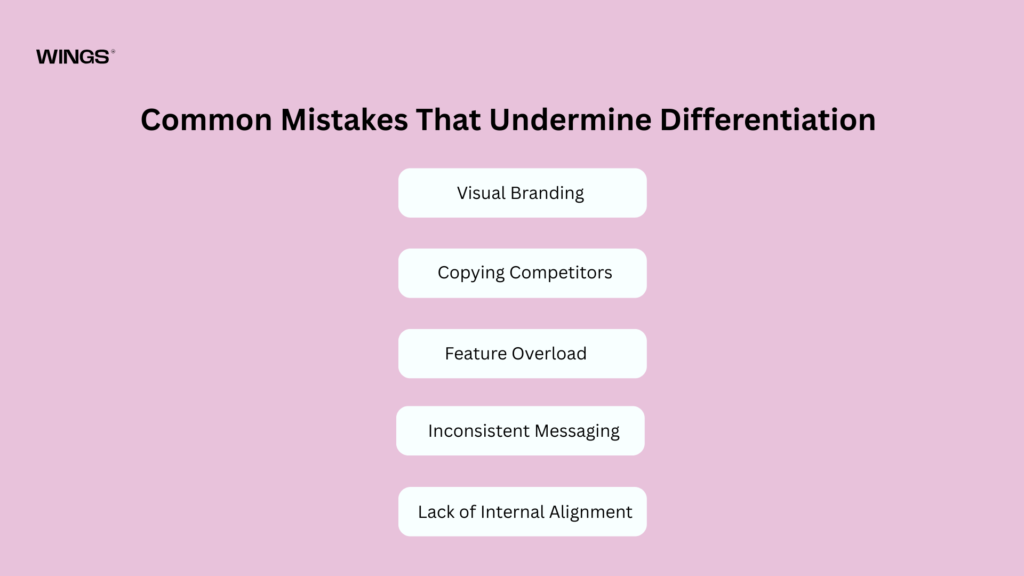
Common Mistakes That Undermine Differentiation
To create meaningful differentiation, it’s just as important to understand what weakens it. Many organizations invest time and resources into standing out, yet unintentionally fall into patterns that make them blend in. These mistakes often stem from good intentions, wanting to look modern, competitive, or comprehensive but they dilute clarity and impact. Recognizing these pitfalls helps decision-makers avoid wasted effort and focus on what truly drives distinction.
01. Over-Reliance on Visual Branding
Visual identity elements like logos, colors, and design systems play an important role in how a brand is recognized, but they are not the foundation of differentiation. Many companies assume that a refreshed look or modern design will set them apart, when in reality it only enhances what already exists. If the underlying value and positioning are unclear, even the strongest design will not create meaningful separation. Visual branding should reinforce differentiation, not attempt to replace it.
02. Copying Competitors
In competitive markets, it’s natural to look at what others are doing and follow similar patterns, especially when those approaches seem successful. However, this often leads to a cycle where every brand adopts the same language, tone, and positioning. What feels like staying relevant quickly turns into becoming indistinguishable. True differentiation requires the confidence to take a distinct stance, even if it means moving away from industry norms.
03. Feature Overload
A common response to competition is to add more features in an attempt to appear more capable or advanced. While this may seem like a way to stand out, it often creates the opposite effect. Too many features can overwhelm users, reduce usability, and make the core value harder to understand. Customers rarely choose based on the number of features, they choose based on how effectively their problem is solved. Simplicity and clarity often outperform complexity.
04. Inconsistent Messaging
When different parts of the organization communicate different value propositions, it creates confusion in the market. Marketing may focus on vision, sales on immediate benefits, and product on technical capabilities, but without alignment, the overall message becomes fragmented. Customers don’t see internal structures, they experience the brand as a whole. Inconsistency weakens trust and makes it harder for customers to clearly understand why they should choose you.
05. Lack of Internal Alignment
Differentiation is not just a marketing initiative; it must be understood and supported across the entire organization. If teams are not aligned on what makes the company different, the message will break down at various touchpoints. Employees may interpret positioning differently, leading to inconsistent execution and diluted impact. Strong differentiation requires shared clarity, where everyone from leadership to frontline teams understands and reinforces the same core narrative.
A Practical Approach to Building Differentiation
For differentiation to be effective, it needs to move beyond theory and translate into clear, repeatable actions. Decision-makers are not looking for abstract ideas, they need a structured approach that can be applied across teams and functions. The process of building differentiation is iterative, requiring both internal clarity and external validation. When done right, it creates alignment within the organization and clarity in the market.
Step 1: Conduct a Positioning Audit
The process begins with an honest and often uncomfortable assessment of your current positioning. Many organizations believe they are differentiated, but that belief is rarely tested against real customer perception. This step involves identifying what you claim as your differentiators and comparing it with how customers actually experience and describe your brand. By analyzing customer feedback, reviews, and sales conversations, you can uncover gaps between intention and reality. These gaps are where most differentiation efforts either fail or need to be rebuilt.
Step 2: Analyze the Competitive Landscape
Understanding your competitors is not about imitation, it’s about identifying patterns of sameness. By mapping what competitors emphasize, the language they use, and the promises they make, you begin to see where the market is saturated. Often, multiple brands cluster around similar claims, creating a crowded and indistinguishable space. This analysis helps you avoid repeating the same narratives and instead look for angles that are underutilized. The goal is not just to be better, but to be meaningfully different in a way that is visible.
Step 3: Identify White Space
White space is where real differentiation emerges, it represents the gaps that competitors have overlooked or underserved. These gaps can exist in customer segments, use cases, or even in how problems are framed and communicated. By focusing on customer frustrations that are consistently ignored or poorly addressed, you can uncover opportunities to create unique value. This requires shifting from an internal perspective to an external one, where the customer needs guide positioning decisions. The more specific the insight, the stronger the differentiation.
Step 4: Define Your Core Value Proposition
A strong value proposition brings clarity to everything your brand stands for. It should clearly define who you serve, what you deliver, and why it matters in a way that is easy to understand and hard to ignore. The most effective value propositions are specific, outcome-driven, and directly tied to customer priorities. Generic or vague statements dilute impact and make it harder for customers to connect with your offering. Precision, not complexity, is what makes a value proposition powerful and memorable.
Step 5: Align Messaging Across Channels
Even the strongest positioning can fail if it is not consistently communicated across all touchpoints. Customers interact with your brand through multiple channels, and each one shapes their perception. From your website and marketing campaigns to sales conversations and customer support, the core message must remain aligned. Inconsistency creates confusion, while consistency reinforces clarity and trust. Alignment ensures that no matter where or how a customer engages with your brand, they receive the same clear narrative.
Step 6: Build Proof Into Your Story
Differentiation becomes credible only when it is supported by evidence. Integrating proof into your messaging helps move customers from interest to confidence by reducing uncertainty. This includes sharing measurable results, highlighting real customer experiences, and using data to validate your claims. Proof should not be treated as an add-on but as a core part of your communication strategy. When customers can clearly see the outcomes you deliver, decision-making becomes faster and more assured.
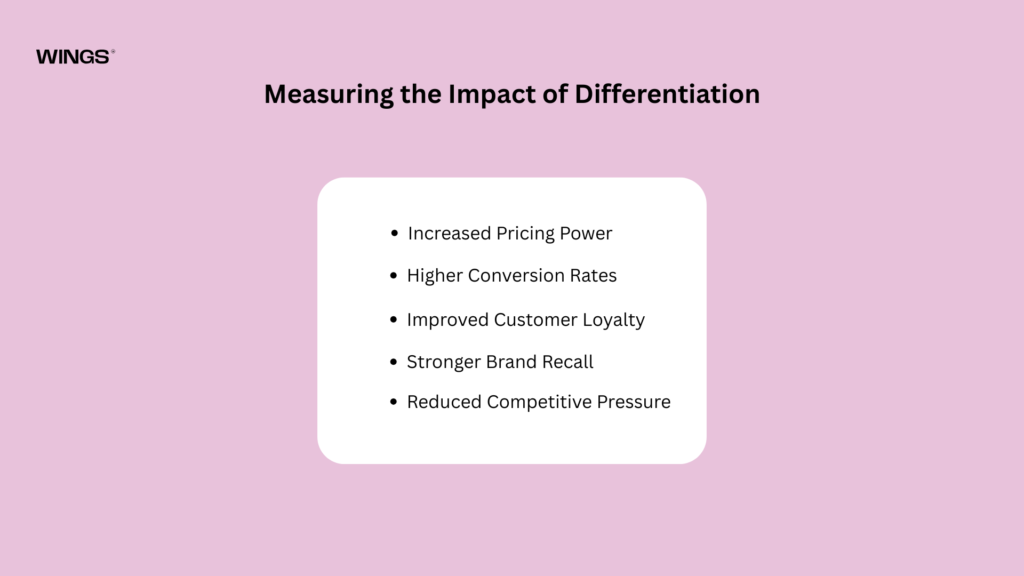
Measuring the Impact of Differentiation
Differentiation is only valuable if it translates into measurable business outcomes. Decision-makers are not just interested in whether a brand sounds different, they want to know whether that difference drives performance. The effectiveness of differentiation should be evaluated through clear metrics that reflect both market perception and financial impact. Without measurement, differentiation remains a conceptual effort rather than a strategic advantage.
01. Increased Pricing Power
One of the clearest indicators of strong differentiation is the ability to command higher prices without losing customers. When your value is clearly understood and perceived as meaningful, buyers are less likely to compare you purely on cost. Instead, they evaluate the outcome and relevance you provide. This shift reduces dependency on discounts and protects margins over time. Pricing power is often the first tangible signal that differentiation is working.
02. Higher Conversion Rates
Clear differentiation reduces confusion and makes decision-making easier for customers. When buyers quickly understand why your offering is the right fit, the time and effort required to choose decreases. This leads to faster sales cycles and improved conversion rates across channels. Instead of hesitating or comparing multiple similar options, customers move forward with greater confidence. Clarity, in this context, directly translates into momentum.
03. Improved Customer Loyalty
Customers who clearly understand why they chose you are more likely to stay with you. Differentiation strengthens the initial decision and reinforces it over time through consistent value delivery. When customers see a direct connection between your offering and their outcomes, switching to alternatives becomes less appealing. Loyalty, in this sense, is not driven by habit but by perceived relevance and trust. Strong differentiation builds relationships that extend beyond transactional interactions.
04. Stronger Brand Recall
Brands that stand for something specific are easier to remember in a crowded market. When your positioning is clear and distinct, it creates mental shortcuts that help customers recall and recognize you quickly. This not only improves direct engagement but also increases the likelihood of word-of-mouth recommendations. In contrast, generic brands are easily forgotten because they lack a defining characteristic. Memorability is a direct outcome of meaningful differentiation.
04. Reduced Competitive Pressure
When you occupy a unique position, direct comparisons with competitors become less relevant. Instead of being evaluated side-by-side on similar attributes, you are seen as an alternative with a different value proposition. This reduces the intensity of competition and gives you more control over how you are perceived. Rather than reacting to competitors, you define your own space in the market. Over time, this creates a more defensible and sustainable advantage.
Tracking these metrics provides clarity on whether your differentiation strategy is working or needs refinement. It allows decision-makers to move beyond assumptions and make informed adjustments based on real performance. When differentiation is measured effectively, it becomes a continuous process of improvement rather than a one-time exercise.
Real-World Application: What Success Looks Like
In practice, successful differentiation is rarely about dramatic changes, it’s about shifting how a business thinks, communicates, and delivers value. Many organizations already have the capability to stand out, but they frame it in ways that make them sound like everyone else. The real transformation happens when the focus moves from internal thinking to customer impact. These shifts may appear subtle on the surface, but they fundamentally reshape how a brand is understood and chosen in the market.
From selling products to selling outcomes
Customers are not buying products or services for their own sake, they are buying the results those offerings enable. When businesses shift their messaging from what they sell to what customers achieve, the value becomes clearer and more compelling. This approach aligns directly with customer priorities, making the offering feel more relevant and actionable. It also helps simplify complex solutions into benefits that are easy to understand. Outcome-focused positioning turns abstract capabilities into tangible reasons to choose.
From targeting broad audiences to focusing on specific segments
Trying to appeal to a wide audience often leads to generic messaging that resonates with very few. In contrast, focusing on a clearly defined segment allows for deeper relevance and stronger connection. When customers feel that a brand is specifically designed for their needs, trust and engagement increase. This targeted approach also enables more precise communication and better alignment with customer expectations. Narrowing the audience doesn’t limit growth, it strengthens the foundation for it.
From emphasizing features to highlighting impact
Features describe what a product does, but impact explains why it matters. While features are important, they rarely create emotional or strategic urgency on their own. By shifting the focus to the real-world impact such as saving time, reducing costs, or improving outcomes, brands make their value more meaningful. This helps customers quickly connect the offering to their own goals and challenges. Impact-driven communication makes differentiation more visible and easier to evaluate.
From making claims to demonstrating proof
In a market filled with bold promises, claims alone are no longer enough to build trust. Customers expect evidence that supports what is being said, whether through data, case studies, or real customer experiences. Demonstrating proof reduces uncertainty and makes the decision feel safer and more justified. It also reinforces credibility over time, as consistent results build confidence in the brand. Moving from claims to proof transforms messaging from persuasive to convincing.
These shifts may seem incremental, but together they create a powerful change in perception. They move a brand from being one of many options to being a clear and confident choice.
The Leadership Perspective
For decision-makers, differentiation is not just a marketing initiative, it is a strategic priority that shapes the direction of the business. It influences how products are built, how teams communicate, and how customers experience the brand at every touchpoint. Treating it as a surface-level activity creates inconsistency, while true differentiation requires leadership to treat it as a core business discipline. This depends on strong cross-functional alignment, where marketing, sales, product, and customer experience teams share a unified understanding of what makes the company distinct. Without this alignment, differentiation breaks into disconnected messages that confuse customers.
Differentiation also requires clear communication and long-term commitment. It is not enough to define positioning at the leadership level, it must be understood and applied across the organization through simple, repeatable messaging. As markets evolve and expectations shift, differentiation must be continuously reinforced and refined. Over time, consistency turns positioning into perception, and leadership ensures it is embedded across every decision and customer interaction. Without that commitment, differentiation may exist in theory but rarely holds in execution.

Explore the Branding behind the BLYP.
The Future of Differentiation
As markets evolve, differentiation is becoming both harder to achieve and more essential for growth. Faster innovation cycles and increased competition mean that advantages are quickly replicated, reducing the lifespan of product-based differentiation. At the same time, customers are more informed and selective, raising the bar for how brands communicate and deliver value. This shift forces companies to rethink how they stand out in a meaningful and sustainable way.
Emerging trends such as personalization, stronger customer experience, and demand for transparency are reshaping expectations. Customers no longer respond to generic messaging, they expect relevance, consistency, and authenticity at every interaction. This makes experience and perception just as important as the product itself. Brands that fail to adapt risk becoming interchangeable in the eyes of their audience.
In this environment, sustainable differentiation will depend less on what you offer and more on how you deliver it and how you are perceived. Execution, clarity, and trust will define competitive advantage far more than features alone.
Conclusion
In crowded markets, visibility is rarely the real challenge clarity is. Many brands are seen, but few are truly understood in a way that makes them easy to choose. Competing harder, increasing spend, or amplifying messaging often doesn’t solve this problem if the core positioning remains unclear. What ultimately separates strong brands is not how loudly they communicate, but how clearly they articulate their value. Clarity reduces friction, builds confidence, and accelerates decision-making.
The brands that succeed are those that position themselves with intent and consistency. They give customers a clear, compelling reason to choose them and reinforce that reason across every interaction. This consistency builds trust over time, turning initial interest into long-term preference. Instead of trying to win attention repeatedly, they make it easier for customers to remember and return. Strong positioning, when executed well, compounds in value.
Differentiation, at its core, is not about volume, it is about precision. It’s about ensuring that your message is understood quickly and without ambiguity. When customers immediately grasp what makes you relevant and valuable, the decision becomes simpler and more confident. In contrast, when clarity is missing, even strong offerings can be overlooked. Understanding drives choice far more than exposure alone.
A Question to Consider
If your brand disappeared tomorrow, would your customers actively look for a replacement, or would they simply choose the next available option? This question cuts through assumptions and highlights the true strength of your differentiation. If customers would not notice your absence, it signals that your value is not clearly defined or deeply felt. If they would seek you out, it reflects strong positioning and meaningful connection.
If the answer isn’t where you want it to be, the path forward is clear. Refine your positioning, sharpen your message, and align your organization around a distinct value that customers recognize and trust. The goal is not just to exist in the market, but to occupy a space that is clearly yours and difficult to replace.

Akshita Shivani Sundar
Senior Graphic Designer