



What is WooCommerce?
WooCommerce is a free, open-source eCommerce plugin built specifically for WordPress. It allows businesses to transform a standard WordPress website into a fully functional online store where they can sell products, accept payments, manage inventory, track orders, and handle shipping and taxes.
Launched in 2011, WooCommerce quickly became one of the most popular eCommerce solutions due to its flexibility, affordability, and ease of use. Today, it powers millions of online stores worldwide and is trusted by everyone from small business owners and startups to large enterprises.
One of WooCommerce’s biggest advantages is its versatility. The platform supports a wide range of business models, including:
- Physical product stores
- Digital product sales
- Subscription businesses
- Membership websites
- Online course platforms
- Service-based businesses
- B2B eCommerce stores
- Multi-vendor marketplaces
Unlike many hosted eCommerce platforms, WooCommerce gives businesses complete control over their website and customer data. Since it is built on WordPress, users can choose from thousands of themes and plugins to customize their store’s design and functionality according to their specific needs.
Another key benefit is its scalability. Businesses can start with a small online store and gradually add new features, products, and integrations as they grow. Whether you’re selling a handful of products or managing a large catalog, WooCommerce provides the flexibility to support your business at every stage.
Because it is open source, developers can also create custom features, integrate third-party tools, and tailor the shopping experience to match unique business requirements. This combination of flexibility, ownership, and scalability has made WooCommerce one of the leading eCommerce platforms for businesses looking to build and grow a successful online store.
How WooCommerce Works
WooCommerce operates as a plugin within the WordPress ecosystem, making it easy for businesses to add eCommerce functionality to their existing websites. Once installed and configured, WooCommerce transforms a standard WordPress site into a fully functional online store capable of managing products, payments, shipping, taxes, and customer orders.
Store owners can manage their entire eCommerce operation from a user-friendly dashboard, allowing them to create products, organize categories, configure payment gateways, and monitor store performance without requiring advanced technical knowledge.
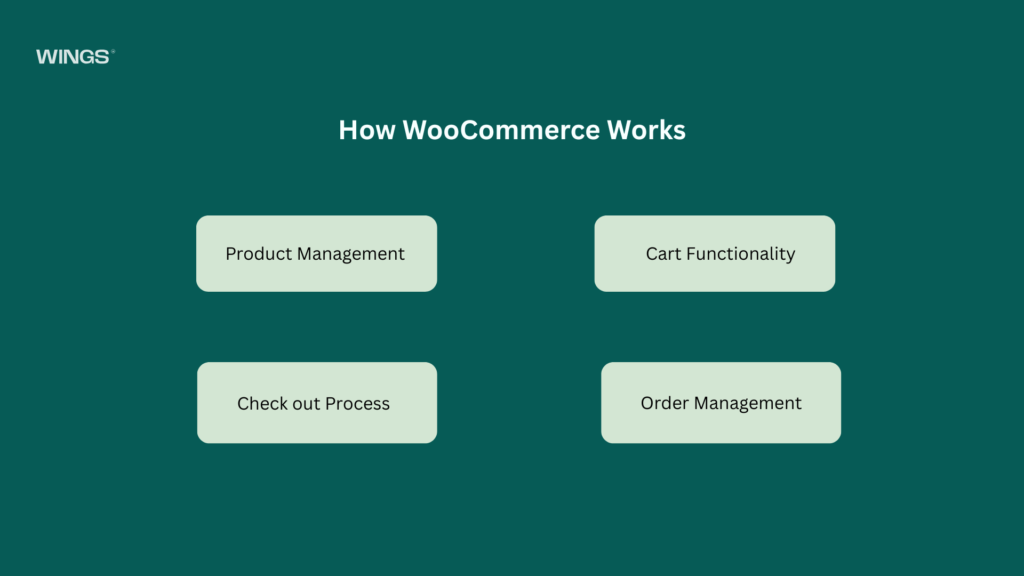
The typical WooCommerce workflow includes:
Product Management
WooCommerce makes it easy to create detailed product pages that help customers make informed purchasing decisions. Store owners can add:
- Product descriptions
- Images and galleries
- Pricing information
- Inventory levels
- Product variations
- Attributes and specifications
Whether you’re selling physical products, digital downloads, or subscription services, WooCommerce provides the flexibility to showcase products professionally and keep information organized.
Shopping Cart Functionality
When customers browse your store, they can add products to a shopping cart, update quantities, apply discount coupons, and review their selections before checkout. A smooth and user-friendly cart experience helps reduce abandoned purchases and encourages customers to complete their orders.
Checkout Process
WooCommerce offers customizable checkout pages that collect customer information, process payments, and generate orders automatically. Businesses can simplify the checkout process by removing unnecessary fields, enabling guest checkout, and integrating popular payment gateways such as Stripe, PayPal, and Razorpay to improve the customer experience.
Order Management
Once an order is placed, WooCommerce provides a centralized system for tracking and managing the entire order lifecycle. Store administrators can monitor:
- New orders
- Processing orders
- Completed orders
- Refunded orders
- Cancelled orders
This streamlined order management process helps businesses stay organized, fulfill orders efficiently, and provide better customer service.

Explore the Web development process behind the Chaitanya.
Key Features of WooCommerce
WooCommerce offers a comprehensive set of features that help businesses manage, optimize, and grow their online stores.
Product Variations
One of WooCommerce’s most useful features is the ability to create multiple variations of a single product. This is particularly beneficial for businesses that sell products with different options such as sizes, colors, materials, styles, or configurations.
For example, a clothing retailer can list one t-shirt product and offer customers multiple size and color combinations without creating separate product pages for each variation. Similarly, an electronics store can provide different storage capacities or product configurations under a single listing.
Inventory Management
Managing inventory effectively is crucial for avoiding stock shortages and maintaining customer satisfaction. WooCommerce includes built-in inventory management tools that help businesses monitor product availability and track stock levels in real time.
Store owners can:
- Monitor inventory levels
- Receive low-stock notifications
- Prevent overselling
- Manage backorders
- Track stock status automatically
These features reduce manual work and help ensure that customers always see accurate product availability. As businesses grow and manage larger product catalogs, effective inventory management becomes essential for smooth operations and improved customer trust.
Coupon and Discount Management
Promotions play a major role in attracting new customers and encouraging repeat purchases. WooCommerce makes it easy to create and manage a variety of discount campaigns without requiring additional tools.
Businesses can offer:
- Percentage-based discounts
- Fixed amount discounts
- Free shipping promotions
- Limited-time offers
- Customer-specific coupons
- Minimum purchase discounts
These promotional features can be used to increase sales during seasonal events, reward loyal customers, recover abandoned carts, or encourage larger order values. A well-planned discount strategy can significantly improve conversion rates and customer retention.
Reporting and Analytics
Understanding store performance is essential for making informed business decisions. WooCommerce provides built-in reporting and analytics tools that give store owners valuable insights into sales and customer behavior.
Business owners can track key metrics such as:
- Revenue and sales performance
- Sales trends over time
- Top-selling products
- Customer purchasing behavior
- Average order value
- Order volume
These insights help businesses identify growth opportunities, evaluate marketing campaigns, optimize product offerings, and make data-driven decisions. By regularly monitoring performance metrics, store owners can improve efficiency and develop strategies that support long-term growth.
Flexible Payment Gateway Integration
WooCommerce supports a wide range of payment gateways, allowing businesses to offer secure and convenient payment options to customers. Popular integrations include Stripe, PayPal, Razorpay, UPI payments, credit cards, and digital wallets.
Providing multiple payment methods improves the checkout experience and can help reduce cart abandonment by giving customers the flexibility to pay using their preferred option.
Shipping and Tax Management
WooCommerce simplifies the process of managing shipping and taxes. Store owners can configure shipping zones, delivery rates, free shipping offers, and tax rules based on customer location.
This flexibility allows businesses to serve local, national, and international customers while ensuring accurate shipping charges and tax calculations. Automated shipping and tax management reduce administrative work and help maintain compliance with regional regulations.
Top Benefits of WooCommerce
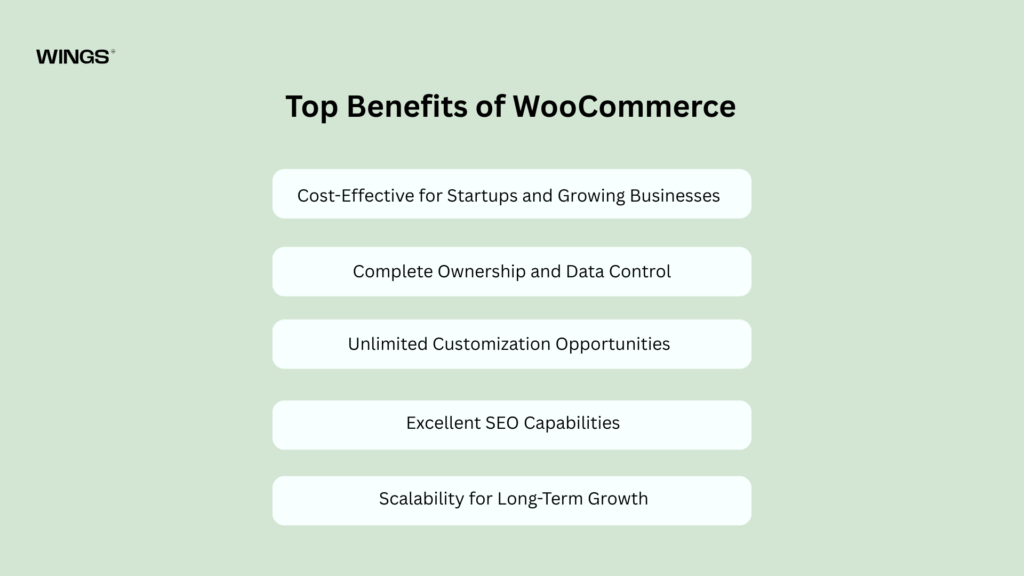
WooCommerce has become one of the most popular eCommerce platforms because it offers a combination of affordability, flexibility, and scalability.
1. Cost-Effective for Startups and Growing Businesses
One of the biggest reasons businesses choose WooCommerce is its affordability. Unlike many proprietary eCommerce platforms that charge monthly subscription fees, the core WooCommerce plugin is completely free to use.
This allows businesses to allocate more of their budget toward important growth activities such as:
- Marketing campaigns
- Product development
- Website optimization
- Customer acquisition
- Branding and design
Store owners only need to pay for essentials such as hosting, domain registration, and any premium plugins or themes they choose to use. This flexibility makes WooCommerce particularly attractive for startups and small businesses looking to build an online presence without a significant upfront investment.
2. Complete Ownership and Data Control
Data ownership is becoming increasingly important as businesses rely more on customer insights and digital marketing. With WooCommerce, store owners maintain full control over their website, customer information, and business data.
This includes:
- Customer records
- Product information
- Website content
- Sales history
- Marketing assets
Unlike some hosted platforms that place restrictions on data access or charge additional fees for advanced features, WooCommerce gives businesses complete ownership and control. This freedom allows companies to manage their stores according to their own goals without being limited by platform policies or pricing changes.
3. Unlimited Customization Opportunities
Every business has unique requirements, and WooCommerce is designed to accommodate them. Because it is open-source and built on WordPress, businesses can customize nearly every aspect of their online store.
With thousands of themes and plugins available, store owners can add features such as:
- Advanced product filters
- Custom checkout experiences
- Subscription services
- Membership programs
- Loyalty rewards
- Multi-vendor functionality
For businesses with specialized needs, developers can build custom features and integrations tailored to specific workflows. This flexibility allows WooCommerce to support everything from simple online stores to highly complex eCommerce operations.
4. Excellent SEO Capabilities
Search engine optimization (SEO) plays a critical role in attracting customers and generating sales. One of WooCommerce’s strongest advantages is its integration with WordPress, a platform known for its SEO-friendly structure.
Businesses can optimize:
- Product pages
- Category pages
- Blog content
- Landing pages
- Meta titles and descriptions
- URL structures
- Technical SEO elements
By combining eCommerce functionality with content marketing, businesses can attract organic traffic from search engines and reduce their dependence on paid advertising. Over time, strong SEO performance can lead to increased visibility, more qualified visitors, and higher sales.
5. Scalability for Long-Term Growth
As businesses grow, their eCommerce platform must be able to handle increased traffic, larger product catalogs, and more complex operations. WooCommerce is highly scalable and can support businesses at every stage of growth.
Whether you’re managing a small store with a handful of products or a large operation with thousands of SKUs, WooCommerce provides the flexibility needed to expand without switching platforms.
Businesses can easily add:
- New products and categories
- Additional payment methods
- Advanced marketing tools
- Third-party integrations
- International shipping options
This scalability ensures that your online store can evolve alongside your business, making WooCommerce a reliable long-term investment for sustainable growth.

Explore the Web development process behind the Franck Muller.
WooCommerce vs Shopify
One of the most common questions business owners ask when starting an online store is whether they should choose WooCommerce or Shopify. Both platforms are popular, powerful, and capable of supporting successful eCommerce businesses, but they take very different approaches to online store management.
Shopify is a fully hosted eCommerce platform that provides an all-in-one solution, while WooCommerce is an open-source plugin that gives businesses complete control over their website and online store. The right choice ultimately depends on your budget, technical requirements, customization needs, and long-term business goals.
WooCommerce Advantages
WooCommerce is often preferred by businesses that value flexibility and ownership. Since it is built on WordPress, store owners have full control over their website, data, and functionality.
Some key advantages of WooCommerce include:
- Full ownership of website and customer data
- Greater design and customization flexibility
- Lower long-term costs
- Access to thousands of WordPress plugins and themes
- Better content marketing capabilities
- Extensive SEO control and optimization options
WooCommerce is particularly beneficial for businesses that rely heavily on content marketing, search engine optimization, and custom functionality. It allows store owners to build a highly personalized shopping experience without being restricted by platform limitations.
Shopify Advantages
Shopify is designed for simplicity and convenience. Since it is a hosted platform, Shopify handles hosting, security updates, and maintenance on behalf of store owners.
Some key advantages of Shopify include:
- Faster and easier setup process
- Managed hosting and security
- Built-in maintenance and updates
- User-friendly interface
- Reliable performance and uptime
- Minimal technical management
For beginners or businesses that want a plug-and-play solution, Shopify can be an attractive option because it reduces the technical responsibilities associated with running an online store.
Which Platform Is Right for Your Business?
If your priority is getting an online store launched quickly with minimal technical involvement, Shopify offers a straightforward and user-friendly experience. However, businesses may encounter limitations when they require advanced customizations, greater control over data, or more flexibility in managing their website.
WooCommerce, on the other hand, requires slightly more setup and management but offers significantly more freedom and scalability. Businesses can customize nearly every aspect of their store, integrate specialized tools, and create a website that aligns perfectly with their brand and operational requirements.
For businesses focused on long-term growth, content marketing, SEO, and complete ownership of their online presence, WooCommerce is often the preferred choice. Its flexibility, customization capabilities, and lower long-term costs make it a powerful solution for companies looking to build a scalable and future-ready eCommerce store.

Explore the Web development process behind the Blossom Height.
Common WooCommerce Challenges
While WooCommerce is a powerful and flexible eCommerce platform, businesses may face certain challenges as their stores grow. Fortunately, most of these issues can be resolved through proper setup, ongoing maintenance, and professional optimization.
Slow Website Performance
Website speed plays a critical role in both user experience and conversion rates. A slow-loading store can frustrate visitors, increase bounce rates, and negatively impact search engine rankings.
Performance issues are often caused by factors such as:
- Poor-quality hosting
- Large image files
- Excessive plugins
- Unoptimized themes
- Large product catalogs
Regular performance optimization, caching, image compression, and choosing reliable hosting can significantly improve site speed and overall store performance.
Plugin Compatibility Issues
One of WooCommerce’s biggest strengths is its extensive plugin ecosystem. However, using multiple plugins from different developers can sometimes lead to compatibility issues.
Conflicting plugins may cause:
- Website errors
- Broken functionality
- Checkout problems
- Slow performance
To minimize these risks, businesses should keep plugins updated, remove unnecessary extensions, and test new plugins before deploying them on a live store.
Security Concerns
As with any online platform that handles customer information and payment transactions, security is an important consideration. Outdated software, weak passwords, or poorly maintained plugins can create vulnerabilities that may expose a website to cyber threats.
Businesses can improve security by:
- Regularly updating WordPress and WooCommerce
- Using strong authentication methods
- Installing security plugins
- Performing regular backups
- Choosing secure hosting providers
A proactive approach to security helps protect customer data and maintain trust.
Checkout and Conversion Challenges
Even when a store attracts traffic, a complicated checkout process can lead to abandoned carts and lost sales. Long forms, unexpected fees, limited payment options, or confusing navigation can discourage customers from completing purchases.
Optimizing the checkout experience by simplifying forms, offering multiple payment methods, and improving mobile usability can help increase conversion rates and improve customer satisfaction.
SEO Implementation Issues
WooCommerce provides excellent SEO capabilities, but achieving strong search engine rankings still requires a strategic approach. Businesses that neglect product optimization, keyword targeting, technical SEO, or content marketing may struggle to generate organic traffic.
A successful WooCommerce SEO strategy should include optimized product pages, category pages, blog content, metadata, and site structure to maximize visibility in search results.
Migration and Scaling Difficulties
Businesses migrating from platforms such as Shopify, Magento, or custom-built systems may encounter challenges when transferring products, customer data, order history, and SEO settings. Similarly, growing stores may require performance improvements and infrastructure upgrades as traffic and product catalogs expand.
Careful planning and expert support can help ensure a smooth migration process and prepare the store for long-term growth.
While these challenges can seem intimidating, they are generally manageable with the right development, optimization, and maintenance practices. With proper management, WooCommerce remains one of the most reliable and scalable eCommerce solutions available for businesses of all sizes.
Conclusion

Prasanna M
WordPress Developer