

Why Discount Requests Are a Warning Sign
“Can you give me a discount?”
If you hear this question from almost every prospect, it may seem like a normal part of doing business. Many business owners assume customers are simply trying to save money. As a result, they lower their prices to close the deal.
While occasional price negotiations are expected, constant discount requests often point to a deeper issue. They suggest that potential customers don’t fully understand the value of what you’re offering. Instead of seeing your product or service as the best solution, they compare it primarily on price.
This is rarely just a pricing problem, it’s a positioning problem.
When your business is positioned clearly, customers focus on the results, expertise, and value you provide. When positioning is weak, price becomes the deciding factor. Understanding this difference is the first step toward attracting better-quality leads and increasing profitability without relying on discounts.
Explore the Branding behind the Blyp.
The Real Reason Prospects Ask for Discounts
Customers don’t always ask for discounts because they can’t afford your product or service. In many cases, they ask because they aren’t convinced that your offering is worth the price.
Several factors contribute to this behavior:
- They don’t see enough value. If your messaging focuses only on features instead of benefits, customers struggle to understand why your solution deserves its price.
- They compare you with competitors. Without a clear differentiator, buyers assume every option is the same and choose the cheapest one.
- They expect negotiation. In many industries, customers have learned that asking for a discount often works.
- They perceive risk. If they’re unsure about the outcome, they look for ways to reduce their financial risk by paying less.
The important takeaway is that price objections usually reflect uncertainty, not necessarily a lack of budget.
Price vs. Value: Understanding Buyer Psychology
People don’t always buy the cheapest option. Instead, they buy the option they believe offers the greatest value.
Think about why some consumers happily pay premium prices for luxury cars, high-end smartphones, or well-known software platforms. They’re not paying more simply because of the product, they’re paying for trust, quality, reliability, reputation, and expected outcomes.
The same principle applies to any business.
When customers clearly understand how your product or service solves their problem, saves time, reduces risk, or increases profits, the conversation shifts from “How much does it cost?” to “When can we get started?”
Value is about outcomes, while price is just a number.
Businesses that consistently communicate value experience fewer pricing objections because customers already understand what they’re receiving in return.
How Weak Positioning Creates Price-Sensitive Leads
Positioning is the way customers perceive your business compared to alternatives.
If your marketing sounds similar to everyone else in your industry, prospects have little reason to choose you except for price.
For example, imagine two digital marketing agencies.
Agency A says: “We offer SEO, PPC, social media marketing, and web design.”
Agency B says: “We help local businesses generate qualified leads and increase revenue through data-driven digital marketing strategies.”
The second agency communicates a clear outcome rather than listing services. This immediately creates more perceived value.
Weak positioning often results in:
- More discount requests
- Longer sales conversations
- Lower conversion rates
- Increased competition based on price
- Reduced customer loyalty
Strong positioning attracts customers who appreciate expertise rather than simply hunting for the lowest price.
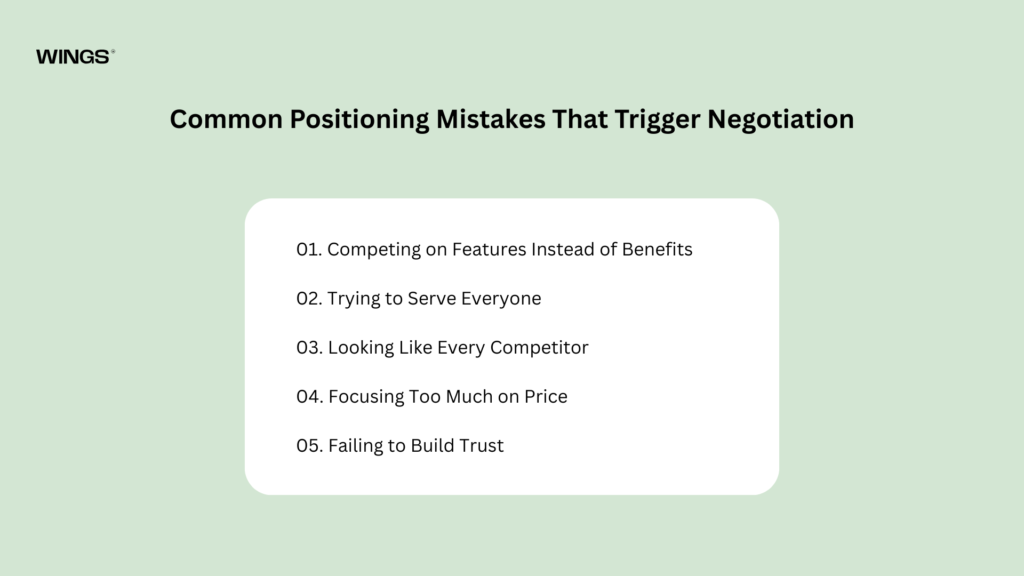
Common Positioning Mistakes That Trigger Negotiation
Many businesses unintentionally encourage price negotiations through their marketing and sales approach.
Some of the most common mistakes include:
01. Competing on Features Instead of Benefits
Customers don’t buy features, they buy results. Listing technical specifications without explaining the business impact makes it difficult for prospects to justify your pricing.
02. Trying to Serve Everyone
When your messaging targets everyone, it resonates with no one. A broad audience often leads to generic marketing that fails to communicate unique value.
03. Looking Like Every Competitor
Using the same promises as everyone else, such as “high quality,” “best service,” or “affordable pricing”, makes your business blend into the crowd.
04. Focusing Too Much on Price
Promoting discounts, offers, and low prices trains customers to expect cheaper deals instead of appreciating your expertise.
05. Failing to Build Trust
Without testimonials, case studies, reviews, certifications, or proof of results, prospects perceive more risk and become more price-sensitive.
Signs Your Business Has a Positioning Problem
If your business experiences any of the following consistently, your positioning may need improvement:
- Nearly every prospect asks for a discount.
- Customers compare you only on price.
- Sales conversations revolve around cost rather than outcomes.
- Competitors frequently win by offering lower prices.
- Your marketing generates many inquiries but few qualified leads.
- Customers struggle to explain what makes your business different.
- You feel pressured to reduce prices just to close deals.
Recognizing these warning signs is essential because they indicate that improving your positioning could have a greater impact than lowering your prices.
How Strong Brands Sell Without Competing on Price
Some businesses seem to attract customers who never ask for discounts. Instead of negotiating over price, buyers are eager to invest because they trust the brand and believe in the value it delivers. This isn’t a coincidence. Strong brands intentionally position themselves to compete on expertise, outcomes, and customer experience rather than cost.
Consider companies like Apple, Tesla, or Rolex. Their products often cost significantly more than comparable alternatives, yet millions of customers willingly pay premium prices. These brands rarely lead with discounts because they have built strong positioning through innovation, consistent quality, trust, and emotional connection.
The same principle applies to businesses of every size. Whether you run a consulting firm, software company, marketing agency, local service business, or eCommerce store, customers are more likely to accept your pricing when they clearly understand why your solution is different.
Strong positioning allows businesses to:
- Attract customers who prioritize quality over price.
- Reduce lengthy price negotiations.
- Build stronger customer loyalty.
- Increase profit margins.
- Establish long-term credibility in their market.
The goal isn’t to become the cheapest option. It’s to become the obvious choice.
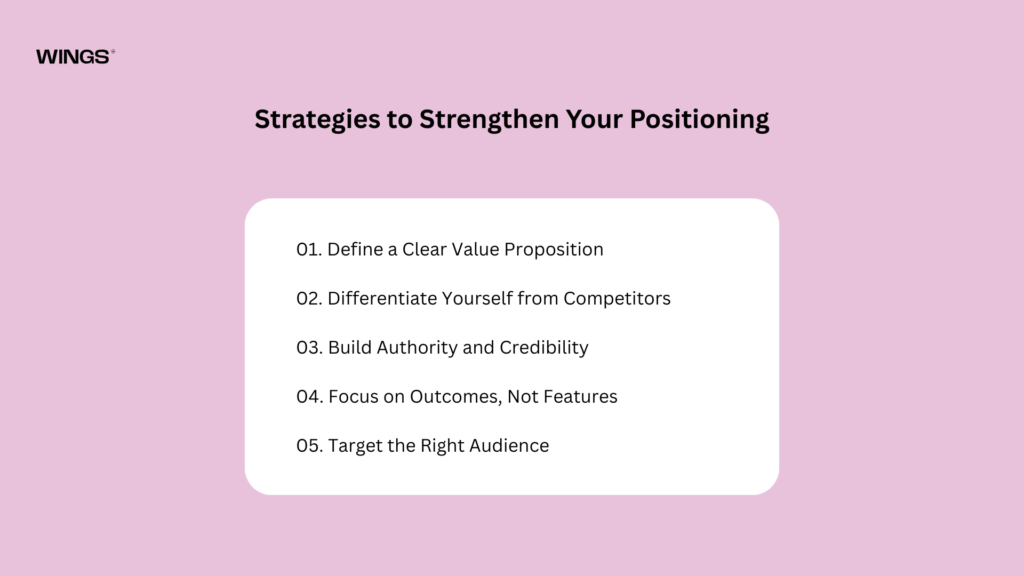
5 Strategies to Strengthen Your Positioning
Improving your positioning doesn’t require a complete business overhaul. Small but strategic changes in your messaging, branding, and customer experience can significantly reduce price objections.
01. Define a Clear Value Proposition
Your value proposition answers one simple question: “Why should customers choose you instead of someone else?” Many businesses describe what they do instead of explaining the value they create.
For example: Weak Value Proposition “We provide website development services.” Strong Value Proposition “We build high-converting websites that help small businesses generate more leads and increase online sales.”
Notice the difference. The second statement focuses on business outcomes rather than technical services. A strong value proposition should clearly explain:
- Who you help.
- What problem you solve.
- The results customers can expect.
- Why your approach is different.
When your value proposition is clear, prospects spend less time questioning your price.
02. Differentiate Yourself from Competitors
If your business sounds exactly like every competitor, customers naturally compare prices. Differentiation gives buyers a compelling reason to choose you. Ways to differentiate include:
- Specialized expertise in a niche industry.
- Faster delivery.
- Superior customer support.
- Unique processes or frameworks.
- Proven success with measurable results.
- Exclusive tools or technology.
Instead of saying: “We provide digital marketing.”
Say something like: “We help SaaS startups double their inbound leads using AI-powered SEO strategies.” Specific positioning attracts specific customers. And specific customers usually care less about finding the cheapest option.
03. Build Authority and Credibility
People trust experts. The more evidence you provide that your business consistently delivers results, the easier it becomes to justify premium pricing.
Ways to build authority include:
- Customer testimonials.
- Video reviews.
- Case studies.
- Industry certifications.
- Awards and recognitions.
- Published articles.
- Speaking at events.
- Educational content.
- Before-and-after success stories.
Imagine two agencies.
Agency A simply says: “We’re the best.”
Agency B shares:
- 150 successful client projects.
- 4.9-star average rating.
- Multiple detailed case studies.
- Recognized industry certifications.
Most customers will feel far more confident paying Agency B’s prices. Authority reduces uncertainty. Reduced uncertainty reduces price objections.
04. Focus on Outcomes, Not Features
One of the biggest marketing mistakes is talking endlessly about features. Customers don’t buy features. They buy solutions. Instead of saying: “Our software includes automated reporting, dashboards, and integrations.”
Focus on outcomes: “Our software saves managers over 10 hours every week while providing real-time business insights.”
Similarly: Instead of: “We offer weekly coaching sessions.” Say: “We help professionals gain confidence, improve leadership skills, and accelerate career growth.” Every feature should answer one question: “How does this improve the customer’s life or business?” When you communicate outcomes, customers see value beyond price.
05. Target the Right Audience
Not everyone is your ideal customer. Some buyers will always prioritize low prices. Others prioritize quality, expertise, convenience, speed, or long-term results. Trying to appeal to everyone usually attracts bargain hunters. Instead, identify customers who genuinely value your expertise.
Consider factors such as:
- Industry.
- Company size.
- Budget.
- Business goals.
- Pain points.
- Decision-making process.
For example: Rather than marketing to “all small businesses,”
Target: “Healthcare clinics with 10–50 employees looking to increase appointment bookings.” Specific positioning attracts qualified leads who are already looking for the type of solution you provide.
How Better Positioning Improves Lead Quality
Positioning doesn’t just improve sales conversations, it changes the type of customers your business attracts. When your marketing clearly communicates your expertise and value, several positive changes occur.
You attract:
- Customers who already understand your pricing.
- Buyers seeking expertise rather than bargains.
- Businesses with realistic budgets.
- Long-term clients instead of one-time customers.
- Referrals from satisfied customers.
This creates a healthier sales pipeline.
Instead of spending time convincing people why you’re worth the price, you spend more time helping customers who already appreciate your value.
Higher-quality leads often result in:
- Higher conversion rates.
- Shorter sales cycles.
- Increased customer lifetime value.
- Better client relationships.
- Greater profitability.
Better positioning improves both the quantity and quality of your opportunities.
Real-World Examples of Value-Driven Brands
Many successful brands have built their reputation by emphasizing value instead of competing on price.
Apple
Apple consistently focuses on innovation, design, user experience, privacy, and ecosystem integration. Rather than competing on price, Apple reinforces the premium experience customers receive.
Rolex
Rolex isn’t simply selling watches. It sells craftsmanship, prestige, heritage, and exclusivity. Its positioning creates strong demand despite premium pricing.
Salesforce
Instead of promoting software features alone, Salesforce positions itself as a platform that helps businesses improve customer relationships, increase productivity, and drive revenue growth. Customers invest because they understand the business impact.
Local Businesses
Premium dental clinics, fitness coaches, interior designers, consultants, and boutique agencies also benefit from strong positioning. Rather than advertising low prices, they emphasize expertise, customer experience, personalized service, and measurable results. This approach attracts clients who value quality over discounts.
Key Takeaways
If your prospects constantly ask for discounts, the issue may not be your pricing. More often, it’s a sign that your value isn’t being communicated effectively.
Remember these key lessons:
- Customers pay more when they understand value.
- Weak positioning creates price-sensitive buyers.
- Clear differentiation reduces comparisons.
- Authority builds trust.
- Outcomes matter more than features.
- Better positioning attracts higher-quality leads.
- Premium pricing becomes easier when customers see unique value.
Your goal should be to become memorable, not simply affordable.
Conclusion: Stop Discounting, Start Positioning
Discounts can occasionally help close a sale, but relying on them as your primary sales strategy reduces profit margins and weakens your brand over time.
Instead of asking, “How can I lower my prices?”
Ask:
- How can I communicate more value?
- How can I stand out from competitors?
- How can I build greater trust?
- How can I attract customers who appreciate quality?
Businesses that answer these questions successfully create stronger brands, better customer relationships, and healthier profit margins.
The next time a prospect asks for a discount, view it as an opportunity to evaluate your positioning. Strengthening how your business communicates value will help you attract customers who focus on results rather than the lowest price.

Akshita Shivani Sundar
Senior Graphic Designer