


What is Brand psychology?
Brand psychology is the study of how people think, feel, and behave toward a brand, focusing on the psychological factors that influence their perceptions, emotions, decisions, and loyalty. It explores how elements such as a brand’s identity, messaging, colours, logo, storytelling, customer experience, and reputation shape consumer attitudes and purchasing behaviour. By creating positive emotional connections, building trust, and aligning with customers’ values and aspirations, effective brand psychology helps businesses differentiate themselves, strengthen brand recognition, encourage customer loyalty, and influence buying decisions beyond the functional features of their products or services.
Explore the Branding behind the Crypto bean.
Quick roadmap for this article
- What memory and emotion mean for B2B brands
- Five psychological principles that boost memorability
- A simple table you can use in creative brief workshops
- Concrete tactics across the buyer journey (website, sales, proposals, onboarding, support)
- Common traps and how to fix them
- A short plan you can implement this quarter
What it means to be memorable (and why it’s different in B2B)
Being memorable isn’t the same as being loud. In B2B, memorability equals trustworthiness plus distinctiveness. Loudness can get attention; memorable creates preference. Many B2B purchases involve months of research, multiple stakeholders, and genuine risk. A memorable brand reduces perceived risk by appearing reliable, easy to understand, and relevant to the buyer’s role.
At the cognitive level, memory favors:
- Emotion: emotional events stick better than neutral ones.
- Distinctiveness: unique cues help retrieval.
- Repetition/consistency: familiarity strengthens recall.
- Simplicity: the brain prefers patterns it can process quickly.
As marketers we shape all four.
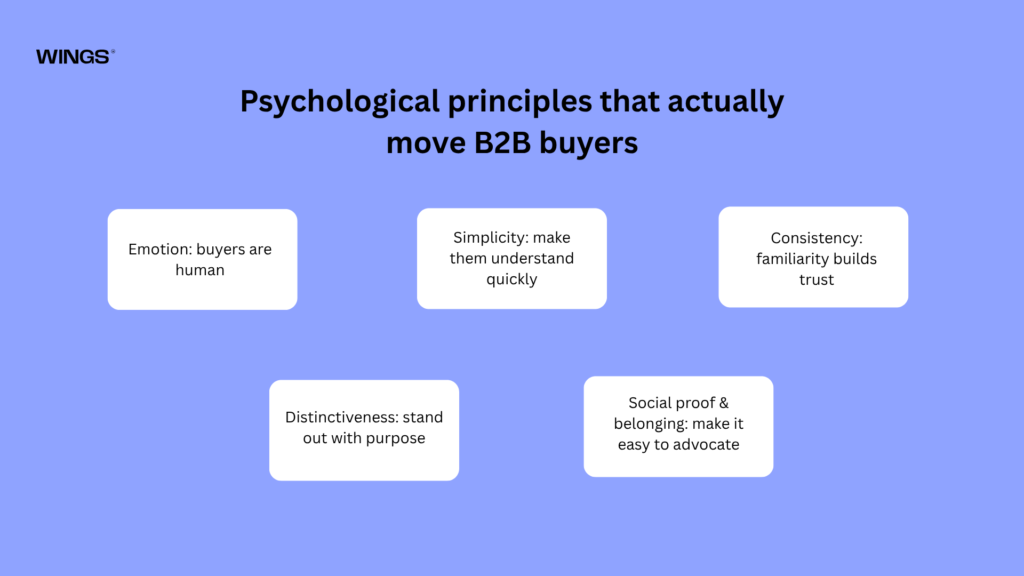
Psychological principles that actually move B2B buyers
01. Emotion: buyers are human
Don’t be afraid of emotion in B2B. The emotions most relevant to business buyers are trust, relief, confidence, and belonging. You’re not selling feelings; you’re reducing anxiety and making a difficult choice feel manageable. Use case studies that show human outcomes (teams saved time, customers saw fewer outages), and tone that signals empathy, not hyperbole.
02. Simplicity: make them understand quickly
Buyers skim. Make the first 5–10 seconds of any touchpoint crystal clear: who you help, what outcome you deliver, and why you’re different. Use plain language, visuals that summarize impact, and clear CTAs that match intent (learn, evaluate, request demo).
03. Consistency: familiarity builds trust
Consistent voice, visuals, value props, and sales behavior create a single mental model for your brand. That reduces friction when a buyer brings your solution into internal discussions. Inconsistent signals create doubts: “They said premium, but their onboarding felt amateurish.”
04. Distinctiveness: stand out with purpose
If everyone claims “enterprise-grade” or “scalable,” those words mean nothing. Distinctiveness can be visual (a bold identity), verbal (a confident point of view), or operational (a unique onboarding guarantee). The goal is to give buyers a short, repeatable phrase or image they can use when explaining your choice to procurement or an executive.
05. Social proof & belonging: make it easy to advocate
B2B decisions often need an internal champion. Give that champion social proof and framable artifacts: case studies with metrics, testimonials from similar titles, role-specific one-pagers, and community-style events where peers share experiences. Belonging is subtle, if your brand looks like the buyer’s peer group, it’s easier to recommend.
Psychological principles mapped to tactical actions
Use this table when briefing teams or training sales, it’s short, practical, and ready to paste into a creative or operations doc.
| Principle | What it means | Quick tactical actions |
| Emotion | Buyers form memory through feelings (trust, relief, confidence) | Use human-focused case studies, empathetic copy, and onboarding that reduces anxiety |
| Simplicity | Brains prefer clarity; fast comprehension reduces friction | Headline that states outcome in 5 words, visual explainer, role-specific microcopy |
| Consistency | Repeated cues build familiarity and credibility | Unified design system, messaging matrix, sales playbooks aligned with content |
| Distinctiveness | Unique cues aid recall and advocacy | Signature visual device, a declarative POV, a product or service ritual (e.g., onboarding promise) |
| Social proof/Belonging | Peers and measurable outcomes reduce perceived risk | Title-specific case studies, customer panels, ROI calculators with real examples |
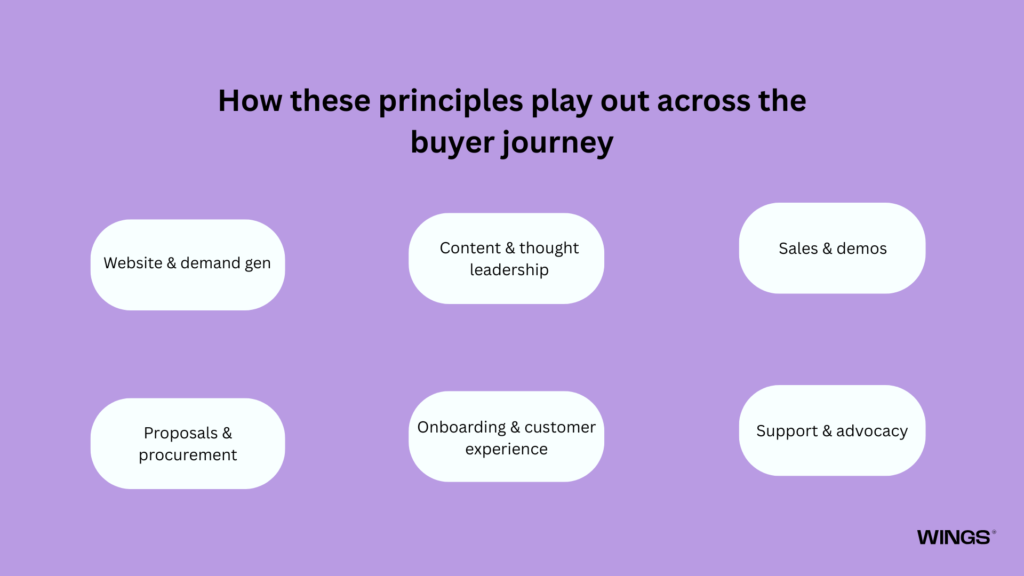
How these principles play out across the buyer journey
Website & demand gen
- First 5–10 seconds: use a headline that clarifies the customer and the outcome. Avoid generic claims.
- Above-the-fold content should answer: “Do I belong here?” and “Can they solve my problem?” in under a glance.
- Provide role-based pathways: CTO vs. Procurement vs. Operations. Each should see content that answers their concerns first.
- Use visuals to show process and outcomes (graphs, before/after metrics, logos). Visual distinctiveness helps memory.
Content & thought leadership
- Thought leadership should do more than educate. Use it to stake a clear POV and make complex decisions feel straightforward.
- Use narratives and short case stories to show outcomes, people remember stories better than lists.
- Repurpose long reports into deck summaries, short videos, and one-pagers that sales can use.
Sales & demos
- Train sales to start with outcomes, not product specs. Frame the demo as a conversation about the buyer’s risk and timeline.
- Use behavioral scripts that reduce anxiety: “Here’s how we’ll limit disruption” is better than a list of features.
- Give sales ready-made social proof: short testimonial videos, slides showing similar customer outcomes, and ROI snapshots.
Proposals & procurement
- Proposals should be skimmable: executive summary first, clear outcome, a one-page implementation timeline, and the key metrics customers will care about.
- Include a “what success looks like” section with measurable KPIs and a first-90-days plan. This gives internal stakeholders an artifact to use when advocating for your solution.
Onboarding & customer experience
- Onboarding is where brand promises get verified. Use checklists, clear milestones, and frequent wins to create momentum and build trust.
- Design the first 30/60/90 days to produce visible outcomes. A smooth onboarding is a huge driver of referral and renewal.
Support & advocacy
- Support interactions are memory-makers. Fast, human responses that go the extra mile create loyalty.
- Create advocate programs and community forums where customers can share templates, results, and peer tips. Advocates are often your most memorable brand touchpoint.
Explore the Branding behind the Blyp.
Practical templates you can use right away
- Homepage headline: “[Customer type] reduce [pain] by [outcome] in [timeframe].” Example: “SaaS companies cut provisioning time by 70% in under 4 weeks.”
- Demo opener: “Tell me the last time [problem] caused friction. If we could remove that friction in X weeks, what would change?”
- Proposal exec summary: 3 bullets, (1) Outcome, (2) How we deliver, (3) Proof (one metric).
- Onboarding week 1 email: Clear milestone + what the customer will see and what you need from them.
Storytelling examples that feel B2B-appropriate
01. The “Relief” story: start with the pain that keeps a buyer awake, show a simple path to relief, and quantify the early outcomes. This is powerful for operations and IT buyers worried about downtime or complexity.
02. The “Transformation” story: frame the purchase as a step-change in capability. Use before/after numbers and customer quotes that show what changed for the people who used the product.
03. The “Peer narrative”: highlight a similar company in the same industry and role. This works well for procurement and enterprise champions needing credibility.
Common traps and how to avoid them
Trap: Overloading with detail
Fix: Use layered content. Top-level clarity first, deeper technical docs behind gated resources or sales follow-up.
Trap: Inconsistent signals across teams
Fix: Create a short messaging matrix and a visual style guide; run a 1-hour cross-functional workshop to align marketing, sales, and CS.
Trap: Mistaking uniqueness for relevance
Fix: Be distinctive in ways that map to real buyer benefits. Distinctive design that doesn’t communicate value is just noise.
Trap: Forgetting the buyer’s internal champion
Fix: Provide advocacy assets: one-page ROI summaries, slide decks, and FAQ documents that champions can use in internal meetings.
How to measure whether your brand experience is becoming more memorable
Brand memorability is a soft concept, but you can measure leading indicators:
- Brand recall in surveys (unaided and aided).
- Time to decide (shortening the sales cycle suggests less friction).
- Win rates for deals where your brand was included early.
- Net Promoter Score (NPS) and Customer Effort Score (CES) during onboarding.
- Usage of advocacy assets (downloads of ROI decks, shares of one-pagers).

Explore the Branding behind the Shivam.
A simple quarterly test you can run
01. Pick a single buyer persona and one product line.
02. Redesign the homepage pathway and one case study to speak directly to that persona.
03. Equip your sales team with a one-page advocacy pack and a script for demos.
04. Run the test for 3 months and measure conversion rate into demos, demo-to-proposal conversion, and time-to-close.
05. Debrief, iterate, and expand.
Short case vignette: small changes, big returns
A mid-market HR tech vendor we’ll call “PeopleFlow” had a long sales cycle and low close rate for enterprise deals. Things felt competent but forgettable. They ran a 90-day experiment:
- Rewrote the homepage headline to “HR teams reduce time-to-hire by 30% in 45 days.”
- Built a one-page ROI sheet for talent acquisition directors.
- Trained sales to open demos with a 3-question diagnostic and show the ROI sheet during the demo.
Result: demo requests rose 22%, demo-to-proposal conversion rose 18%, and time-to-close shortened by 20%. The biggest win: champions in target accounts were now leading conversations internally because they had a concise artifact to share.
Operational Checklist: Who Needs to Be Involved
Successfully applying psychological principles to create memorable B2B brand experiences requires collaboration across the entire organization. Each team plays a critical role in delivering a consistent and trustworthy customer experience.
- Marketing: Develop clear messaging, compelling content, and a distinctive visual identity that communicates the brand’s value consistently across all channels.
- Sales: Align demo scripts, presentations, one-pagers, and sales conversations with the brand’s core value propositions to build trust and reduce buyer uncertainty.
- Product: Create intuitive user experiences through clear documentation, simple interfaces, and effective onboarding flows that help customers achieve value quickly.
- Customer Success: Design structured onboarding milestones, proactive support, and meaningful customer engagement practices that reinforce confidence and encourage long-term loyalty.
- Leadership: Champion the brand vision, ensure cross-functional alignment, allocate the necessary resources, and remove organizational barriers that may hinder the delivery of a consistent customer experience.
When these teams work together with a shared understanding of customer psychology and brand strategy, organizations can deliver seamless experiences that strengthen trust, improve customer satisfaction, and create lasting competitive advantage.

Explore the Branding behind the Diamensions.
Where to Invest First (Priorities for Limited Budgets)
| Aspect | Brand | Product |
|---|---|---|
| Primary Role | Builds awareness, trust, and perception | Delivers functionality and value |
| Focus | Creates emotional connection and brand identity | Solves customer problems and meets needs |
| Customer Impact | Encourages customers to consider and choose the brand | Determines customer satisfaction and retention |
| Success Depends On | Clear messaging, credibility, and consistent experience | Quality, performance, reliability, and usability |
| Long-Term Outcome | Increases loyalty and advocacy | Fulfils brand promises and drives repeat business |
| Key Takeaway | Attracts and reassures customers | Retains customers by delivering on expectations |
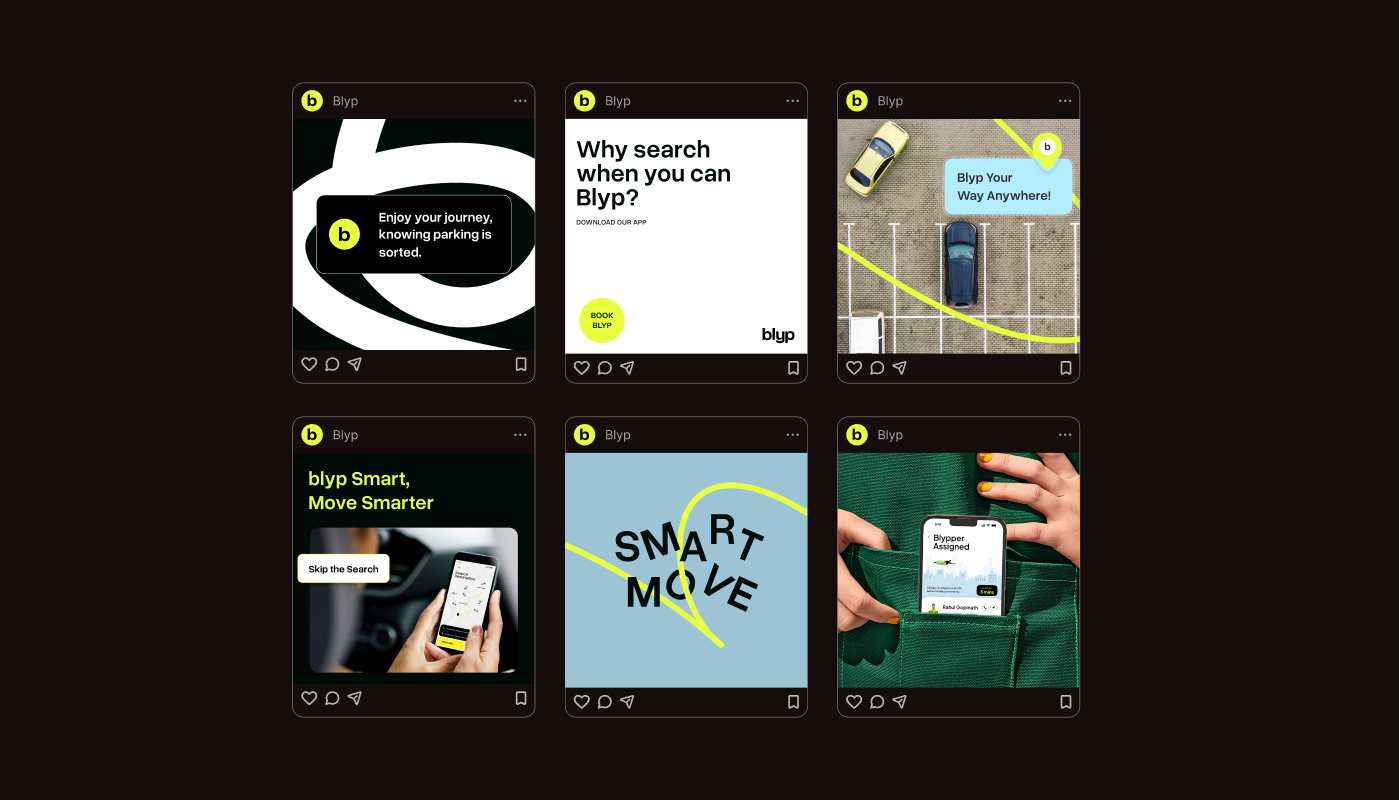
Explore the Branding behind the Blyp.
Final checklist: 10 small things to improve memorability this quarter
- Rewrite your homepage headline to state the customer outcome.
- Create 1 role-based landing page for your top persona.
- Produce a one-page ROI summary for sales.
- Add 2 brief customer video testimonials (60–90 seconds) that emphasize outcomes.
- Train sales to open demos with outcome questions.
- Standardize proposal exec summaries (3 bullets).
- Implement a 30/60/90 onboarding template.
- Make support responses more human (shorter response windows, named reps).
- Run a small AB test of two homepage hero designs for click-through to demo.
- Ask new customers for a short onboarding NPS after 30 days.
Closing Thoughts
Memorable B2B brand experiences are not built by being the loudest in the market, they are created by being clearer, more human, and consistently valuable. Although B2B decisions are often viewed as rational, they are ultimately made by people whose choices are influenced by emotions, trust, and cognitive biases. By applying psychological principles such as emotion, simplicity, consistency, distinctiveness, and social proof, brands can capture attention, build credibility, and remain memorable throughout the buying journey.
These principles become most effective when they are embedded across every customer touchpoint, from marketing campaigns and websites to sales conversations, onboarding, and customer support. Clear messaging reduces cognitive effort, consistent experiences reinforce trust, distinctive branding improves recall, and authentic customer testimonials or case studies reduce perceived risk. Together, these elements create a seamless experience that helps buyers feel confident and informed at every stage of the decision-making process.
In today’s complex B2B environment, purchasing decisions often involve multiple stakeholders who must justify their recommendations internally. Brands that use psychological insights to communicate value clearly, address concerns proactively, and provide credible evidence make it easier for decision-makers to build consensus and defend their choices. Ultimately, applying psychology thoughtfully enables businesses to create stronger relationships, foster long-term loyalty, and build brands that customers not only choose but also confidently recommend.

Akshita Shivani Sundar
Senior Graphic Designer