

What Are Custom Web Development Services?
Custom web development is the process of designing and building a website or web application tailored specifically to your business requirements. Unlike pre-built templates or drag-and-drop platforms, custom development starts from a blank canvas. Every feature, interaction, and system is created with intention, based on how your business works and what your users need. At its core, custom development includes:
Tailored Functionality — Built Around How You Work
With custom development, features are not borrowed from a generic template, they’re created specifically for your workflows, your users, and your goals. Instead of forcing your business to adapt to predefined tools, your platform adapts to you. Whether it’s a unique booking system, a multi-step checkout process, or an internal dashboard designed for your team, every function is intentional.
This level of customization allows you to streamline operations, reduce manual work, and create experiences that feel seamless to your users. Over time, this translates into better efficiency internally and stronger satisfaction externally.
Scalable Architecture — Designed for Growth, Not Just Launch
Many websites work well at the beginning but struggle as demand increases. Custom development ensures your platform is built with growth in mind. From the underlying code structure to the database design and hosting environment, everything is planned to handle increasing traffic, users, and data without compromising performance.
This means you won’t need to rebuild your system every time your business scales. Instead, your platform evolves with you supporting expansion into new markets, higher user volumes, and more complex functionality. Scalability isn’t just technical, it’s strategic. It gives you the confidence to grow without limits.
Optimized Performance — Speed That Drives Results
Performance is one of the most critical aspects of any digital experience. Custom-built platforms are optimized from the ground up. Unlike template-based systems that often carry unnecessary code and dependencies, custom development focuses on efficiency. Every line of code serves a purpose.
The result is faster load times, smoother interactions, and a more responsive experience across devices. This has a direct impact on user behavior. Faster websites reduce bounce rates, improve engagement, and increase conversions. In competitive markets, even small performance improvements can make a significant difference.
System Integrations — Everything Working Together Seamlessly
Your website doesn’t operate in isolation, it’s part of a larger ecosystem of tools and systems. Custom development allows you to integrate your platform seamlessly with the tools you already use, such as CRM systems, payment gateways, inventory management, analytics platforms, and marketing automation tools, Instead of juggling disconnected systems, you create a unified workflow where data flows smoothly between platforms. This reduces errors, saves time, and provides better visibility into your operations. In essence, integration turns your website into a central hub for your business.
Enhanced Security — Built Around Your Specific Needs
Security isn’t a one-size-fits-all solution. Template-based platforms are often targeted because of their widespread use. Custom development, on the other hand, allows you to implement security measures tailored to your specific risks, industry requirements, and data sensitivity, This includes secure authentication systems, data encryption, role-based access controls, and protection against common vulnerabilities. By designing security into the foundation of your platform, you reduce risks and build trust with your users, especially when handling sensitive information like payments or personal data.
Full Ownership and Flexibility — Complete Control Over Your Platform
One of the biggest advantages of custom development is control. You’re not tied to a platform’s limitations, pricing changes, or feature restrictions. You own your system and have the freedom to modify, expand, or pivot whenever your business needs evolve, This flexibility allows you to experiment, innovate, and respond quickly to market changes without waiting for third-party updates or workarounds. Over time, this level of control becomea major competitive advantage.
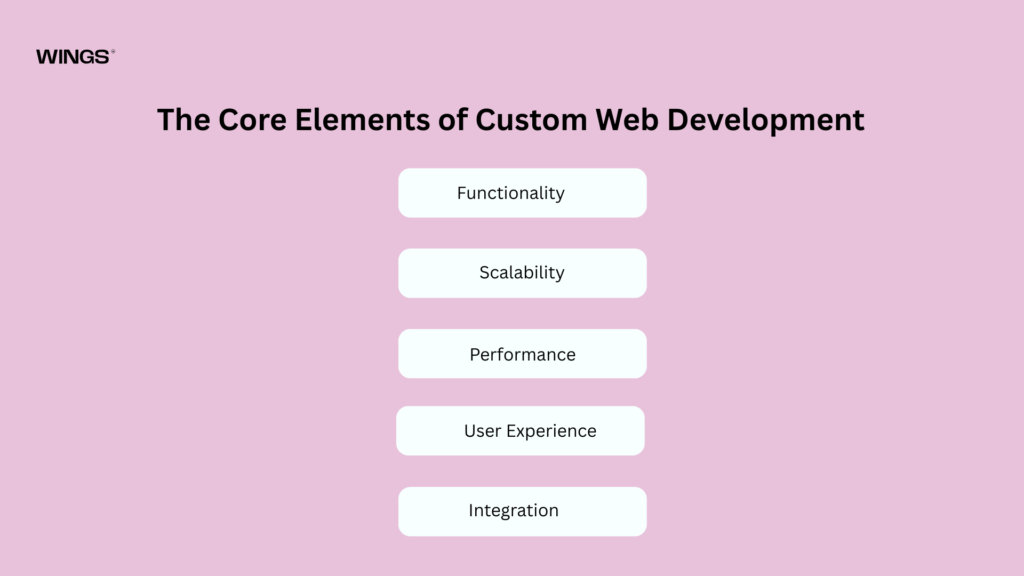
The Core Elements of Custom Web Development
Custom web development isn’t just one thing. It’s a combination of key components working together to create a seamless, powerful digital experience.
01. Functionality — What Your Website Can Do
Functionality is the backbone of any custom-built platform. It defines how your website behaves and what it enables users to accomplish. With custom development, you’re not limited to pre-defined features. Instead, you build exactly what your business requires.
This might include:
- User dashboards and account systems
- Booking and scheduling platforms
- Custom checkout or subscription models
- Multi-vendor marketplaces
- Advanced search and filtering systems
- Internal tools and admin panels
- Workflow automation systems
Why it matters:
Every business operates differently. When your website matches your internal processes, everything becomes more efficient. You reduce manual work, improve user satisfaction, and create a system that actually supports growth instead of slowing it down.
02. Scalability — How Your Website Grows
A common mistake businesses make is building for today instead of planning for tomorrow. Custom development allows you to create a scalable foundation, one that grows with your business instead of breaking under pressure.
Scalability includes:
- Modular system design
- Cloud-based infrastructure
- Flexible databases
- API-first architecture
- Load balancing and performance handling
Why it matters:
Growth is a good problem but only if your system can handle it. Without scalability, increased traffic can slow your site, crash your servers, or create poor user experiences. With the right architecture, your platform can handle growth smoothly, whether that’s 100 users or 1 million.
03. Performance — How Fast and Efficient It Is
Speed isn’t just a technical metric. It’s a business metric. Users expect websites to load instantly. Even a delay of a few seconds can lead to higher bounce rates and lost revenue.
Custom development focuses heavily on performance through:
- Clean, optimized code
- Minimal reliance on unnecessary plugins
- Efficient database queries
- Content delivery networks (CDNs)
- Server-side optimization
Why it matters:
A faster website improves user experience, boosts search engine rankings, and increases conversions. Performance directly impacts how users perceive your brand.
04. User Experience — How It Feels to Use
User experience (UX) is where design and functionality come together. Custom development allows you to craft user journeys that are intuitive, seamless, and aligned with your audience’s behavior.
This includes:
- Logical navigation structures
- Personalized content experiences
- Smooth interaction flows
- Mobile-first design
- Accessibility considerations
Why it matters:
A well-designed experience reduces friction. It helps users achieve their goals faster, whether that’s making a purchase, signing up, or exploring your services. Better experiences lead to better outcomes.
05. Integration — How Everything Connects
Modern businesses rely on multiple tools and systems. Your website shouldn’t exist in isolation, it should act as a central hub.
Custom development enables deep integrations with:
- Customer Relationship Management (CRM) systems
- Payment gateways
- Inventory and ERP systems
- Marketing automation tools
- Analytics platforms
- Third-party APIs
Why it matters:
When your systems are connected, your operations become smoother. Data flows seamlessly. Teams work more efficiently. And your business gains better insights.
Custom Development vs Template Websites — What’s the Difference?
Understanding the difference between custom development and template-based solutions is key to making the right decision.
| Custom Development | Template Websites |
| Built for your exact needs | Built for general use |
| Fully customizable | Limited flexibility |
| Highly scalable | Hard to scale |
| Unique user experience | Reused designs |
| Long-term investment | Short-term solution |
Templates are a great starting point for any business stepping into the digital space. They offer speed, simplicity, and affordability, helping you get your website up and running without heavy investment or long development cycles. For early stages, that’s often exactly what you need: a functional presence that lets you launch quickly and start reaching your audience.
But as your business evolves, growth demands more than just a basic setup. That’s where custom development steps in. It gives you the flexibility to build around your unique processes, integrate tools seamlessly, and create a user experience that truly reflects your brand. In simple terms, templates help you launch, but custom development is what empowers you to grow, adapt, and scale without limitations.
Why Custom Web Development Matters
Custom development isn’t just about having a “better website.”
It’s about building a system that actively contributes to your business growth. When done right, it delivers real, measurable value, impacting everything from operations and performance to customer experience and long-term scalability.
Supports Unique Business Needs — Built Around You, Not the Other Way Around
No two businesses operate the same way. Your processes, customer journeys, and internal workflows are unique. But most off-the-shelf solutions are designed for the “average” use case. This often forces businesses to adjust how they work just to fit the limitations of a tool.
Custom development changes that dynamic. Instead of adapting your business to software, the software is designed around your business. Whether it’s a custom dashboard for your team, a specialized checkout flow, or a platform that reflects your exact service model, everything is built with intention.
The result is a system that feels natural to use, because it mirrors how you already think and operate. Over time, this alignment improves efficiency, reduces friction, and allows your team to focus on what actually matters.
Improves Performance — Speed That Directly Impacts Results
Performance is more than a technical detail, it’s a critical part of user experience. Custom-built websites are optimized from the ground up. Unlike templates that often carry unnecessary code, plugins, and dependencies, custom platforms are lean and purpose-driven.
Every component is designed to serve a function, which leads to:
- Faster load times
- Smoother interactions
- Better responsiveness across devices
This has a direct effect on user behavior. Users are more likely to stay, explore, and take action on a fast website. Search engines also prioritize performance, which can improve your visibility online.
In simple terms: better performance leads to better engagement and better engagement leads to better results.
Enhances Security — Protection Designed for Your Risk Profile
Security is often overlooked, until it becomes a problem. Template-based platforms are widely used, which makes them common targets for attacks. Vulnerabilities in popular plugins or themes can expose multiple websites at once.
Custom development reduces this risk significantly. Because your system is uniquely built, it’s less predictable and less exposed to mass-targeted exploits. More importantly, security can be designed specifically for your needs.
This may include:
- Custom authentication systems
- Role-based access controls
- Data encryption protocols
- Secure payment handling
- Protection against common threats
For businesses handling sensitive data, this level of control is essential. It not only protects your operations but also builds trust with your users, something that’s increasingly valuable in today’s digital landscape.
Enables Scalability — Ready for Growth at Every Stage
Growth is the goal but it often comes with technical challenges. As your business expands, your website needs to handle more users, more data, and more complex interactions. Template-based systems can struggle under this pressure, leading to slow performance or the need for complete rebuilds.
Custom development is designed with scalability in mind. From the architecture to the infrastructure, everything is built to handle growth smoothly. This means you can:
- Add new features without breaking existing systems
- Support higher traffic volumes
- Expand into new markets or services
- Adapt to changing business needs
Instead of starting over every time you grow, you build on a strong foundation. That continuity saves time, reduces costs, and keeps your business moving forward without disruption.
Creates Competitive Advantage — Stand Out Where It Matters
In crowded markets, being “good enough” isn’t enough. Customers have options, and they tend to choose businesses that offer better experiences, clearer value, and smoother interactions.
Custom development gives you the tools to stand out. You’re not limited to standard layouts or common features. You can create unique user experiences that reflect your brand, solve specific problems, and deliver real value.
This could be:
- A faster, more intuitive interface
- A feature competitors don’t offer
- A smoother customer journey
- A platform that simply works better
These differences may seem small individually, but together they create a strong competitive edge. They give users a reason to choose you, and more importantly, to stay with you.
In the End, It’s About Impact
Custom development isn’t just a technical decision, it’s a strategic one. It affects how your business operates, how your customers experience your brand, and how effectively you can grow.
When everything is built around your needs, the result isn’t just a better website.It’s a better business system. One that’s faster, smarter, more secure and ready for whatever comes next.

Explore the Web development process behind the Shivam.
When Do You Need Custom Web Development?
Not every business needs custom development from day one and that’s okay. In the early stages, templates and website builders can help you move quickly and validate your ideas. But as your business evolves, your needs become more specific, your operations more complex, and your expectations higher. That’s when the shift toward custom development becomes not just beneficial but necessary. Here are the key signals that tell you it’s time to move beyond templates.
01. When Templates Start Limiting You — Growth Meets Friction
At first, templates feel convenient. Everything is pre-built, easy to use, and quick to launch. But over time, limitations start to surface. You might find yourself:
- Trying to force features to work in ways they weren’t designed for
- Installing multiple plugins just to achieve basic functionality
- Compromising on design or user experience
- Hitting restrictions on customization
What once felt simple now feels restrictive.Instead of enabling your business, your platform starts slowing you down. This is one of the clearest signs that you’ve outgrown your current setup. Custom development removes these constraints, giving you the freedom to build exactly what you need, without workarounds.
02. When You Need Advanced Features — Beyond Basic Functionality
As your business model evolves, so do your technical requirements.You may need features like:
- Subscription-based systems
- Multi-user dashboards
- Marketplaces connecting buyers and sellers
- SaaS platforms with complex logic
- Real-time data processing
- Custom reporting tools
These aren’t simple add-ons, they require thoughtful architecture and tailored development. Templates are not designed for this level of complexity. Even if you try to extend them, the result is often unstable, inefficient, or difficult to maintain.
Custom development allows you to build these features from the ground up, ensuring they work seamlessly, scale properly, and integrate smoothly with your existing systems.
03. When Performance Becomes Critical — Every Second Counts
Performance might not matter much when your traffic is low. But as your audience grows, speed becomes a defining factor. Slow load times, laggy interactions, and unresponsive pages can:
- Frustrate users
- Increase bounce rates
- Reduce conversions
- Impact search engine rankings
Template-based systems often struggle here because they rely on heavy code, multiple plugins, and shared infrastructure. Custom development, on the other hand, focuses on efficiency.
Your platform is built to handle your specific use case, with optimized code, streamlined architecture, and performance-first design.When performance directly impacts user satisfaction and revenue, custom development becomes a necessity, not a luxury.
04. When You’re Scaling Rapidly — Growth Without Bottlenecks
Growth is exciting, but it also puts pressure on your systems. As your business expands, you may experience:
- Increased traffic and user activity
- Larger volumes of data
- More complex workflows
- New features and integrations
If your platform isn’t designed to scale, these changes can lead to slowdowns, crashes, or costly rebuilds. Custom development provides a scalable foundation.
Instead of patching problems as they arise, you build a system that’s ready for growth from the start. You can add features, handle higher demand, and expand your offerings without disrupting your existing operations. This kind of flexibility is essential for businesses that are growing quickly or planning to scale in the near future.
05. When User Experience Directly Impacts Revenue — Every Interaction Matters
In many industries, your website isn’t just informational, it’s transactional. For businesses like eCommerce platforms, SaaS products, or digital services, user experience (UX) plays a direct role in revenue generation.
Small friction points, like:
- Confusing navigation
- Complicated checkout processes
- Slow page loads
- Poor mobile experiences
can lead to lost conversions.Templates offer limited control over these experiences. Custom development allows you to optimize every step of the user journey. From the first interaction to the final action, you can design flows that are intuitive, fast, and aligned with user expectations.
This level of control helps you:
- Increase conversion rates
- Improve customer satisfaction
- Build long-term loyalty
When every click has value, experience becomes everything.
Explore the Web development process behind the Importex.
Custom Development in Practice: Step-by-Step Guide
Building a custom platform isn’t just about writing code, it’s about solving the right problems in the right way. It’s a structured, strategic process where every step builds on the previous one. When done correctly, it ensures that the final product isn’t just functional, but aligned with your business goals, user needs, and long-term vision. Here’s how that process typically unfolds.
Step 1: Define Your Business Goals — Start With Purpose
Every successful project begins with clarity. Before any design or development starts, you need to understand why you’re building this platform in the first place.
Ask yourself:
- What problem are we solving?
- Who are we solving it for?
- What does success look like?
- How will this platform support our business growth?
This step is about setting direction. Without clear goals, projects can quickly become unfocused, adding features that don’t add value or missing opportunities that matter. Strong goals act as a decision-making filter throughout the entire process. They ensure that every feature, design choice, and technical decision serves a purpose.
Step 2: Understand Your Users — Design With Empathy
Your platform exists for your users, not for your internal assumptions. Understanding your audience is critical to building something that people will actually use and value. This involves identifying:
- User needs and expectations
- Pain points and frustrations
- Behavior patterns and usage habits
- Motivations and goals
You might use methods like user interviews, surveys, analytics, or competitor analysis to gather insights. The goal is simple: see your platform from the user’s perspective. When you truly understand your users, you can design experiences that feel intuitive, helpful, and relevant. This reduces friction and increases engagement from the very first interaction.
Step 3: Plan the Architecture — Build a Strong Foundation
Once you know what you’re building and who it’s for, the next step is figuring out how it will be built. This is where technical planning comes in.
Architecture planning includes:
- Choosing the right backend technologies
- Selecting frontend frameworks
- Designing database structures
- Defining APIs and integrations
- Planning hosting and infrastructure
These decisions may not be visible to users, but they have a huge impact on performance, scalability, and maintainability.
A well-planned architecture ensures your platform is:
- Stable under load
- Easy to expand
- Efficient to maintain
- Secure by design
Think of this step as laying the foundation of a building. If it’s strong, everything built on top of it becomes more reliable.
Step 4: Design the Experience — Make It Simple and Intuitive
Now comes the part users will actually see and interact with. Design is not just about aesthetics, it’s about how things work.
This step involves:
- Creating wireframes to map structure and layout
- Building prototypes to simulate interactions
- Defining user flows and journeys
- Designing visual elements and interface components
The focus should always be on simplicity and usability. A well-designed experience guides users naturally, helping them complete tasks without confusion or frustration. Every click, scroll, and interaction should feel intentional. Good design doesn’t draw attention to itself, it makes everything feel effortless.
Step 5: Develop in Phases — Build, Test, Improve
Instead of building everything at once, custom platforms are typically developed in phases.
This approach allows you to:
- Launch faster with core features
- Test functionality early
- Gather feedback during development
- Make improvements along the way
Development often follows an iterative process:
- Build a feature
- Test it
- Refine it
- Move to the next
This reduces risk and ensures that issues are identified and resolved early, before they become costly problems.
It also keeps the project flexible, allowing adjustments based on real-world feedback rather than assumptions.
Step 6: Launch and Optimize — Growth Starts Here
Launching your platform is a milestone but it’s not the finish line. In reality, it’s the beginning of a new phase. Once your platform is live, you gain access to real user data and behavior insights. This is where continuous improvement begins.
Post-launch activities include:
- Monitoring performance and uptime
- Tracking user behavior and engagement
- Identifying bottlenecks or drop-off points
- Gathering user feedback
- Releasing updates and enhancements
A successful platform evolves over time. By continuously optimizing your system, you ensure it stays relevant, efficient, and aligned with your business goals.
From Idea to Impact
Custom development is a journey, not a one-time task. Each step plays a critical role in turning an idea into a fully functional, high-performing platform. When approached strategically, the result isn’t just a website or application.
It’s a system that:
- Solves real problems
- Delivers meaningful user experiences
- Supports long-term business growth
Because the true value of custom development isn’t just in what you build, It’s in how well it works, adapts, and evolves over time.
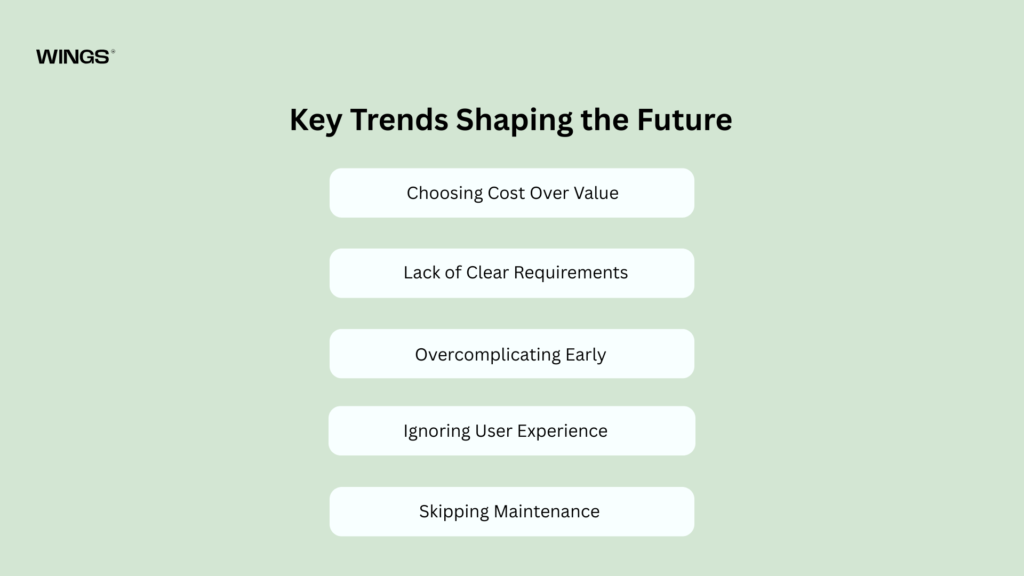
Common Mistakes to Avoid
Even with the best intentions, businesses often run into challenges when approaching custom web development. Not because the idea itself is flawed, but because the execution lacks clarity, strategy, or long-term thinking. Recognizing these common mistakes early can help you avoid unnecessary costs, delays, and inefficiencies, while ensuring your platform delivers real value.
Choosing Cost Over Value
It’s natural to consider budget when starting a project, but focusing only on the lowest cost can lead to bigger problems down the line. Cheaper solutions often compromise on code quality, scalability, and long-term reliability. While the initial investment may seem lower, the cost of fixing issues, rebuilding systems, or dealing with poor performance can quickly add up. Custom development should be seen as a long-term investment where value, quality, and sustainability matter more than short-term savings.
Lack of Clear Requirements
Without clear goals and defined requirements, even the most skilled development team can struggle to deliver the right outcome. When expectations are vague, projects tend to drift, timelines extend, and costs increase. A strong foundation built on clear business objectives, user needs, and prioritized features ensures that everyone involved is aligned. This clarity keeps the project focused and helps transform ideas into a functional, meaningful product.
Overcomplicating Early
Trying to build every possible feature in the first version of your platform can slow down progress and introduce unnecessary complexity. It often leads to longer timelines, higher costs, and increased chances of errors. Instead, starting with a focused version that delivers core value allows you to launch faster and learn from real user interactions. Growth should be gradual, where features are added based on actual needs rather than assumptions.
Ignoring User Experience
A platform can be technically powerful but still fail if it’s difficult to use. User experience plays a critical role in how people interact with your product and how they perceive your brand. If users feel confused or frustrated, they are unlikely to engage or return. A well-designed experience ensures that interactions feel intuitive and seamless, helping users achieve their goals effortlessly. Functionality and usability must go hand in hand to create a truly effective platform.
Skipping Maintenance
Launching your platform is just the beginning, not the end. Over time, systems require updates, improvements, and optimizations to remain secure and efficient. Ignoring maintenance can lead to performance issues, security risks, and outdated functionality. Continuous monitoring and refinement ensure that your platform stays reliable and evolves alongside your business and user expectations.
Conclusion
Custom web development isn’t just about building something new, it’s about building something right. It’s about creating a platform that truly aligns with how your business operates, rather than forcing your business to adapt to limitations. When your systems are designed with intention, they don’t just function, they support your growth, streamline your processes, and create meaningful experiences for your users.
A well-built custom platform becomes more than a website. It becomes a foundation. One that evolves with your business, adapts to new challenges, and consistently delivers value over time. From performance and scalability to user experience and flexibility, every element works together to move your business forward.
In a digital landscape filled with templates, shortcuts, and one-size-fits-all solutions, custom development offers something increasingly rare, control. Control over how your platform looks, how it performs, and how it grows alongside your business. And with that control comes the ability to build something truly valuable. Not just for today, but for the long term. Because the businesses that succeed aren’t the ones that choose the easiest path. They’re the ones that build with clarity, intention, and a vision for what comes next.

Prasanna M
WordPress Developer