


In an industry often defined by rapid innovation, flashy frameworks, and constant reinvention, the true foundation of great web development is surprisingly understated. It is not just about mastering the latest tools or shipping features at lightning speed. Instead, it lies in a quiet discipline, an intentional, consistent approach to building systems that are reliable, scalable, and meaningful.
This discipline is rarely celebrated in headlines or conference talks. It does not trend on social media. Yet, it is the difference between fragile codebases that crumble under pressure and resilient platforms that evolve gracefully over time. Great web developers understand that excellence is not accidental, it is engineered through habits, principles, and thoughtful decision-making. 
Explore the Web development process behind the Shivam.
The Nature of Quiet Discipline
Quiet discipline is the practice of doing the right things even when no one is watching. It is choosing clarity over cleverness, simplicity over complexity, and long-term stability over short-term wins.
In web development, this shows up in small, almost invisible ways:
- Writing clean, readable code
Writing clean, readable code is about making your intent obvious at a glance. It means choosing meaningful names for variables and functions, keeping functions small and focused, and avoiding clever shortcuts that sacrifice clarity. Clean code reduces cognitive load, making it easier to debug, extend, and review. Over time, this habit prevents confusion and minimizes errors, especially in collaborative environments where multiple developers interact with the same codebase.
- Structuring projects thoughtfully
Thoughtful project structure ensures that code is organized in a logical, scalable way. This involves grouping related files together, separating concerns (such as UI, business logic, and data handling), and following consistent architectural patterns. A well-structured project allows developers to quickly locate files, understand dependencies, and extend functionality without breaking existing features. It sets the foundation for scalability as the application grows in complexity.
- Documenting decisions
Documenting decisions goes beyond writing comments, it captures the reasoning behind key technical and architectural choices. This includes why a certain framework was selected, why a specific approach was taken, or why an alternative was rejected. Good documentation prevents repeated debates, reduces knowledge silos, and helps new team members understand the context of the system. It ensures continuity, especially in long-term projects where teams evolve over time.
- Testing consistently
Consistent testing is about building confidence in your code. By writing unit tests, integration tests, and end-to-end tests, developers ensure that each part of the system behaves as expected. Testing helps catch bugs early, reduces regression issues, and enables safer refactoring. When testing becomes a habit rather than an afterthought, it creates a safety net that allows teams to move faster without compromising reliability.
- Refactoring when necessary
Refactoring is the disciplined practice of improving existing code without changing its functionality. As requirements evolve, code can become messy or inefficient. Refactoring helps clean up these issues by improving structure, readability, and performance. It prevents technical debt from accumulating and keeps the codebase maintainable. Regular refactoring ensures that the system remains flexible and easier to adapt to future changes.
These actions may not produce immediate visible results, but they compound over time. A well-structured codebase today becomes a faster development cycle tomorrow. A clear naming convention reduces onboarding time for future developers. A thoughtful architecture prevents costly rewrites down the line.
Mastery Beyond Tools
Many developers fall into the trap of chasing tools, new frameworks, libraries, or programming paradigms. While staying updated is important, great developers know that tools are secondary to fundamentals.
The quiet discipline focuses on:
- Understanding core web principles (HTTP, browser rendering, networking)
A strong grasp of core web principles forms the backbone of effective web development. Understanding how HTTP works, requests, responses, headers, and status codes, helps developers design efficient communication between client and server. Knowledge of browser rendering (how HTML, CSS, and JavaScript are parsed and turned into pixels) allows developers to optimize performance and avoid issues like unnecessary reflows or blocking scripts. Networking concepts such as latency, caching, and data transfer further influence how quickly and reliably applications perform. Without this foundation, developers may rely on guesswork; with it, they can diagnose problems precisely and build faster, more resilient applications.
- Mastering JavaScript deeply rather than superficially
JavaScript is more than just a scripting language for interactivity, it is the core engine behind modern web applications. Mastery goes beyond syntax and frameworks; it involves understanding concepts like closures, asynchronous programming, event loops, prototypal inheritance, and memory management. Developers who deeply understand JavaScript can write more efficient code, debug complex issues, and adapt easily to different frameworks or libraries. Instead of being dependent on tools, they become capable of building and optimizing solutions from first principles.
- Learning how systems interact, not just how components work in isolation
Great developers think in terms of systems, not just individual pieces. While it is important to understand how a component works, it is equally critical to know how it interacts with APIs, databases, servers, and other services. This includes understanding data flow, state management, error handling across layers, and integration points. A system-level perspective helps developers anticipate edge cases, design scalable architectures, and ensure that changes in one part of the system do not unintentionally break another. It transforms development from assembling parts into engineering cohesive, reliable solutions.
A disciplined developer can adapt to any framework because their knowledge is not tied to a specific tool, it is rooted in principles.
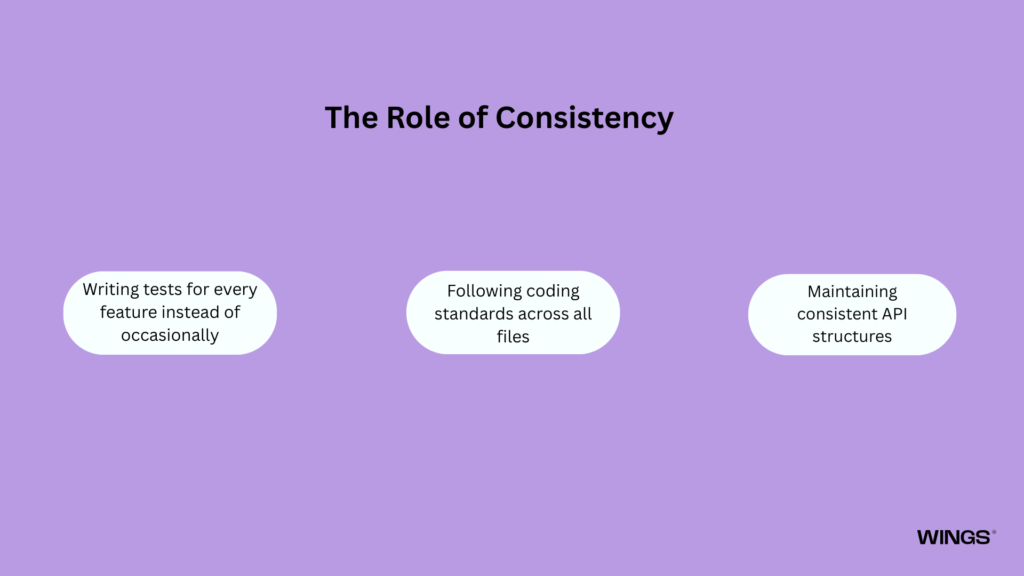
The Role of Consistency
Consistency is one of the strongest indicators of discipline. It is not about working harder, but about working steadily and predictably.
Consider:
- Writing tests for every feature instead of occasionally
Writing tests for every feature ensures that quality is built into the development process rather than inspected afterward. Instead of treating testing as an optional or last-minute step, disciplined developers make it a standard part of feature development. Each new feature is accompanied by tests that validate its behavior under different scenarios, including edge cases. This approach creates a reliable safety net, catching issues early and reducing the chances of regressions when changes are made later. Over time, it builds confidence in the codebase, allowing teams to move faster without fear of breaking existing functionality.
- Following coding standards across all files
Consistent coding standards bring uniformity to a codebase, making it easier for developers to read, understand, and contribute. This includes conventions for naming, formatting, file organization, and even how functions and classes are structured. When every file follows the same rules, developers do not need to mentally adjust to different styles, which improves efficiency and reduces errors. Coding standards also make code reviews smoother and more objective, as feedback can focus on logic and design rather than style inconsistencies.
- Maintaining consistent API structures
Consistent API structures ensure that interactions between different parts of a system remain predictable and intuitive. This includes standardized request and response formats, naming conventions for endpoints, and uniform error handling. When APIs are consistent, developers can integrate and consume them more easily without constantly referring to documentation. It also simplifies debugging and scaling, as patterns remain uniform across the application. In the long run, consistent APIs contribute to a more maintainable and developer-friendly system architecture.
Consistency builds trust, not only within teams but also in the product itself. When systems behave predictably, they become easier to maintain, scale, and debug.
Decision-Making in Web Development
At its core, web development is a series of decisions. Every line of code, every architectural choice, and every trade-off reflects a decision.
Below is a table that outlines key areas where disciplined decision-making plays a critical role:
| Area | Undisciplined Approach | Disciplined Approach | Long-Term Impact |
| Code Structure | Quick fixes, inconsistent patterns | Modular, reusable components | Easier maintenance and scalability |
| Performance Optimization | Ignored until issues arise | Considered from the start | Faster applications, better user experience |
| Testing | Minimal or reactive | Proactive and comprehensive | Fewer bugs, higher reliability |
| Documentation | Sparse or outdated | Clear and regularly updated | Faster onboarding and collaboration |
| Technology Choices | Trend-driven | Requirement-driven | Stable and future-proof systems |
| Security | Added as an afterthought | Integrated into design | Reduced vulnerabilities and risk |
A Decision Maker’s View
From a decision maker’s perspective, whether a CTO, product manager, or team lead, the disciplined approach outlined in the table above directly influences business outcomes. When developers prioritize structured code, proactive testing, and thoughtful technology choices, organizations benefit from reduced technical debt, faster time-to-market for future features, and lower maintenance costs. For decision makers, the value is not just technical elegance but operational efficiency and risk mitigation. A disciplined development culture ensures that investments in technology continue to deliver returns over time rather than becoming liabilities that require constant rework.
The Power of Simplicity
Can this be simpler?
This question encourages developers to strip away unnecessary complexity and focus on the most straightforward solution. Simplicity does not mean cutting corners, it means solving the problem in the clearest, most efficient way possible. By constantly asking this, developers avoid over-engineering and reduce the chances of introducing hidden bugs or maintenance challenges. Simple code is easier to read, test, and extend, making it more sustainable in the long run.
Is this abstraction necessary?
Abstraction is powerful, but when overused, it can make code harder to understand rather than easier. This question helps developers evaluate whether an abstraction genuinely improves clarity and reuse, or if it is adding an unnecessary layer of indirection. Good abstractions simplify complexity; bad ones hide it in confusing ways. Being selective ensures that abstractions serve a real purpose and do not burden future development.
Will this be understandable six months from now?
This question brings a long-term perspective into everyday coding decisions. Code is rarely a one-time effort, it evolves over time, often handled by different developers. Writing with future readability in mind ensures that the logic remains clear even after context is lost. It encourages better naming, cleaner structure, and thoughtful documentation. Ultimately, this mindset helps create code that stands the test of time rather than becoming a source of confusion later.
Embracing Refactoring
Refactoring is a cornerstone of disciplined development. It is the willingness to revisit and improve existing code without changing its functionality.
Undisciplined teams avoid refactoring because:
- It does not immediately deliver visible value
This reflects one of the biggest misconceptions in development work, equating value only with visible output. Activities like refactoring, writing tests, or improving code structure may not produce new features that users can see, but they create invisible strength within the system. These efforts improve stability, reduce bugs, and make future development faster and safer. While stakeholders may not notice immediate changes, the long-term impact is significant: fewer production issues, smoother releases, and a more reliable product. In reality, this “invisible work” is what sustains visible success. - It takes time away from new features
At first glance, investing time in code quality practices can feel like it slows down feature delivery. However, this is a short-term trade-off for long-term efficiency. Skipping these practices may speed up initial development, but it often leads to technical debt, making future features harder and slower to build. Over time, teams end up spending more effort fixing issues than creating value. By allocating time to quality upfront, developers actually protect future velocity, ensuring that new features can be added quickly without constantly battling existing problems.
Disciplined teams embrace it because:
- It prevents technical debt from accumulating
Regularly improving and maintaining code helps stop small issues from growing into major problems. When developers ignore messy or inefficient code, it builds up over time as technical debt, making the system harder to understand, modify, and scale. By addressing problems early through practices like refactoring and clean coding, teams keep the codebase healthy and avoid costly rewrites in the future. - It improves long-term velocity
While investing time in code quality may seem to slow things down initially, it actually speeds up development over the long run. A well-maintained codebase is easier to work with, allowing developers to implement new features faster and with fewer obstacles. Instead of constantly fixing old issues, teams can focus their energy on building and innovating. - It enhances code quality
Consistently refining code leads to better structure, readability, and performance. High-quality code is easier to test, debug, and extend, reducing the likelihood of errors and improving overall system reliability. This not only benefits developers but also results in a more stable and efficient product for users.
Refactoring is not a one-time activity, it is a continuous process embedded in daily work.

Explore the Web development process behind the Importex.
Testing as a Mindset
Testing is often treated as a checkbox activity. However, in disciplined environments, testing is a mindset.
This includes:
- Writing unit tests for logic
Unit tests focus on verifying the smallest pieces of your application, individual functions or modules, to ensure they behave exactly as expected. By isolating logic and testing it independently, developers can quickly identify where something goes wrong without needing to inspect the entire system. This practice not only improves accuracy but also makes future changes safer, as developers can rely on these tests to confirm that core logic remains intact. - Using integration tests for system behavior
While unit tests validate isolated pieces, integration tests ensure that different parts of the system work correctly together. This includes interactions between components, APIs, databases, and services. Integration testing helps uncover issues that don’t appear at the unit level, such as data flow problems or mismatched interfaces. It provides a more realistic view of how the application behaves in real-world scenarios. - Automating test pipelines
Automating test pipelines ensures that tests are run consistently and reliably without manual effort. Whenever new code is pushed or changes are made, automated systems trigger test suites to validate the application. This continuous testing approach catches issues early, prevents faulty code from being deployed, and maintains overall code quality. It also saves time for developers, allowing them to focus more on building features rather than manually verifying functionality.
The goal is not just to catch bugs but to build confidence. When developers trust their tests, they can make changes without fear, enabling faster and safer iteration.
Documentation: The Unsung Hero
Documentation is rarely glamorous, but it is essential. It bridges the gap between knowledge and accessibility.
Disciplined documentation includes:
- Clear README files
A clear README file acts as the entry point to any project. It should explain what the project does, how to set it up, how to run it, and any important conventions or dependencies. A well-written README saves time for both new and existing developers by eliminating guesswork and providing immediate clarity. It sets the tone for the project and ensures that anyone can get started without needing constant guidance. - API documentation
API documentation defines how different parts of a system communicate with each other. It includes details about endpoints, request and response formats, authentication methods, and error handling. Good API documentation makes integration smooth and predictable, allowing developers to use services without confusion. It reduces back-and-forth communication and ensures consistency across teams working on different parts of the system. - Architectural diagrams
Architectural diagrams provide a visual representation of how a system is structured. They illustrate components, data flow, and interactions between services, making complex systems easier to understand at a glance. These diagrams are especially useful for onboarding new team members and for aligning teams on system design. They help bridge the gap between abstract ideas and practical implementation. - Decision logs
Decision logs capture the reasoning behind important technical and architectural choices. Instead of just documenting what was done, they explain why it was done that way. This helps teams avoid revisiting the same discussions repeatedly and provides valuable context when changes are needed in the future. Decision logs ensure continuity, especially in long-term projects where team members may change over time.
Good documentation reduces dependency on individuals and ensures that knowledge is shared across the team.
Time Management and Focus
Discipline is also about how developers manage their time.
Great developers:
- Prioritize deep work over constant context switching
Deep work refers to uninterrupted, focused time spent on cognitively demanding tasks like coding, debugging, or designing systems. Constant context switching, jumping between tasks, messages, or meetings, breaks concentration and reduces efficiency. By prioritizing deep work, developers can think more clearly, solve complex problems faster, and produce higher-quality output. Protecting blocks of focused time leads to better results than fragmented effort spread across distractions. - Avoid unnecessary meetings
Meetings can be useful for alignment, but too many of them can disrupt productivity. Unnecessary meetings consume time that could otherwise be spent on meaningful work, especially when they lack clear agendas or outcomes. Disciplined teams evaluate whether a meeting is truly needed or if the same goal can be achieved through documentation or asynchronous communication. Reducing meeting overload helps developers maintain focus and momentum. - Break tasks into manageable chunks
Large tasks can feel overwhelming and difficult to track. Breaking them into smaller, manageable pieces makes progress more visible and achievable. It allows developers to focus on one step at a time, reduces the risk of errors, and makes it easier to estimate timelines. Smaller tasks also improve collaboration, as they can be distributed across team members and completed more efficiently.
They understand that productivity is not about being busy, it is about being effective.
Collaboration and Communication
Web development is rarely a solo effort. Discipline extends to how developers interact with others.
This includes:
- Writing clear commit messages
Clear commit messages provide a concise explanation of what changes were made and why. Instead of vague messages like “fixed bug” or “updated code,” effective commits describe the intent and impact of the change. This helps team members understand the evolution of the codebase, makes debugging easier, and allows anyone to trace back decisions when needed. Over time, a well-maintained commit history becomes a valuable source of context and documentation. - Providing constructive code reviews
Code reviews are not just about finding mistakes, they are opportunities for collaboration and learning. Constructive reviews focus on improving code quality while respecting the developer’s effort. This means giving specific, actionable feedback, suggesting better approaches when needed, and acknowledging good practices. A healthy review culture encourages knowledge sharing, reduces errors, and strengthens team alignment without creating friction. - Communicating trade-offs effectively
Every technical decision involves trade-offs, between performance and simplicity, speed and scalability, or short-term delivery and long-term maintainability. Communicating these trade-offs clearly ensures that everyone, including non-technical stakeholders, understands the implications of decisions. It helps teams make informed choices, align expectations, and avoid misunderstandings. Strong communication in this area turns development from isolated coding into collaborative problem-solving.
Strong communication ensures alignment and prevents misunderstandings that can derail projects.

Explore the Web development process behind the Perceptyne.
The Long-Term Perspective
Perhaps the most defining trait of disciplined developers is their long-term thinking.
They consider:
- How will this scale?
This question pushes developers to think beyond the current scope and anticipate future growth. Scaling is not just about handling more users, it includes managing increased data, higher traffic, and more complex features. By considering scalability early, developers can design systems that won’t break under pressure, such as choosing appropriate architectures, optimizing performance, and avoiding bottlenecks. It helps prevent costly rework when the application grows. - What happens when requirements change?
Change is inevitable in any project. This question encourages building flexibility into the system so it can adapt without major disruption. Developers who plan for change avoid rigid designs and instead create modular, loosely coupled components that can evolve independently. This makes it easier to add features, modify behavior, or pivot direction without rewriting large portions of the codebase. - Will this be maintainable by someone else?
Code is rarely owned by just one person over its lifetime. This question emphasizes writing code that others can easily understand, modify, and extend. Maintainability involves clear structure, good naming, proper documentation, and avoiding unnecessary complexity. When code is maintainable, teams can collaborate more effectively, onboarding becomes smoother, and the system remains sustainable even as developers come and go.
This perspective transforms development from a reactive activity into a strategic one.
The Cost of Ignoring Discipline
The absence of discipline leads to:
- Technical debt
Technical debt refers to the accumulation of shortcuts, quick fixes, and suboptimal decisions made during development. While these choices may speed up delivery in the short term, they create long-term challenges by making the codebase harder to understand, modify, and scale. Over time, this debt compounds, requiring more effort to implement even simple changes and increasing the likelihood of bugs. - Fragile systems
Fragile systems are those that break easily when changes are introduced. This often happens when code lacks proper structure, testing, or clear dependencies. In such systems, even small updates can cause unexpected failures in unrelated areas. This instability reduces confidence in the product and forces developers to spend more time fixing issues rather than building new features. - Slow development cycles
When a codebase becomes difficult to work with, development naturally slows down. Developers need more time to understand existing logic, debug issues, and ensure changes do not introduce new problems. As a result, releasing new features or updates takes longer, reducing the team’s ability to respond quickly to user needs or market demands. - Increased costs
All of these issues ultimately lead to higher costs. More time spent on maintenance, debugging, and rework translates directly into increased development expenses. Additionally, delays in delivering features can impact business opportunities and user satisfaction. Investing in good practices early helps avoid these escalating costs later.
These issues do not appear immediately. They accumulate silently until they reach a tipping point, forcing teams into costly rewrites or firefighting modes.
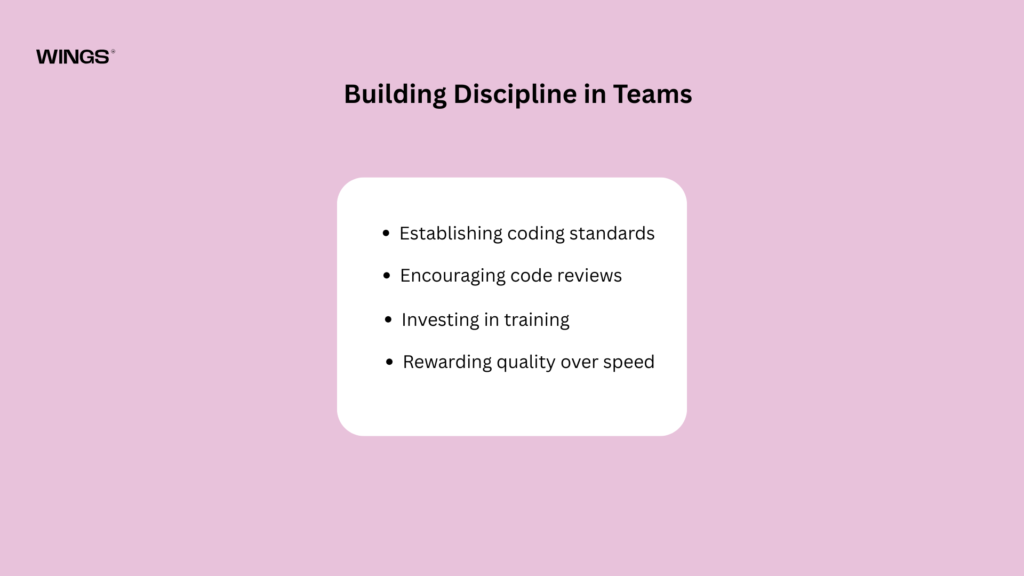
Building Discipline in Teams
Discipline is not just an individual trait, it is a cultural attribute.
Teams can cultivate it by:
- Establishing coding standards
Establishing coding standards creates a shared foundation for how code is written, structured, and maintained across a team. These standards define conventions for naming, formatting, file organization, and best practices. When everyone follows the same guidelines, the codebase becomes more consistent and easier to navigate. It reduces confusion, improves readability, and ensures that developers can collaborate smoothly without constantly adjusting to different styles. - Encouraging code reviews
Encouraging regular code reviews fosters a culture of collaboration and continuous improvement. Code reviews help catch bugs early, ensure adherence to standards, and provide opportunities for knowledge sharing. When done constructively, they also help developers learn from each other and improve their skills. Over time, this practice strengthens overall code quality and builds collective ownership of the codebase. - Investing in training
Investing in training ensures that developers stay updated with evolving technologies, tools, and best practices. This can include workshops, courses, mentorship, or hands-on learning opportunities. A well-trained team is more confident, efficient, and capable of making better technical decisions. Continuous learning also helps teams adapt to change and maintain a high standard of development. - Rewarding quality over speed
Rewarding quality over speed reinforces the importance of building reliable and maintainable systems rather than rushing to deliver features. When teams are recognized for writing clean code, thorough testing, and thoughtful design, they are more likely to prioritize long-term success over short-term gains. This mindset reduces technical debt, improves product stability, and creates a healthier development culture overall.
Leadership plays a crucial role in reinforcing these values.
Conclusion
The quiet discipline behind great web development is not about perfection, it is about intention. It is the daily commitment to doing things thoughtfully, consistently, and responsibly.
While trends will come and go, this discipline remains constant. It is what enables developers to build systems that stand the test of time, adapt to change, and deliver real value.
In the end, great web development is not defined by what users see on the surface. It is defined by the invisible decisions, habits, and principles that shape everything beneath it. And it is this quiet discipline that turns good developers into great ones.

Mugesh Kanna
Junior Web developer