

The Shift Every Decision-Maker Needs to Understand
Engagement today is no longer just about visibility, but about attention, retention, and conversion in a highly competitive digital space. Brands are now competing not only with each other but also with entertainment, algorithms, and shrinking audience attention spans. This raises a key strategic question for marketers: should they focus more on Reels or Static Posts for engagement? The answer is not simple, as both formats play different roles in the content ecosystem. Reels primarily drive reach and discovery, while Static Posts focus on depth, trust, and information delivery. Each format contributes differently across the marketing funnel and business objectives. Understanding these differences is essential for making informed, ROI-driven content investment decisions.
Understanding Engagement Beyond Vanity Metrics
Before comparing Reels and Static Posts, it is important to redefine engagement. For leadership teams, engagement should go beyond likes, comments, and shares. It should include meaningful signals like saves, watch time, and conversions that reflect real business impact.
- Likes
- Comments
- Shares
- Views
Instead, meaningful engagement includes:
- Watch time and retention (for video)
- Saves and shares (intent signals)
- Profile visits (interest escalation)
- Click-throughs (commercial intent)
- Conversions (business outcome)
This distinction matters because Reels and Static Posts influence different layers of the funnel. Reels primarily attract attention and drive top-of-funnel discovery. Static Posts, on the other hand, build trust, educate audiences, and support conversions in the middle and bottom of the funnel.
- Reels primarily drive reach and discovery
- Static Posts primarily drive consideration and retention
This foundational difference shapes everything else in content strategy. It determines how audiences are attracted, engaged, and nurtured across the funnel. Ultimately, it influences both brand perception and conversion outcomes.
Reels: The Engine of Discovery and Reach
Reels and similar short-form video formats across platforms like Instagram, Facebook, and TikTok are fundamentally designed to maximize distribution beyond an account’s existing follower base. Unlike traditional content formats that rely heavily on follower networks, Reels are engineered for algorithmic discovery, making them one of the most powerful tools for rapid audience expansion in today’s social media ecosystem.
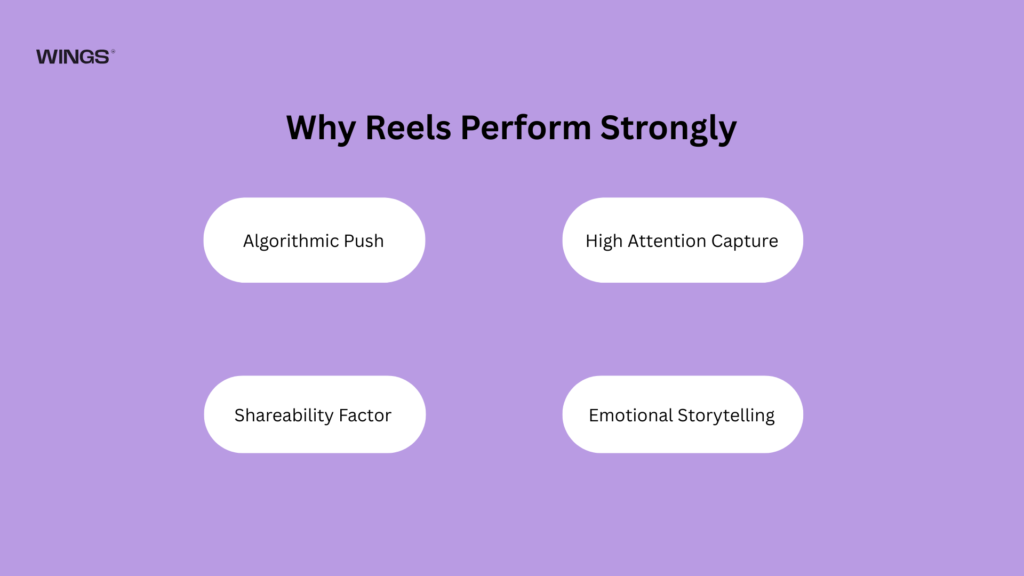
Why Reels Perform Strongly
1. Algorithmic Push
Platforms actively prioritize Reels because they directly contribute to increased user engagement and longer time-on-app metrics. The algorithm is designed to test content with small audience segments first and, if performance signals are strong, rapidly scale distribution. This allows even new or small accounts to achieve significant reach if the content resonates with viewers. In essence, virality is structurally built into the format.
2. High Attention Capture
Reels are optimized for instant attention capture. The combination of motion, audio, rapid pacing, and storytelling creates a sensory-rich experience that immediately interrupts scrolling behavior. The first 3–5 seconds are critical, as this is where the viewer decides whether to continue watching or scroll away. Compared to static posts, Reels have a significantly higher chance of stopping attention due to their dynamic nature.
3. Shareability Factor
Reels are inherently social and highly shareable, particularly through direct messages, story reposts, and group sharing. This peer-to-peer distribution significantly amplifies organic reach beyond algorithmic recommendations. When users share Reels, they act as distribution nodes, extending content lifespan and reach without additional media spend.
4. Emotional Storytelling
Video enables a multi-dimensional storytelling experience that includes tone of voice, facial expressions, music, and pacing. These elements work together to create emotional resonance, which is a key driver of memory retention and brand recall. As a result, Reels are particularly effective for building brand personality and emotional connection at scale.
Engagement Characteristics of Reels
Reels exhibit a unique engagement profile that differs significantly from static formats:
- High reach potential driven by algorithmic distribution
- Lower average engagement rate per impression due to broad audience exposure
- Strong top-of-funnel performance ideal for awareness and discovery
- High variability in performance, where content can either go viral or remain underperforming
- Strong dependency on hook quality, especially within the first few seconds
This makes Reels a high-reward but also high-variance content format.
Business Impact of Reels
From a decision-maker’s perspective, Reels function primarily as an attention acquisition engine. Their value lies not in immediate conversion, but in building scalable visibility and expanding audience reach efficiently.
Reels are particularly effective for:
- Brand awareness campaigns, especially for new or emerging brands
- Product discovery, where visual demonstration drives interest
- Influencer collaborations, leveraging creator-led distribution
- New market entry strategies, where rapid exposure is critical
- Top-of-funnel traffic generation, feeding broader marketing funnels
However, while Reels are powerful for attracting attention, they are not typically sufficient on their own to drive consistent conversions. Without supporting assets such as static posts, landing pages, and remarketing strategies, the engagement generated from Reels often remains superficial.
In a well-structured content ecosystem, Reels should be viewed as the front door of discovery, not the final step in the customer journey.
Static Posts: The Foundation of Trust and Conversion
Static posts, whether single-image creatives or carousel formats, remain a fundamental pillar of social media strategy. While they may not offer the same immediate excitement or viral potential as short-form video, they play a critical role in structured communication, brand credibility, and conversion-focused storytelling. For decision-makers, static posts represent the stabilizing force in a content ecosystem that is otherwise driven by algorithmic volatility.
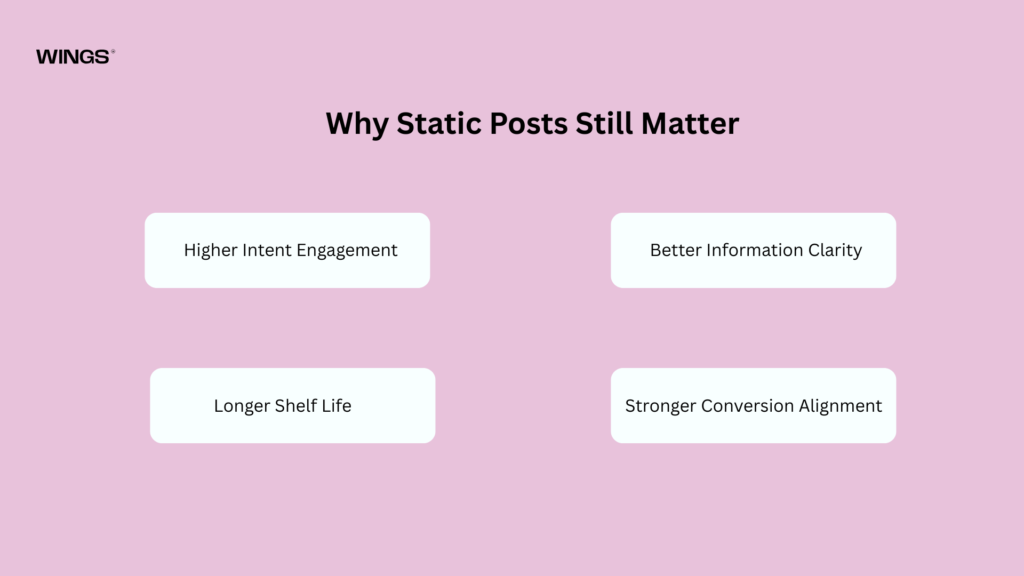
Why Static Posts Still Matter
1. Higher Intent Engagement
Users who engage with static content typically demonstrate more deliberate behavior. Unlike passive scrolling through video feeds, static posts require active attention and reading or viewing intent. This often results in a more qualified audience that is genuinely interested in the message being communicated, making engagement more meaningful from a business perspective.
2. Better Information Clarity
Static formats excel at delivering structured and digestible information. Whether it is explaining a product feature, breaking down a service offering, or presenting data-driven insights, static posts allow brands to communicate with precision. Carousels, in particular, guide users step-by-step through a narrative, improving comprehension and retention.
3. Longer Shelf Life
Unlike Reels, which often experience rapid spikes in visibility followed by sharp declines, static posts tend to have a longer and more stable performance cycle. They continue to generate engagement over time through profile visits, search discovery, saves, and reshares. This makes them valuable long-term assets within a brand’s content library.
4. Stronger Conversion Alignment
Static content is often more effective at driving direct actions such as link clicks, website visits, inquiries, and sign-ups. Because users spend more time processing information, they are better primed for conversion. This is especially true for carousel posts that educate before they sell.
Engagement Characteristics of Static Posts
Static posts exhibit a fundamentally different engagement pattern compared to Reels:
- Lower reach compared to Reels on most platforms
- Higher save rates, particularly for educational and carousel content
- More consistent engagement over time, with less volatility
- Better performance among niche or professional audiences
- Stronger ability to nurture interest and build trust gradually
Rather than chasing mass visibility, static posts focus on depth, relevance, and sustained audience engagement.
Business Impact of Static Posts
From a strategic leadership perspective, static posts function as a trust-building and conversion-enabling layer within the content funnel. They are less about attracting cold audiences and more about educating, convincing, and converting audiences who have already shown some level of interest.
Static posts are especially effective for:
- Product education, explaining features, benefits, and use cases in detail
- Thought leadership content, positioning the brand as an authority in its domain
- Case studies and testimonials, building social proof and credibility
- Pricing and feature breakdowns, supporting informed decision-making
- Retargeting warm audiences, reinforcing messages for users already exposed to the brand
In many high-performing content strategies, static posts act as the conversion support system that gives structure and depth to the high-reach awareness generated by Reels. Without them, brands often struggle to translate attention into measurable business outcomes.
Reels vs Static Posts: A Strategic Comparison
To make a practical decision, it is essential to compare Reels and Static Posts across business-critical dimensions rather than surface-level metrics. This includes how each format performs in reach, engagement quality, and conversion impact. A structured comparison helps identify where each format delivers the highest business value.
| Dimension | Reels | Static Posts | Insight |
| Reach Potential | High (algorithm-driven discovery) | Moderate (mostly follower-based distribution) | Reels dominate top-of-funnel visibility |
| Engagement Quality | Broad but shallow engagement | Narrow but deeper engagement | Static posts attract more qualified attention |
| Conversion Capability | Indirect, requires funnel support | Direct, especially carousels and educational content | Static posts convert better for warm audiences |
| Content Production Effort | High (shooting, editing, scripting) | Lower (design and copywriting) | Static content is more scalable and consistent |
| Algorithm Dependency | Highly dependent on algorithmic favor | More stable and predictable performance | Reels are volatile, static posts are stable |
What the Data Trend Actually Shows
Across most industries and platforms, content performance trends show a consistent pattern in how audiences interact with different formats. Short-form video like Reels generally drives higher reach and discovery due to algorithmic prioritization. Meanwhile, static posts tend to generate deeper engagement, stronger intent signals, and better conversion outcomes over time.
- Reels generate 2x–5x higher reach than static posts
- Static posts generate higher save-to-like ratios
- Carousels often outperform single-image posts in engagement depth
- Reels dominate follower growth
- Static content dominates lead nurturing
But the key insight is not about declaring one format superior over the other, it is about sequencing them strategically within a content system. Successful brands understand that Reels and Static Posts are not competing formats but complementary tools serving different stages of the customer journey. Instead of choosing one, they design an integrated approach where each format strengthens the other.
The Real Strategy: Funnel-Based Content Design
Decision-makers should not frame the choice as “Reels or static posts,” because that creates a false trade-off between two complementary formats. Instead, the more strategic question is how both formats can work together across different stages of the marketing funnel. This shift in thinking enables a more integrated and performance-driven content strategy.
Top of Funnel (Awareness)
Decision-makers should not frame the choice as “Reels or static posts,” because it incorrectly positions two complementary formats as competitors rather than collaborators. Instead, the focus should shift toward understanding how both formats can work together across different stages of the marketing funnel, from awareness to conversion. This approach allows brands to design a cohesive content system where Reels drive attention and Static Posts convert and nurture it. Ultimately, this shift enables a more integrated, efficient, and performance-driven content strategy.
Middle of Funnel (Consideration)
Use Static Posts for educational carousels that simplify complex topics and build audience understanding. They are highly effective for product breakdowns that clearly explain features, benefits, and use cases in a structured format. Static Posts also work well for comparison content, helping audiences evaluate options and make informed decisions. Additionally, they are ideal for case studies that showcase real results, build credibility, and strengthen trust.
Bottom of Funnel (Conversion)
Use Static Posts for testimonials that build trust through real customer experiences and social proof. They are also effective for presenting offers and pricing clarity in a structured, easy-to-understand format that supports decision-making. Static Posts work well for detailed feature explanations that require clarity and step-by-step communication. They are equally valuable for FAQs, helping address objections and reduce friction in the buying journey. This layered strategy ensures that attention captured by Reels is not wasted but effectively nurtured and converted through static content.
Industry Differences That Matter
The effectiveness of Reels versus Static Posts is not universal, it varies significantly based on industry context, audience behavior, and the nature of the purchase decision. Each industry uses these formats differently depending on whether the goal is discovery, trust-building, or conversion. Understanding these differences allows decision-makers to allocate content resources more strategically rather than applying a one-size-fits-all approach.
E-commerce & D2C Brands
For e-commerce and direct-to-consumer brands, content must balance emotional attraction with rational justification.
- Reels: Highly effective for discovery, impulse-driven engagement, and showcasing products in real-life scenarios. Short-form videos help simulate usage, lifestyle appeal, and urgency, which often leads to quick interest generation and spontaneous buying behavior. They are especially powerful during product launches, seasonal campaigns, and influencer-led promotions.
- Static Posts: Essential for product explanation and trust building. Carousels and static creatives allow brands to break down features, highlight benefits, compare variants, and answer common objections. They also support post-discovery evaluation, helping users move from “interest” to “purchase confidence.”
In this industry, Reels create demand, while Static Posts convert that demand into informed purchases.
B2B Companies
B2B marketing is driven by logic, credibility, and longer decision cycles, making content depth more important than virality.
- Reels: Useful primarily for top-of-funnel brand awareness and thought leadership snippets. Short videos can simplify complex ideas, showcase leadership presence, and humanize the brand. However, they rarely drive immediate conversions in isolation.
- Static Posts: Critical for lead generation, authority building, and education. Detailed carousels, frameworks, industry insights, and case summaries help establish expertise and support rational decision-making. Static content is often consumed by stakeholders during research and evaluation phases.
Here, Reels open conversations, while Static Posts support trust, validation, and pipeline progression.
Service-Based Businesses
Service-based industries rely heavily on trust, credibility, and perceived expertise.
- Reels: Effective for humanizing the brand and building emotional connection. Behind-the-scenes content, client interactions, team introductions, and quick tips help reduce perceived distance between the business and the customer.
- Static Posts: Strongly drive inquiries and conversions by clearly explaining services, packages, outcomes, and processes. They also help manage objections by presenting structured information that reduces uncertainty.
In this case, Reels build familiarity, while Static Posts drive decision-making and action.
Media & Influencers
Media brands and influencers operate in an attention-driven ecosystem where growth velocity is critical.
- Reels: The primary growth engine. Short-form videos maximize reach, follower growth, and algorithmic amplification. They help creators stay relevant in fast-moving content cycles and tap into trending topics.
- Static Posts: Secondary but still important for depth, credibility, and audience retention. They are used for storytelling, personal insights, announcements, and structured content that strengthens long-term audience relationships.
In this industry, Reels drive expansion, while Static Posts sustain engagement quality and audience loyalty.
Key Strategic Insight
Across all industries, the pattern remains consistent: Reels drive attention, while Static Posts drive understanding and conversion. The mix may change, but the roles remain fundamentally the same. Successful brands do not choose between them, they calibrate their usage based on industry dynamics, audience intent, and business objectives.

Explore how social media relates to the concept of dimension.
Common Mistakes Decision-Makers Make.
Mistake 1: Over-investing in Reels Alone
Many brands aggressively focus on Reels because of their high reach and viral potential, but this often leads to a fragmented strategy. While Reels are excellent for attracting attention, they rarely provide enough structured information to guide decision-making. Without supporting static content or a clear funnel, brands end up generating views without building meaningful conversion pathways.
Mistake 2: Ignoring Static Content
Static posts are often underestimated or treated as secondary content, despite their critical role in education and trust-building. When brands neglect static formats, they lose the ability to clearly explain their value proposition, resulting in weak consideration-stage engagement. This creates a gap where audiences are aware of the brand but not confident enough to take action.
Mistake 3: Inconsistent Content Strategy
A common issue is posting content without aligning formats to specific funnel stages or business objectives. Randomly mixing Reels and static posts without a clear structure leads to inconsistent messaging and diluted impact. Over time, this reduces overall ROI because content is not systematically guiding users from awareness to conversion.
Mistake 4: Measuring Wrong KPIs
Focusing only on vanity metrics such as likes, views, or follower growth can be misleading for decision-makers. While these metrics indicate surface-level engagement, they do not reflect business performance. A more effective approach is to track deeper KPIs like saves, click-through rates, leads, and conversions, which better represent actual business impact.
The ROI Perspective: What Actually Matters
From a leadership standpoint, content is not about engagement alone, it is about return on attention. Reels provide cheap reach that helps brands scale visibility quickly. They also enable faster awareness building and broader audience expansion across platforms.
- Cheap reach
- Faster awareness scaling
- Audience expansion
Static posts provide:
- Stronger intent signals
- Better conversion efficiency
- Long-term content value
The highest ROI comes from integration, not isolation in content strategy. When Reels and Static Posts work together, they create a complete funnel from attention to conversion. This combined approach ensures both scale and sustained business impact.
Conclusion: The Decision-Maker’s Framework
If engagement is defined purely as reach and visibility, Reels win decisively due to their algorithm-driven discovery and scale. If engagement is defined as meaningful interaction that leads to business outcomes, Static Posts remain equally important and often more valuable because they build depth, trust, and conversions.
The strategic reality is simple: Reels = Attention Acquisition, while Static Posts = Attention Conversion. One without the other creates an incomplete marketing system that cannot fully move users through the funnel.
For brands aiming to scale sustainably, the decision is not about choosing between them but about allocating resources intelligently across both based on funnel requirements. A mature content strategy uses Reels to attract attention at scale and Static Posts to educate, build trust, and convert. Success is measured through business outcomes, not vanity metrics, and continuously optimized based on audience behavior and platform shifts. In the evolving attention economy, winning brands are not those that post more content, they are those that build intent-driven content ecosystems where Reels and Static Posts do not compete, but compound.

Aakash
Digital Marketing Manager