

In an increasingly interconnected world, brands are no longer confined by geography but they are deeply shaped by it. As companies expand across borders, they face a critical tension: how to remain globally consistent while resonating locally. This is where cultural context becomes not just a consideration, but a design strategy.
For decision-makers, the challenge is not whether to localize, it’s how to do so without diluting the essence of the brand. The brands that succeed are those that treat cultural nuance as a strategic asset rather than a constraint. They understand that localization is not translation; it is interpretation, adaptation, and sometimes reinvention.
This blog explores how organizations can embed cultural context into design and experience strategy while preserving a coherent and recognizable brand identity.
The Strategic Importance of Cultural Context
Cultural context is not a peripheral consideration. It is a central force that shapes how people interpret the world around them, including the products and services they use. For businesses operating across markets, this means that every design decision, message, and interaction is filtered through deeply ingrained cultural lenses.
At a surface level, cultural differences may appear as variations in language, dress, or traditions. However, at a deeper level, they influence cognition, emotion, and behavior. They determine what people value, how they build trust, how they make decisions, and how they respond to brands.
When organizations fail to account for these factors, they often encounter subtle but powerful resistance. Interfaces feel unintuitive, messaging feels disconnected, and brand intent is misunderstood. In contrast, when cultural context is thoughtfully integrated, experiences feel natural, intuitive, and even personalized, despite being delivered at scale.

Explore the design system behind the EVOS.
Beyond Symbolism: The Depth of Cultural Influence
It is easy to reduce cultural context to visible symbols such as colors, icons, or imagery. While these elements matter, they are only the tip of the iceberg. True cultural alignment requires understanding the underlying systems of meaning that guide behavior.
Take the example of color. A global design team might choose white as a dominant color to convey simplicity, cleanliness, and modernity. In many Western markets, this aligns well with user expectations. However, in several Asian cultures, white is traditionally associated with mourning and loss. The same design choice can therefore evoke entirely different emotional responses depending on the cultural context.
Cultural influence extends far beyond symbolism. It shapes fundamental aspects of user interaction.
Decision making behavior
In individualistic cultures, users are often comfortable making independent choices and may prefer interfaces that emphasize personalization and autonomy. In more collectivist cultures, decision making may be influenced by social proof, community validation, or family input. Features such as reviews, testimonials, and recommendations may carry significantly more weight.
Communication styles
Some cultures favor direct and explicit communication, where clarity and brevity are valued. Others rely on indirect and context rich communication, where meaning is conveyed subtly. A message that feels concise and efficient in one market may come across as blunt or even insensitive in another.
Attitudes toward authority and hierarchy
In cultures where hierarchy is emphasized, users may expect clear guidance, structured flows, and authoritative messaging. In contrast, users in more egalitarian cultures may prefer interactions that offer greater control and flexibility.
Preferences for simplicity versus richness
Minimalist design is often celebrated in global design discourse, but it is not universally preferred. Some cultures value dense information, vibrant visuals, and multiple options presented simultaneously. What one market perceives as clean, another may perceive as lacking depth or value.
Trust in digital systems
Trust is culturally constructed. In some regions, users readily adopt digital payments and share personal data with minimal hesitation. In others, skepticism toward digital systems requires stronger trust signals such as certifications, guarantees, or familiar local payment methods.
These dimensions illustrate a critical point. Cultural context is not a constraint to design around. It is a blueprint for designing better.
Friction versus Relevance
When cultural context is ignored, the result is friction. Users hesitate, misunderstand, or disengage. Conversion rates drop, customer acquisition costs rise, and brand perception suffers.
This friction is often invisible in early stages. Metrics may show underperformance, but the root cause, cultural misalignment, remains unaddressed. Organizations may respond by optimizing copy, adjusting layouts, or increasing marketing spend without realizing that the issue lies deeper.
On the other hand, when cultural context is embraced, the opposite effect occurs, relevance. Experiences feel intuitive because they align with existing mental models. Messaging resonates because it reflects familiar values and communication styles. Trust is built faster because the brand communicates in a way that feels natural, not just linguistically but culturally.
For decision makers, this translates directly into business outcomes. Products that align with cultural expectations are adopted more quickly because users face fewer cognitive barriers. They are trusted more deeply, which reduces hesitation and increases engagement. They are retained longer because the experience continues to feel relevant over time.
In competitive markets, this alignment can be the difference between marginal presence and sustained success.
The False Trade Off: Consistency versus Localization
Despite the clear importance of cultural context, many organizations struggle with how to integrate it into their global strategy. At the heart of this struggle is a persistent misconception that global consistency and local relevance are inherently at odds.
This belief often leads companies toward one of two extremes, both of which create long term challenges.
Extreme One: Rigid Standardization
In this approach, organizations design a single global experience and deploy it uniformly across all markets. The rationale is straightforward. Consistency ensures brand recognition, operational efficiency, and easier scalability.
At first glance, this seems logical. A unified experience simplifies design systems, reduces complexity, and maintains a strong and cohesive brand image.
However, the downside is significant. By prioritizing uniformity, organizations often overlook the nuances that make experiences meaningful in different cultural contexts. The result is a product that is consistent but not compelling.
Users may be able to use the product, but they do not connect with it. It feels foreign, generic, or disconnected from their expectations. Over time, this leads to lower engagement and weaker market penetration.
Extreme Two: Fragmented Localization
At the opposite end of the spectrum is fragmented localization. In this model, each market operates with a high degree of independence and tailors products and experiences extensively to local preferences.
This approach often delivers strong short term results. Local teams create highly relevant experiences that resonate deeply with their audiences.
However, the long term consequences can be challenging. Without a unifying framework, the brand begins to fragment. Different markets present different identities, tones, and experiences, making it difficult to maintain a coherent global presence.
This fragmentation increases operational complexity, dilutes brand equity, and makes it harder to scale innovations across markets.
Why Both Approaches Fall Short
Both rigid standardization and fragmented localization attempt to solve the same problem, but they overcorrect in opposite directions.
Standardization prioritizes efficiency over relevance.
Fragmentation prioritizes relevance over coherence.
Neither approach fully addresses the needs of a global brand operating in diverse cultural environments.
The Shift to Structured Flexibility
The most effective organizations move beyond this false trade off by adopting a model of structured flexibility.
In this model, brand identity is not treated as a fixed artifact. Instead, it is understood as a dynamic system made up of two interconnected layers.
The core, which consists of non negotiable elements, forms the foundation of the brand. These include brand purpose, core values, personality and tone, key visual identifiers such as logo and typography, and overall design principles.
The adaptive layer surrounds this core and allows for contextual flexibility. This includes messaging nuances, visual expression, interaction patterns, content structure, and local trust signals.
Designing the System, Not Just the Output
The key shift for decision makers is moving from designing outputs, such as individual screens or campaigns, to designing systems that enable both consistency and flexibility.
A well designed system provides clear guidance on what must remain consistent, defined boundaries for adaptation, tools and frameworks for local teams to execute effectively, and governance mechanisms to maintain alignment.
This approach reduces ambiguity. Local teams are empowered, but they operate within clear boundaries. Global teams maintain oversight without imposing rigidity.
Recognizable Everywhere, Meaningful Anywhere
When structured flexibility is implemented effectively, brands achieve a powerful balance. They remain recognizable across markets while feeling locally relevant in each one.
This is the hallmark of mature global organizations. They do not force uniformity, and they do not lose themselves in adaptation. Instead, they operate with clarity and intention, understanding that consistency and localization are not opposing forces. They are complementary.
For leaders, this requires a shift in mindset. Localization is no longer a tactical adjustment made at the end of the process. It becomes a strategic capability embedded at the core of how products and experiences are designed.
Expanding cultural context as a design strategy is not about adding unnecessary complexity. It is about aligning global ambition with local reality. In doing so, organizations can build products that are not only used, but also understood, trusted, and valued across cultures.
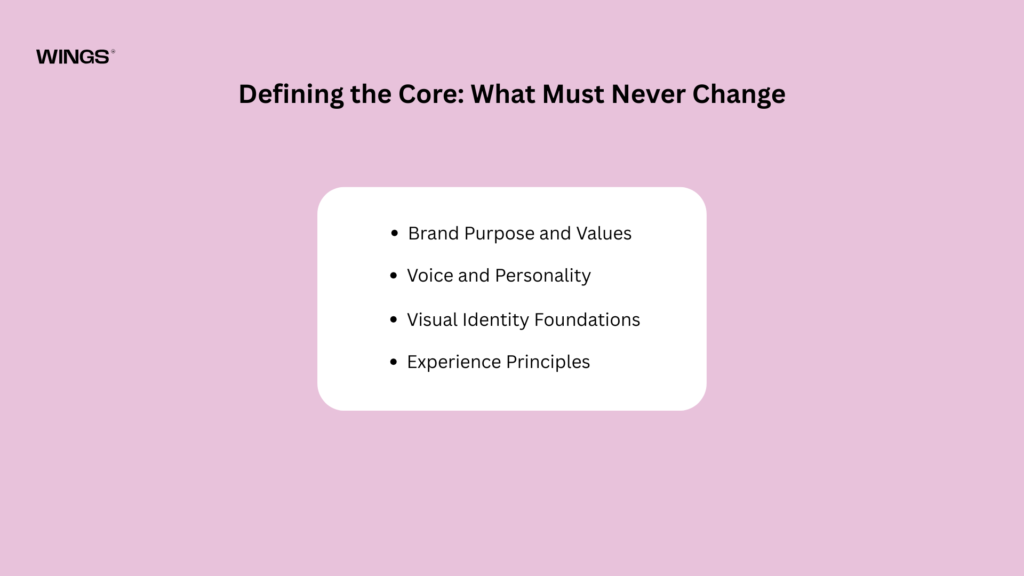
Defining the Core: What Must Never Change
Before localizing anything, organizations must define what cannot be localized.
These typically include:
01. Brand Purpose and Values
Brand purpose defines why an organization exists beyond profit and growth. It acts as a constant across all markets, grounding decisions in a shared intent. When this remains unchanged, the brand feels authentic and consistent everywhere. Without it, localization risks becoming disconnected and inconsistent.
02. Voice and Personality
A brand’s voice reflects how it communicates, while personality defines how it feels to the audience. These elements create familiarity and emotional connection across regions. Although tone may adapt slightly to suit cultural nuance, the core personality must remain stable. This ensures the brand is recognizable regardless of geography.
03. Visual Identity Foundations
Visual identity includes logos, typography, and primary color systems that define how a brand looks. These elements act as visual anchors that maintain consistency across all touchpoints. While layouts and imagery may adapt locally, the foundational elements should remain intact. This balance preserves recognition while allowing flexibility.
04. Experience Principles
Experience principles guide how products and services are designed and delivered. They reflect priorities such as simplicity, accessibility, and innovation. These principles ensure consistency in decision making across teams and markets. When clearly defined, they enable localization without compromising the overall experience.
The Adaptable Layer: Where Cultural Context Lives
Once the core is defined, the next step is identifying what can and should adapt.
01. Content and Messaging
Content is often the first layer of localization, but true adaptation goes far beyond translation. It requires sensitivity to idioms, humor, tone, and cultural references that shape how messages are received. What feels clever or engaging in one market may feel confusing or inappropriate in another. When messaging aligns with local communication styles, it becomes more relatable and effective.
02. Visual Expression
Visual elements play a powerful role in shaping perception and engagement. Imagery, iconography, and layout density can vary widely based on cultural preferences and expectations. Some audiences are drawn to clean and minimal designs, while others prefer visually rich and information dense interfaces. Adapting visual expression ensures that the experience feels intuitive and appealing within each context.
03. Interaction Patterns
User behavior is deeply influenced by cultural norms and expectations. In some regions, users prefer guided experiences with clear steps and instructions, while in others they value speed, flexibility, and independence. Designing interaction patterns that reflect these preferences improves usability and reduces friction. It also ensures that users feel in control in ways that match their expectations.
04. Payment and Trust Signals
Trust is a critical factor in user adoption, especially in digital environments. Local payment methods, familiar security indicators, and recognizable trust badges help reduce uncertainty and build confidence. When these elements are missing or unfamiliar, users may hesitate or abandon the experience altogether. Aligning with local trust signals creates a smoother and more credible journey.
05. Regulatory and Ethical Considerations
Cultural context is closely tied to legal requirements and societal norms within each market. Regulations around data privacy, accessibility, and content vary widely and must be respected. Beyond compliance, aligning with ethical expectations demonstrates responsibility and builds trust. When handled well, this layer reinforces the brand’s credibility and long term reputation.
Cultural Intelligence as an Organizational Capability
Localization at scale requires more than guidelines, it requires cultural intelligence embedded within the organization.
This includes:
Cross Functional Collaboration
Effective localization requires close collaboration across design, marketing, product, and regional teams. Each function brings a different perspective that is essential to creating culturally relevant experiences. Localization should not be treated as a final step or a simple handoff between teams. Instead, it must be integrated into the process from the beginning to ensure alignment and consistency.
Local Expertise
Local insight is critical to understanding cultural nuance and user behavior. Global teams must actively involve and empower regional experts who have a deep understanding of their markets. This does not mean losing control over the brand, but strengthening it through informed decisions. When local expertise is valued, the resulting experience feels more authentic and relevant.
Continuous Learning
Cultural context evolves over time as consumer behaviors, technologies, and societal norms change. What works today may not remain effective tomorrow, especially in fast growing digital markets. Organizations must continuously gather insights, test assumptions, and refine their approach. Treating localization as an ongoing learning process ensures long term relevance and adaptability.
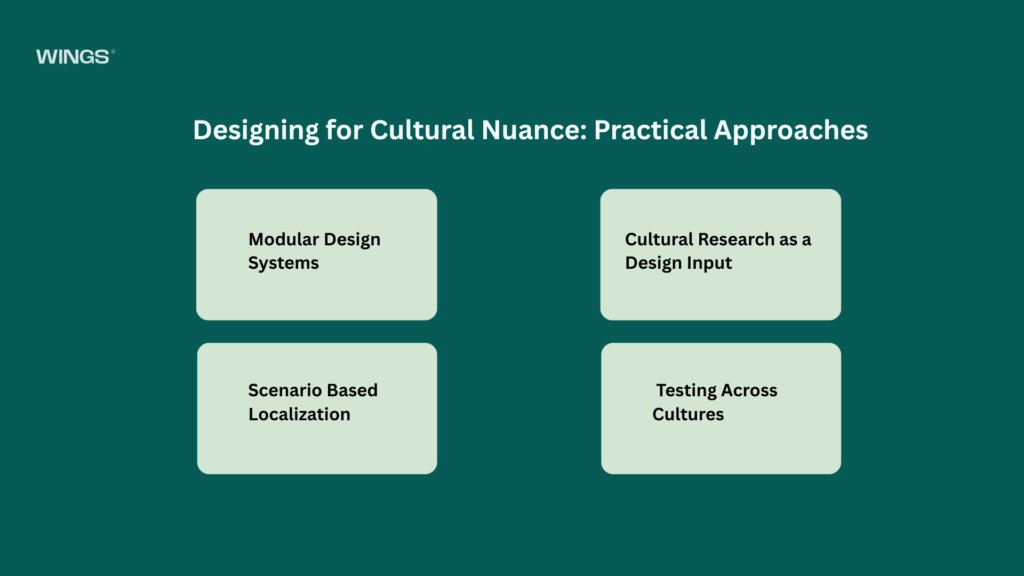
Designing for Cultural Nuance: Practical Approaches
01. Modular Design Systems
A well structured design system is essential for scaling localization effectively. Instead of relying on rigid templates, organizations should build systems that allow flexibility within defined boundaries. This includes adaptable components, variable content areas, and clear guidance on imagery and tone. When supported by clear rules on what can be adapted, teams can create culturally relevant experiences without compromising the brand.
02. Cultural Research as a Design Input
Cultural understanding should inform design decisions from the very beginning, not be added later as an adjustment. Organizations need to invest in research methods such as ethnographic studies, market immersion, user interviews across regions, and behavioral data analysis. These insights provide a strong foundation for decision making. When design is rooted in real cultural understanding, it becomes more accurate and effective.
03. Scenario Based Localization
Instead of creating a single global solution and modifying it slightly for different markets, organizations can design for distinct scenarios. These scenarios may reflect differences in communication styles, technology usage, or levels of trust. By identifying patterns such as high context versus low context communication or mobile first versus desktop heavy usage, teams can develop targeted solutions. This approach ensures relevance while maintaining alignment with brand guidelines.
04. Testing Across Cultures
Testing should be conducted across multiple regions to capture cultural differences in user behavior. What works well in one market may not perform the same way in another. Localized testing helps uncover how users respond to messaging, visuals, and overall experience. It also highlights barriers related to trust or usability. Using data driven insights allows organizations to refine their approach and reduce the risk of cultural misalignment.
Case Patterns: What Successful Brands Get Right
While each organization’s approach differs, successful global brands tend to share common patterns:
They Design for Systems, Not Screens
Successful brands focus on building systems rather than isolated outputs. Instead of designing individual screens or campaigns, they create flexible frameworks that support variation across markets. These systems provide structure while allowing adaptability. This approach ensures consistency without limiting local relevance.
They Empower Local Teams Within Guardrails
Global brands recognize the value of local expertise and give regional teams the ability to adapt experiences. However, this autonomy exists within clearly defined brand boundaries. Guardrails ensure that adaptations remain aligned with the overall identity. This balance allows for both relevance and coherence.
They Invest in Cultural Insight
Cultural understanding is treated as a long term strategic investment rather than a one time effort. Successful organizations continuously gather insights about user behavior, preferences, and societal shifts. These insights inform decision making across design, product, and marketing. As a result, experiences remain relevant as markets evolve.
They Balance Speed with Sensitivity
High performing brands move quickly to stay competitive, but they do so with awareness and care. They understand that cultural missteps can have serious consequences, both financially and reputationally. By combining speed with thoughtful consideration, they reduce risk while maintaining momentum. This balance is critical in global markets.
Common Pitfalls to Avoid
01. Treating Localization as Translation
Localization is often misunderstood as a simple process of translating content from one language to another. This approach overlooks the deeper cultural nuances that shape how messages are interpreted. Direct translation can result in awkward phrasing or loss of meaning. Effective localization requires adapting tone, context, and intent to resonate with the target audience.
02. Over Localizing
While adapting to local contexts is important, excessive changes can weaken the core identity of a brand. Not every element needs to be modified for each market. Over localization can create inconsistency and confusion across regions. A balanced approach ensures that the brand remains recognizable while still being relevant.
03. Ignoring Internal Alignment
Successful localization depends on strong coordination between global and local teams. When alignment is missing, efforts can become fragmented and inefficient. Different markets may interpret brand guidelines in inconsistent ways. Clear communication and shared frameworks are essential to maintain coherence.
04. Assuming Homogeneity
Markets are often treated as uniform, but this assumption can lead to ineffective strategies. Within any region, there are diverse audiences with different preferences and behaviors. Factors such as geography, age, and digital familiarity influence how users engage with products. Recognizing this diversity allows for more precise and meaningful localization.
The Role of Leadership in Cultural Design Strategy
Localization is not just a design challenge, it is a leadership responsibility.
Decision-makers must:
01. Set Clear Strategic Direction
Leaders must clearly define what the brand stands for at a global level and how it should adapt across different markets. This includes establishing non negotiable elements of identity while outlining areas where flexibility is allowed. A well articulated strategy provides direction and reduces ambiguity. It ensures that all teams move in alignment while adapting to local needs.
02. Allocate Resources
Effective localization requires investment in the right resources, including research, tools, and skilled talent. Without adequate support, even well defined strategies fail in execution. Leaders must prioritize funding and infrastructure that enable teams to localize efficiently. This commitment signals that cultural relevance is a business priority, not an afterthought.
03. Foster a Culture of Empathy
Organizations must cultivate an environment where cultural understanding is valued and encouraged. Leaders play a key role in promoting empathy toward different user groups and markets. This involves encouraging curiosity, openness, and respect for diverse perspectives. When teams approach design with empathy, they create more meaningful and inclusive experiences.
04. Measure What Matters
Success in localization cannot be measured by consistency alone. Leaders must track how well experiences perform within each market, including engagement, adoption, and user satisfaction. Metrics should reflect both global alignment and local effectiveness. This balanced approach enables continuous improvement and informed decision making.

Explore the design system behind the Kind energy.
Technology as an Enabler, Not a Solution
Technology can accelerate localization, but it cannot replace cultural understanding.
Tools such as:
01. Content Management Systems
Content management systems help teams manage and distribute localized content efficiently across markets. They enable consistency, speed, and easier updates at scale. However, the way content is structured and delivered still requires cultural awareness. Without human oversight, even well managed content can miss local relevance.
02. Design System Platforms
Design system platforms provide a structured way to maintain consistency while allowing controlled flexibility. They help teams reuse components, follow guidelines, and scale design across regions. Yet, these systems must be built with adaptability in mind to support cultural variation. Technology enables the process, but thoughtful design decisions ensure its effectiveness.
03. AI Driven Translation Tools
AI powered tools can significantly speed up translation and reduce operational effort. They are useful for handling large volumes of content quickly and consistently. However, they often lack the ability to capture tone, nuance, and cultural context accurately. Human input is essential to refine and adapt outputs for meaningful communication.
04. Balancing Efficiency with Sensitivity
While technology improves speed and scalability, it cannot replace cultural understanding. Over reliance on automation can result in experiences that feel generic or disconnected. The most effective approach combines technological efficiency with human insight. This balance ensures that localization remains both scalable and culturally relevant.
The Future of Localization: From Markets to Micro-Cultures
As personalization becomes more sophisticated, localization will move beyond geography.
Brands will need to design for:
01. Subcultures
Localization is expanding beyond broad geographic regions to include smaller, more defined cultural groups. Subcultures are shaped by shared interests, values, and lifestyles rather than location alone. Designing for these groups requires a deeper understanding of identity and behavior. When done well, it creates highly relevant and meaningful experiences.
02. Digital Communities
Online spaces have given rise to communities that transcend physical boundaries. These groups form around shared platforms, interests, and interactions, creating their own norms and expectations. Brands must learn to engage with these communities in ways that feel authentic and respectful. This requires adapting tone, content, and interaction styles to fit each context.
03. Behavioral Segments
User behavior is becoming a more important lens than geography alone. Different segments may share similar needs, habits, and expectations regardless of where they are located. Designing for behavioral patterns allows brands to create more precise and personalized experiences. This approach increases relevance while maintaining scalability.
04. Opportunity in Complexity
As localization evolves, the challenge becomes more complex but also more rewarding. The ability to connect with specific audiences at a cultural level creates stronger engagement and loyalty. Brands that embrace this shift can differentiate themselves in crowded markets. Cultural relevance will become a defining factor in long term success.

Explore the design system behind the DCC.
A Strategic Framework for Decision-Makers
To operationalize cultural context as a design strategy, leaders can adopt the following framework:
01. Define the Core
Leaders must begin by clearly identifying the non negotiable elements of the brand. These include purpose, values, personality, and key visual foundations. Establishing this core creates a strong and consistent identity across all markets. It also provides a clear reference point for any localization efforts.
02. Map Cultural Variables
Understanding cultural differences across markets is essential for effective localization. Leaders should identify key factors such as communication styles, user behaviors, trust patterns, and design preferences. This mapping helps teams anticipate variations and design accordingly. It ensures that decisions are informed rather than reactive.
03. Build Flexible Systems
Scalable localization requires systems that support both consistency and adaptability. Design systems and content frameworks should allow variation within defined boundaries. This enables teams to respond to cultural needs without starting from scratch. Well designed systems reduce complexity while maintaining alignment.
04. Empower Local Teams
Regional teams bring valuable insight into their specific markets. Leaders must equip them with the tools, authority, and guidance needed to adapt experiences effectively. Empowerment should be balanced with clear guardrails to maintain brand integrity. This approach encourages both ownership and accountability.
05. Test and Learn
Localization should be treated as an ongoing process of learning and improvement. Teams must continuously test assumptions through data, user feedback, and experimentation. Insights gained from different markets can inform broader strategy. This iterative approach ensures that experiences remain relevant over time.
06. Scale with Discipline
As organizations grow, maintaining consistency becomes more challenging. Leaders must ensure that expansion does not lead to fragmentation. Clear governance, strong systems, and regular alignment are essential. Scaling with discipline allows brands to grow while preserving a cohesive identity.
Conclusion: Designing for Belonging
At its heart, localization is about belonging. It is about making people feel understood not only as customers but as individuals shaped by culture. When brands achieve this, they move from transactions to meaningful relationships built on trust.
Successful global brands do not impose a single vision everywhere, nor do they lose their identity in constant adaptation. They balance a strong core identity with thoughtful flexibility for local relevance. This balance allows them to stay consistent while still resonating deeply across markets.
For decision makers, cultural context is not a constraint but a strategic advantage. It enables better experiences, stronger trust, and long term growth. In a world of endless choice, relevance driven by cultural understanding becomes the true competitive edge.

Vidhya Shree
Senior Visual Designer