


Why Decision-Makers Must Treat This as a Business Growth Lever, Not a Technical Debate
In modern digital products, design aesthetics and page speed often appear to be at odds. One demands rich visuals, animations, and immersive experiences, while the other requires restraint, optimization, and technical discipline. For decision-makers such as CMOs, product heads, founders, and digital leaders, this is not a design versus engineering debate but a strategic business decision. It directly impacts revenue, retention, and overall brand perception. In 2026, users no longer evaluate products separately on how they look and how fast they load. Instead, they experience everything as a single, unified impression. That combined experience determines whether trust is built or lost within seconds.
The Core Tension: Beauty vs Performance
At the center of modern digital product design lies a fundamental trade-off between aesthetic-driven design goals and performance-driven engineering goals. Both are essential, but they often compete for the same limited resources such as load time, processing power, and bandwidth, creating an ongoing balancing act.
Aesthetic-Driven Design Goals
Aesthetic-focused design prioritizes visual richness and emotional engagement. This includes the use of high-resolution imagery, video backgrounds, complex animations, and micro-interactions that make interfaces feel alive and dynamic. It also involves custom typography systems, large and expressive font treatments, parallax scrolling effects, and immersive storytelling elements that enhance narrative depth. These design choices significantly strengthen brand identity, increase emotional connection with users, and improve perceived product quality and trust. However, they also introduce trade-offs, such as increased asset weight, higher rendering complexity, and greater JavaScript execution demands, all of which can impact speed and responsiveness.
Performance-Driven Engineering Goals
On the other side, performance-driven engineering focuses on efficiency, speed, and stability. Key objectives include achieving fast initial load times, particularly strong First Contentful Paint (FCP), maintaining a low JavaScript bundle size, and ensuring optimized image delivery through techniques like lazy loading. It also emphasizes minimizing layout shifts for visual stability (CLS) and implementing efficient caching strategies to reduce repeated load costs. These improvements directly impact SEO performance, increase conversion rates, reduce bounce rates, and enhance usability, especially on mobile devices, which are critical in mobile-first markets such as India, including cities like Chennai.
Why This Trade-Off Matters More Than Ever
User patience has collapsed in the digital world. Studies show users expect pages to load almost instantly. Even a few seconds of delay leads to abandonment. Small delays can significantly reduce conversions. Speed has become essential for user experience and success.
1. Users abandon pages that take longer than ~3 seconds to load
Modern users expect near-instant access to content. When a page takes longer than around three seconds to load, a significant portion of users lose patience and leave before interacting with it. This behavior is driven by high competition across digital platforms, users can instantly switch to alternatives with similar content or services. As a result, even slight delays directly reduce engagement, making initial load speed a critical factor in retaining attention and preventing early drop-offs.
2. Even a 1-second delay can reduce conversions significantly
Even very small delays in load time can have a measurable impact on business outcomes. A delay of just one second can reduce conversion rates because it interrupts user flow and creates friction at key decision points, such as sign-ups, purchases, or form submissions. This happens because users interpret lag as inefficiency or lack of reliability, which lowers trust and reduces their willingness to complete an action. In competitive markets, this small time gap can translate into substantial revenue loss.
3. Mobile users are especially sensitive due to network variability
Mobile users experience performance issues more intensely because of inconsistent network conditions, weaker device performance, and fluctuating connectivity. Unlike desktop environments, mobile usage often happens on the go, where latency and interruptions are more common. This makes users even less tolerant of slow-loading pages. If an experience is not optimized for mobile-first performance, it risks losing a large portion of its audience, especially in regions where mobile internet is the primary access point.
The Business Impact: What Decision-Makers Often Miss
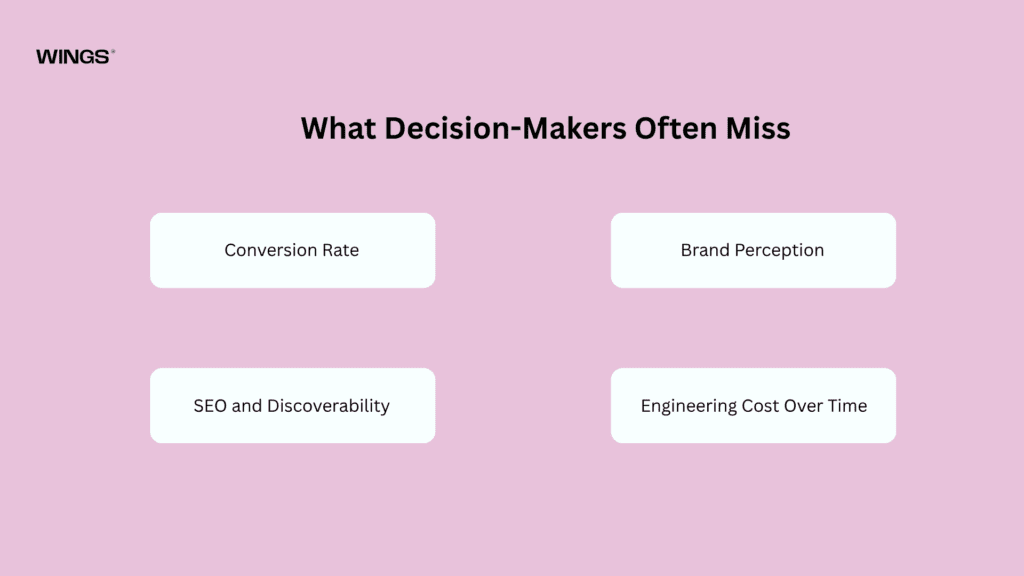
This isn’t just a technical optimization issue, it has a direct impact on core business KPIs. Slow or heavy experiences reduce user engagement, increase bounce rates, and lower the number of users who complete key actions like sign-ups or purchases. This leads to reduced conversion rates and ultimately affects revenue growth. It also weakens user trust and brand perception, which can decrease long-term customer retention and lifetime value.
1. Conversion Rate
Heavy pages reduce conversion rates across multiple key actions, and the impact compounds throughout the user journey:
- Product purchases: Users abandon checkout flows when pages load slowly, especially at payment or cart stages, leading to direct revenue loss.
- Lead form submissions: Delays discourage users from completing forms, increasing drop-offs before submission and reducing qualified leads.
- App installs: Slow landing pages or store redirects reduce install intent, causing users to exit before reaching the download action.
- Funnel compounding effect: Even small delays at the top of the funnel reduce the number of users who ever reach deeper conversion steps, amplifying overall losses across the entire journey.
2. Brand Perception
Brand perception is heavily influenced by how quickly and smoothly a digital experience loads, often at a subconscious level:
- Fast load = modern, reliable, trustworthy: Users tend to associate speed with technical competence, efficiency, and a well-maintained product. A fast experience reinforces confidence in the brand’s quality and professionalism.
- Slow load = outdated, inefficient, risky: When pages lag or feel heavy, users often interpret it as poor engineering or lack of care, which can reduce trust and make the brand feel less credible or outdated.
- Perceived premium paradox: Interestingly, highly designed or visually rich pages can actually reduce perceived quality if they perform poorly. Instead of feeling premium, they may feel frustrating or unreliable, weakening the overall brand impression despite strong aesthetics.
3. SEO and Discoverability
Search engines now treat performance as a core ranking signal, meaning site speed and stability directly affect how easily users can find your content:
- Performance as a ranking factor: Search engines evaluate how fast and efficiently a page loads, prioritizing websites that deliver a smooth and responsive experience.
- Google Lighthouse metrics: Tools like Lighthouse assess key areas such as performance, accessibility, best practices, and SEO readiness, giving a clear indication of overall site quality.
- Impact on visibility: Even if content is high-quality and relevant, a poor performance score can reduce search rankings, limiting organic traffic and discoverability.
- User experience signals: Slow or unstable pages can increase bounce rates, which further signals to search engines that the page may not provide a good user experience.
4. Engineering Cost Over Time
Highly aesthetic-heavy websites often lead to significantly higher long-term engineering costs because of the complexity required to maintain performance and stability:
- More maintenance: Complex animations, large assets, and custom UI behaviors require continuous fixes, updates, and compatibility checks across devices and browsers.
- More optimization cycles: Teams must repeatedly optimize images, scripts, and rendering performance to prevent slowdowns as features grow.
- Higher CDN and infrastructure spending: Large media files, video backgrounds, and heavy assets increase bandwidth usage and content delivery costs over time.
- Constant performance tuning: As new features are added, ongoing monitoring and fine-tuning are required to maintain acceptable load times and user experience standards.
The Real Misconception: “We Must Choose One”
The biggest strategic mistake leaders make is treating beauty and performance as a strict either-or decision. In reality, this is not a binary trade-off where one must be sacrificed for the other. Modern digital product strategy is about balancing both through thoughtful design and engineering integration.
Instead of choosing between speed and aesthetics, effective teams focus on achieving perceived luxury without sacrificing performance. This means creating experiences that feel rich, premium, and visually engaging while still loading quickly, responding instantly, and maintaining stability.
The key shift is from compromise to optimization using techniques like progressive loading, design systems, and performance budgets to ensure that high-end visual design and strong technical performance work together rather than against each other.
The Hidden Middle Ground: Perceived Performance
Not all performance is real performance. Users don’t measure milliseconds, they measure feel. This introduces a powerful concept: perceived performance, where the focus shifts from raw technical speed to how fast and smooth the experience feels in practice.
Perceived speed vs actual speed
A site can feel fast even if it is not technically the fastest if it uses smart perception-focused design techniques that improve the user’s sense of responsiveness. This includes prioritizing visible content first so users can immediately interact with the interface, even while other elements continue loading in the background. It also involves using progressive rendering, smooth transitions, and subtle loading indicators that reduce perceived waiting time. By carefully controlling what the user sees and when they see it, the experience feels fluid and responsive, even if the underlying system is still processing additional resources.
- Skeleton screens
- Progressive loading
- Instant feedback interactions
- Smart content prioritization
This is where design and engineering converge, because perceived performance is not achieved by design alone or engineering alone, but through their tight coordination. Engineering ensures that systems are optimized to load efficiently, prioritize critical resources, and manage performance budgets effectively, while design shapes how users perceive that loading through layout decisions, progressive disclosure, and visual feedback. When both disciplines work together, the result is an experience that feels fast, smooth, and intentional, even if complex processes are happening behind the scenes.

Explore the design aesthetics behind the Obsessions.
Strategic Framework: How Leaders Should Think About This Trade-Off
Step 1: Define the Experience Hierarchy
At this stage, leaders and designers should begin by clearly identifying and prioritizing what matters most in the user experience. The goal is to establish a hierarchy of content and functionality so that the system delivers value in the right order. This starts with asking key questions such as:
- What must load instantly?
- What can load after interaction?
- What is purely decorative?
Not everything deserves priority. This principle means that every element in a product or experience should be evaluated based on its actual impact on the user’s immediate goals. Critical content and actions that directly support user intent should be prioritized first, while secondary enhancements and decorative elements should be deferred or deprioritized. By accepting that limited attention and system resources must be focused only on what truly matters, teams can create faster, clearer, and more effective experiences without unnecessary complexity.
Step 2: Adopt “Progressive Aesthetics”
Instead of loading everything at once, the system should be designed to prioritize essential content first and defer non-critical elements. This means the user is immediately presented with a functional core experience such as layout structure, key information, and primary actions, while secondary visuals, enhancements, and heavier resources are loaded progressively in the background or triggered after interaction. This approach improves perceived speed, reduces cognitive overload, and ensures that performance remains smooth even as richer content is added over time.
- Load core layout first
- Add visuals progressively
- Delay non-critical animations
This preserves both speed and beauty by ensuring that performance is not sacrificed for visual richness, and visual richness is not removed for the sake of speed. Instead, the experience is carefully balanced so that users first receive a fast, responsive core interface, while additional aesthetic elements are layered in progressively. As a result, the system feels both lightweight and visually engaging, maintaining usability without compromising on design quality.
Step 3: Use Design Systems, Not One-Off Creativity
Design systems built in tools like Figma allow teams to create a structured and scalable foundation for product design. They enable the development of reusable components, ensuring consistency across different screens and features without having to redesign elements from scratch each time. They also help define clear performance and design standards, making it easier to manage constraints like spacing, typography, and visual behavior. Additionally, they support scalability by allowing teams to expand or modify the product’s visual identity without introducing inconsistency or design chaos, ultimately improving both efficiency and maintainability.
- Reusable components
- Consistent performance budgets
- Scalable visual identity without chaos
This reduces “creative bloat” by preventing unnecessary or inconsistent design variations from accumulating across the product. When teams rely on structured design systems instead of ad-hoc creativity, every new feature or interface element is built using predefined, reusable patterns. This limits duplication, avoids visual inconsistency, and reduces the tendency to over-design or add unnecessary complexity. As a result, the product remains cleaner, easier to maintain, and more aligned with both performance and usability goals.
Step 4: Enforce Performance Budgets
Top digital companies define strict limits to ensure performance, consistency, and scalability across their products. These limits act as guardrails that prevent individual features from degrading the overall user experience. Instead of allowing unrestricted design or development decisions, they enforce measurable constraints that teams must follow during implementation. This helps maintain a balance between innovation and efficiency while keeping systems fast, stable, and predictable at scale.
- Image size thresholds
- JavaScript bundle caps
- Animation constraints
If a feature breaks the budget, it is not simply pushed through or added as-is. Instead, it is revisited and redesigned to meet the established performance constraints. This may involve simplifying the feature, optimizing its technical implementation, or rethinking its design approach altogether. The goal is to preserve both functionality and performance, ensuring that no single feature negatively impacts the overall system experience or violates the agreed limits.
The Winning Strategy: “Constraint-Driven Creativity”
The best digital products are not unconstrained; they are intelligently constrained to focus on what truly matters. By limiting unnecessary features and complexity, they reduce cognitive load and improve usability. These constraints guide design decisions, ensuring speed, clarity, and consistency. As a result, the product becomes more efficient, purposeful, and easier to use.
Constraints force better design decisions:
- Simpler layouts become more elegant because removing unnecessary elements brings clarity and focus to the design. With fewer distractions, each component has more space and visual importance, allowing the structure to feel balanced and intentional. This simplicity improves readability and guides the user’s attention naturally through the interface. As a result, the overall experience feels cleaner, more refined, and visually appealing.
- Fewer animations become more meaningful because each motion is used with clear intent rather than decoration. When animations are limited to essential interactions, they better guide user attention and improve understanding of system behavior. This makes transitions feel smoother, more purposeful, and less distracting. As a result, motion enhances usability instead of overwhelming the experience.
- Optimized assets become more intentional because every image, icon, or media element is carefully chosen and refined to serve a specific purpose. By reducing file size and removing unnecessary visual noise, the focus shifts to clarity and performance. This ensures faster loading while maintaining visual quality where it matters most. As a result, the design feels more purposeful, efficient, and aligned with the overall user experience.
This is where aesthetics actually improve, not degrade, because thoughtful constraints create clarity and focus in design. By removing unnecessary noise and complexity, the interface becomes more visually coherent and intentional. Every element has a purpose, which strengthens the overall visual hierarchy. As a result, the product feels more refined, elegant, and purposeful rather than cluttered.
Real-World Pattern: What High-Performing Brands Do
Leading digital platforms tend to prioritize a minimal first-load experience that ensures users can access content quickly without delay. They delay heavy visuals and non-essential elements until after initial engagement to maintain responsiveness. These platforms invest heavily in backend infrastructure, caching systems, and CDNs to ensure fast global delivery. They also continuously monitor performance metrics to optimize speed, stability, and user experience in real time:
- Prioritizing a minimal first-load experience means ensuring that users can access and interact with the core functionality of a page or application as quickly as possible by loading only the most essential elements first. It focuses on reducing initial loading time and avoiding unnecessary delays caused by heavy assets or non-critical features. By deferring secondary content and using techniques like lazy loading and code optimization, the system becomes faster and more efficient. This approach ultimately improves user satisfaction by making the experience feel smooth, responsive, and immediately usable.
- Delaying heavy visuals until after user engagement means loading only lightweight, essential content first so users can start interacting immediately without waiting for large images, videos, or animations. Once the user shows intent—such as scrolling, clicking, or staying on the page—heavier visual elements are then loaded in the background. This improves perceived performance and ensures the interface feels fast and responsive from the start. It also helps reduce initial bandwidth usage and avoids blocking the main content with non-critical media.
- Investing heavily in backend and CDN infrastructure means strengthening servers, databases, and content delivery systems to handle high traffic efficiently and reliably. A robust backend ensures fast data processing, quick API responses, and stable performance even under load. A well-configured CDN reduces latency by serving content from edge locations closer to users, minimizing travel time for requests. Together, they improve scalability, speed, and overall system reliability for a smooth user experience.
- Continuously monitoring performance metrics means regularly tracking key indicators like load time, response time, error rates, and system resource usage to ensure the application runs efficiently. This helps identify performance bottlenecks, slow endpoints, or failures in real time before they impact users. By analyzing trends over time, teams can make informed decisions about optimizations and scaling. It ensures the system remains fast, stable, and reliable under changing conditions.
They do not choose between beauty and speed; they balance both strategically. Speed comes first to ensure quick, usable access. Beauty is added progressively after the core experience loads. This creates a fast yet visually rich experience.

Explore the design aesthetics behind the Shivam jewels.
The Executive Takeaway
- The executive takeaway is not about choosing between design and performance, but about strategically integrating both into a single, cohesive digital experience system where neither competes with the other.
- The key question for decision-makers is how to ensure that visual design actively enhances the perception of speed, making interfaces feel faster and more responsive rather than visually heavy or delayed.
- In modern digital ecosystems, speed plays a critical role in user acquisition because users decide within seconds whether to stay or leave based on loading time and responsiveness.
- At the same time, design is essential for building trust, credibility, and emotional resonance, helping users feel confident in the product and the brand behind it.
- When speed and design are aligned effectively, they reinforce each other and directly contribute to higher conversion rates, stronger engagement, and improved long-term user retention.
- In 2026, users no longer separate visual experience from technical performance; instead, they perceive both as one continuous, unified interaction with the product.
- The most successful organizations will treat aesthetics and performance not as trade-offs, but as interconnected levers within a single growth-driven product strategy.
Conclusion
The most successful digital experiences in 2026 will not be defined by extreme visual complexity or raw page speed alone. Instead, they will be the ones where users feel instant responsiveness at every interaction. Brands will be able to appear premium and expressive without creating visual or technical heaviness. This requires engineering and design to function as a single integrated system rather than separate, competing teams. Performance and aesthetics will need to be co-designed from the very beginning of product development. In this new standard, compromises between beauty and speed will no longer be acceptable. Great digital products are not simply designed or optimized in isolation. They are strategically balanced to deliver both experience and efficiency together.

Thanseem
Junior UI/UX Designer