
For years, companies treated design, technology, and business strategy as separate functions, designers focused on visuals and usability, engineers built functionality, and business leaders drove growth. This siloed approach often led to disconnected products that either looked good but didn’t perform well, or worked well but failed to meet user needs or business goals.
Today, that approach no longer works. In a digital-first world, users expect seamless, fast, and meaningful experiences. To meet these expectations, successful companies integrate all three disciplines from the start, When design, technology, and business strategy work together, products become:
- User-friendly (good design)
- Reliable and scalable (strong technology)
- Goal-driven (clear business strategy)
This convergence enables companies to build better products, move faster, and stay competitive in a rapidly changing market.
Why Convergence Matters Now
The digital economy has significantly raised customer expectations. Users now demand seamless experiences across devices, fast and reliable performance, and personalized, relevant interactions. They also expect a clear and consistent value proposition at every touchpoint.
Meeting these expectations requires more than strong design or solid engineering in isolation, it demands convergence across disciplines. Design, engineering, product, and business teams must work in alignment to create unified experiences.
Without this integration, companies often face fragmented user journeys, slower development cycles, and missed opportunities. In contrast, organizations that embrace convergence build cohesive, high-impact products that deliver real value and maintain a competitive edge.

Explore the Design process behind the Quint.
Understanding the Three Pillars
01. Design: Beyond Aesthetics
Design has evolved from being purely visual to becoming a core driver of user experience and product success. It focuses on how a product works, how users interact with it, and how it makes them feel. This includes user experience (UX), user interface (UI), interaction design, and service design, all of which shape the overall journey. Good design simplifies complexity, anticipates user needs, and removes friction. It ensures that technology is accessible and intuitive while clearly expressing the product’s value to the user.
02. Technology: The Enabler
Technology is the foundation that turns ideas into functional, scalable solutions. It determines how fast a system performs, how securely it handles data, and how well it integrates with other platforms. Modern technologies such as cloud computing, APIs, and artificial intelligence expand what organizations can build and deliver. However, technology alone is not enough, without thoughtful design and a clear strategic purpose, even the most advanced systems can feel disconnected or fail to meet user expectations. True value comes when technology is applied in a way that supports both usability and business goals.
03. Business Strategy: The Direction
Business strategy provides the guiding framework that aligns all efforts toward meaningful outcomes. It defines who the target customer is, what problem is being solved, and how the product creates and captures value. It also identifies key differentiators that set the product apart in a competitive market. A strong strategy ensures that decisions across design and technology are intentional and focused, rather than reactive. By connecting user needs with business objectives, it enables organizations to build products that are not only functional and appealing but also sustainable and impactful.
Where They Intersect
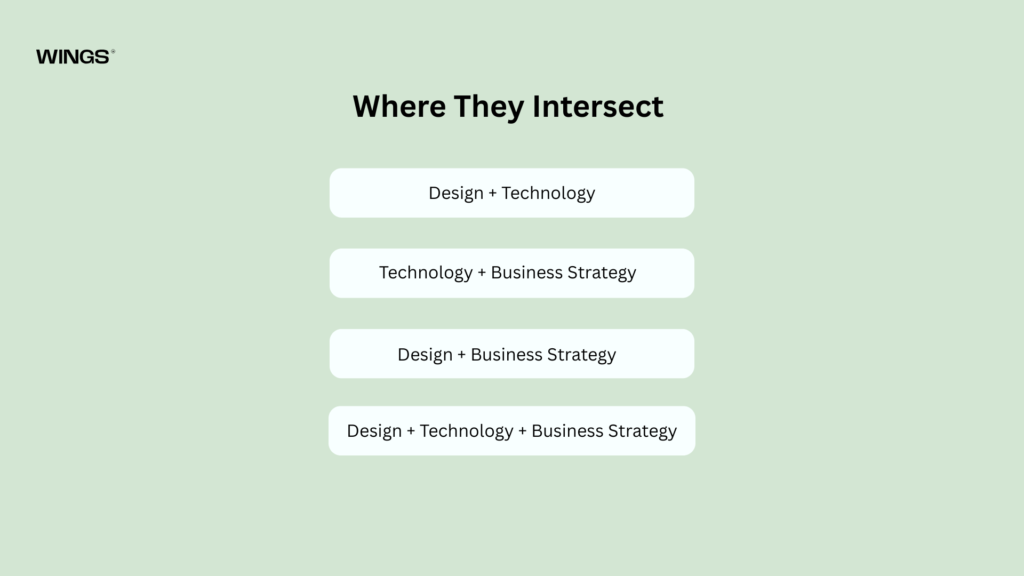
The true impact of design, technology, and business strategy is realized not in isolation, but in how they work together. Their intersections create stronger, more effective products and drive meaningful outcomes.
Design + Technology
When design and technology align, they produce products that are both intuitive and high-performing. This combination enables seamless user experiences while leveraging technical capabilities to innovate interfaces and interactions. For example, real-time collaboration tools rely on strong design to remain user-friendly and robust technology to function smoothly at scale.
Technology + Business Strategy
The intersection of technology and strategy drives scalability and growth. It enables organizations to build flexible systems and adopt new business models such as SaaS or platform-based services. Technology supports the execution of strategic goals, helping businesses expand efficiently and respond to market demands.
Design + Business Strategy
When design is guided by business strategy, products better align with user needs and organizational goals. This leads to improved user engagement, higher conversion rates, and stronger retention. For instance, a frictionless checkout experience is both user-friendly and directly tied to revenue growth.
Design + Technology + Business Strategy
The greatest value emerges when all three pillars converge. At this intersection, products are user-centric, systems are scalable and efficient, and business outcomes are optimized. This alignment enables organizations to innovate with purpose, execute effectively, and deliver consistent value, defining what success looks like in the modern digital landscape.
The Role of Product Thinking
At the center of this convergence is product thinking—the mindset that brings design, technology, and business strategy into alignment. It focuses on building solutions that are not only desirable for users, but also feasible to develop and viable for the business.
Product thinking integrates user needs (design), technical feasibility (technology), and business viability (strategy) into a single, cohesive approach. Instead of working in silos, teams make decisions with all three perspectives in mind, ensuring that no critical aspect is overlooked.
This balance leads to smarter prioritization, better resource allocation, and more impactful products. Every feature, improvement, or innovation is evaluated not just on how it looks or works, but on how well it serves users, fits within technical constraints, and contributes to business success.

Explore the UX design process behind the Kind Energy.
Organizational Impact
Breaking Down Silos
Traditional organizations often operate in silos, where design, engineering, and business teams function independently with limited collaboration. This separation can lead to misaligned priorities, communication gaps, and fragmented user experiences. Each team may optimize for its own goals rather than the overall product outcome.
Modern organizations are shifting toward more integrated ways of working:
- Cross-functional teams: Bringing together diverse expertise to solve problems collectively
- Shared goals and KPIs: Ensuring all teams are aligned toward common outcomes
- Collaborative workflows: Encouraging continuous communication and joint decision-making
Agile and Cross-Functional Teams
Agile methodologies play a crucial role in breaking down silos and enabling convergence. They promote flexibility, faster feedback loops, and continuous improvement, allowing teams to adapt quickly to changing user and business needs.
Agile supports convergence by:
- Encouraging iteration: Delivering in smaller increments and refining based on feedback
- Promoting collaboration: Involving all stakeholders throughout the development process
- Delivering continuous value: Ensuring regular releases that provide measurable impact
Teams today are built to be cross-functional from the start, typically including:
- Designers: Focused on user experience and interface
- Developers: Responsible for building and maintaining the product
- Product managers: Guiding vision, priorities, and alignment with business goals
- Data analysts: Providing insights to inform decisions
By working together from the beginning, these teams create more cohesive, efficient, and user-centered products.
Tools and Frameworks Enabling Convergence
Design Systems
Design systems provide a shared foundation of components, guidelines, and standards that ensure consistency across products and platforms. They help teams move faster by reducing duplication and enabling reuse, while maintaining a unified user experience. By aligning design and development, design systems support scalability and make it easier to evolve products over time.
APIs and Microservices
APIs and microservices enable modular, flexible architectures that support rapid innovation. They allow different parts of a system to communicate seamlessly, making it easier to build, update, and scale products. This approach leads to faster development cycles, better integration across platforms, and the ability to adapt quickly to changing business needs.
Data and Analytics
Data acts as the connective layer between design, technology, and business strategy. It provides user insights that inform design decisions, performance metrics that guide technical improvements, and business intelligence that shapes strategic direction. By leveraging data effectively, organizations can make informed decisions, optimize experiences, and continuously improve outcomes.

Explore the UX design process behind the Maverick AI.
Challenges in Achieving Convergence
Despite its clear benefits, achieving convergence across design, technology, and business strategy is not without challenges. Organizations often face structural, cultural, and skill-related barriers that can slow progress.
01. Cultural Resistance
One of the biggest obstacles is resistance to change. Teams may be comfortable with established workflows and hesitant to adopt new ways of working. A lack of collaboration across departments and misaligned incentives can reinforce silos, making it difficult to build a unified approach. Shifting to a collaborative mindset requires strong leadership, clear vision, and a culture that values shared ownership.
02. Skill Gaps
Many professionals are deeply specialized in a single domain, which can limit their ability to collaborate effectively across disciplines. Bridging these gaps requires developing T-shaped skills, where individuals have deep expertise in one area but a broad understanding of others. Continuous learning and cross-disciplinary exposure are essential to help teams work more cohesively and make balanced decisions.
03. Communication Barriers
Different teams often operate with their own terminology and priorities. Designers may focus on usability and experience, engineers on systems and performance, and business leaders on revenue and ROI. These differences can lead to misunderstandings or misalignment. Effective communication, grounded in shared goals and mutual understanding, is critical to ensuring that all teams are working toward the same outcomes.
Benefits of Convergence
Organizations that successfully integrate design, technology, and business strategy unlock significant advantages that directly impact performance and growth.
01. Better User Experiences
When all three pillars align, products become more intuitive, seamless, and engaging. User needs are understood and addressed effectively, resulting in experiences that feel cohesive and meaningful.
02. Faster Time-to-Market
Aligned teams reduce bottlenecks, miscommunication, and rework. With everyone working toward shared goals, products can be developed, tested, and launched more quickly and efficiently.
03. Higher ROI
Convergence ensures that resources, time, talent, and budget, are used more effectively. Efforts are focused on what truly matters, leading to better outcomes with less waste.
04. Competitive Advantage
Organizations that embrace convergence can innovate faster and adapt more easily to market changes. This agility allows them to stay ahead of competitors and continuously deliver value to their customers.
The Future of Convergence
The convergence of design, technology, and business strategy will continue to deepen as digital expectations evolve and new technologies emerge. Organizations will increasingly move toward more integrated, adaptive ways of building products and services.
Emerging trends shaping this future include:
- AI-driven design and development: Automating workflows, generating insights, and accelerating innovation
- No-code and low-code platforms: Enabling faster prototyping and empowering non-technical contributors
- Hyper-personalized user experiences: Using data to deliver highly relevant, individualized interactions
- Platform ecosystems: Creating interconnected products and services that extend value beyond a single offering
As convergence grows, the boundaries between roles will become less defined. This shift is leading to the rise of hybrid roles such as:
- Product designers: Combining UX, business thinking, and product strategy
- Growth engineers: Blending development with data-driven experimentation
- UX strategists: Aligning user experience with long-term business goals
This evolution reflects a broader shift toward multidisciplinary thinking, where success depends on the ability to integrate perspectives and adapt quickly in a rapidly changing digital landscape.
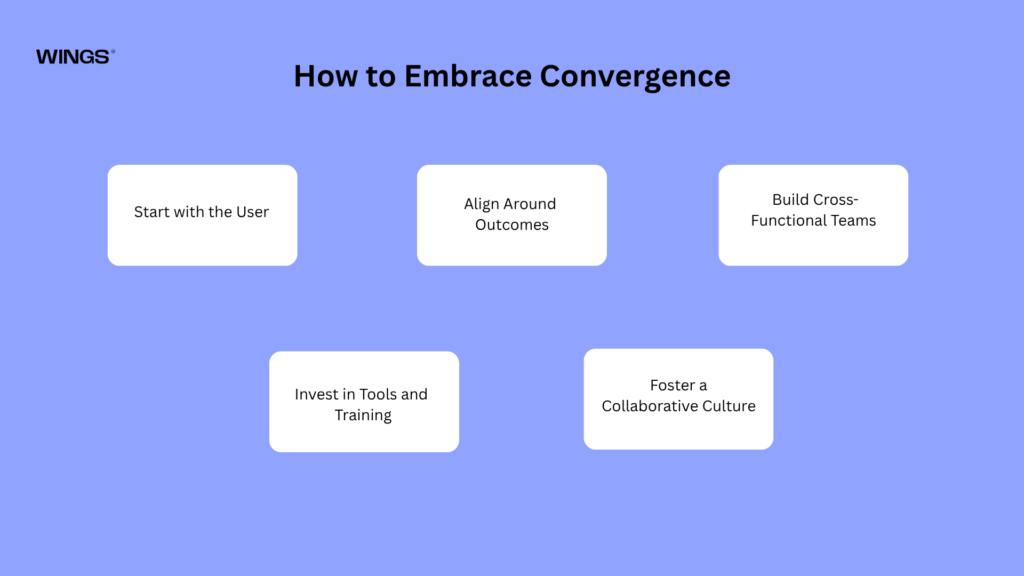
How to Embrace Convergence
01. Start with the User
Anchor every decision in user needs and real-world problems. Understanding user behavior, pain points, and expectations ensures that products are meaningful, usable, and relevant from the start.
02. Align Around Outcomes
Shift focus from outputs to outcomes by defining clear, measurable business goals. This helps teams stay aligned, prioritize effectively, and ensure that every effort contributes to tangible results.
03. Build Cross-Functional Teams
Create teams that bring together design, engineering, product, and data expertise from day one. Early collaboration reduces silos, improves decision-making, and leads to more cohesive solutions.
04. Invest in Tools and Training
Provide teams with the right tools, frameworks, and continuous learning opportunities. This empowers them to work efficiently, stay updated with evolving technologies, and bridge skill gaps across disciplines.
05. Foster a Collaborative Culture
Encourage open communication, experimentation, and shared ownership. A culture that values collaboration and adaptability makes it easier to integrate perspectives and drive innovation.
Conclusion
The convergence of design, technology, and business strategy is no longer optional, it is essential for success. In today’s competitive landscape, where user expectations are constantly rising, organizations must integrate these disciplines to stay relevant and effective.
By aligning user experience, technical capabilities, and business goals, companies can create products that are not only functional but also meaningful and impactful. This integration ensures better decision-making, faster innovation, and stronger market positioning.
Ultimately, organizations that master convergence will go beyond building good products, they will deliver consistent value, foster customer loyalty, and achieve sustainable growth.

Nandin
Design Lead