
This is saying AI in design and development is often misunderstood as just making teams faster, but its real impact is deeper. It doesn’t only improve productivity, it reshapes how organizations allocate “capital” across people, time, and decision-making authority.
Because AI reduces the need for human effort and compresses timelines, the remaining pressure shifts to who gets to make decisions. That’s why leadership discomfort isn’t about speed, it’s about control moving within the organization.
The New Production Model: From Pipeline to Mesh Network
This is contrasting two ways of building software.
In the traditional model, work moves in a straight line, product defines requirements, design interprets them, engineering builds it, QA checks it, and then it ships. Each step waits for the previous one, so delays and handoffs are built in.
The “AI-native” model removes much of that sequential dependency. Instead of a rigid pipeline, work becomes more continuous and parallel: intent is expressed directly, AI systems help translate it into design and code, testing can happen alongside generation, and feedback loops are immediate.
Calling it a “mesh network” means the process is no longer a single chain of custody. Multiple AI-assisted systems and humans are interacting at once, continuously updating artifacts rather than passing them forward stage by stage. The result is less about moving work through departments and more about maintaining a living system that evolves in real time.
What Actually Breaks First: Not Roles, But Dependencies
This is pointing to a less intuitive early effect of AI adoption: the organizational “wiring” breaks before the org chart does.
Instead of people immediately losing roles, the handoff structure between teams starts to dissolve.
In the traditional setup, each function depends on the previous one to translate intent into execution, product hands off to design, design to engineering, engineering to QA. AI reduces the cost and friction of these translations.
So:
- Design no longer needs to wait for engineering to visualize ideas, because systems can generate UI directly from intent or design tokens.
- Engineering and QA become less sequential because code can be tested, validated, and even corrected as it’s generated.
- Product work becomes more direct because prototyping and simulation tools let ideas be tested without full downstream involvement.
The key shift is that coordination costs collapse. That means the “dependencies” that once justified sequential workflows disappear faster than organizational roles can be redefined.
So the real disruption isn’t immediate job replacement, it’s that the architecture of collaboration stops matching the existing org structure, forcing companies to redesign how work flows before they fully redesign who does the work.
The Real Organizational Transformation: Abstraction Moves Upward
This is describing a shift in where “value” sits inside organizations when execution becomes cheap or automated.
In the traditional model, advantage comes from how well people execute. Skilled specialists matter because most work is manual, sequential, and hard to reproduce quickly. That naturally pushes authority upward: leaders decide, teams execute.
In an AI-assisted model, a lot of execution is abstracted away, code, designs, testing, even prototyping can be generated or accelerated. That weakens execution as the primary bottleneck.
So value shifts upstream:
- “Craft quality” matters less because output is easier to produce and iterate
- “Execution skill” becomes less differentiated because AI reduces variance
- “Speed” becomes less about effort and more about system setup
Instead, what becomes scarce is:
- System quality: how well tools, models, workflows, and feedback loops are designed to produce reliable outcomes
- Decision clarity: how precisely intent is defined so AI systems can act without ambiguity
- Constraint design: how boundaries, rules, and guardrails are specified so automated execution stays aligned with goals
The deeper implication is organizational: leadership stops being about approving work and becomes about shaping the environment in which work is generated. The “top” shifts from controlling execution to defining the structure that produces execution.
A Practical Framework: The AI Product Maturity Model
Stage 1: Tool Adoption
- AI is used individually (designers, engineers, PMs experimenting)
- No workflow or org structure changes
- Output acceleration happens locally, not systemically
Core reality:
AI is treated like software feature, not infrastructure
Bottleneck:
No coordination gains, only isolated productivity boosts
Stage 2: Workflow Acceleration
- AI embedded into specific tasks inside existing pipeline
- Examples:
- AI-assisted coding
- AI-generated designs or assets
- AI-supported writing/specs
- Core process still linear (Product → Design → Engineering → QA)
What changes:
- Each stage becomes faster
- Handoffs still exist, but are cheaper
Bottleneck:
Translation overhead between functions remains intact
Stage 3: Process Restructuring
- AI begins to sit inside the workflow, not just within roles
- Partial collapse of handoffs via:
- Prompt-to-prototype systems
- AI-generated UI/code from shared intent layers
- Automated test generation and validation
What changes:
- Some steps disappear entirely
- Teams start working from shared “intent artifacts” instead of static specs
Bottleneck:
Inconsistency between AI-generated outputs and system-wide coherence
Stage 4: System Recomposition (Mesh Organization)
- The linear pipeline breaks down
- Work becomes a network of parallel AI + human agents
- Continuous generation replaces staged delivery
Structure shift:
- From sequence → to mesh
- From roles → to functions (generate, constrain, validate, optimize)
What changes:
- Design, code, and QA happen simultaneously
- Products are continuously regenerated, not passed along
Bottleneck:
System governance (alignment, constraints, reliability)
Stage 5: Adaptive Autonomous Production System
- Organization behaves like a self-adjusting system
- AI agents monitor product behavior and user feedback in real time
- Systems propose and implement changes continuously
Human role:
- Define objectives
- Set constraints
- Govern boundaries and risk
What changes:
- “Shipping” becomes obsolete
- Product becomes a continuously evolving system state
Bottleneck:
Alignment between evolving system behavior and human intent

Explore the design system behind the EVOS.
The Emerging Organizational Unit: The AI-Native Squad
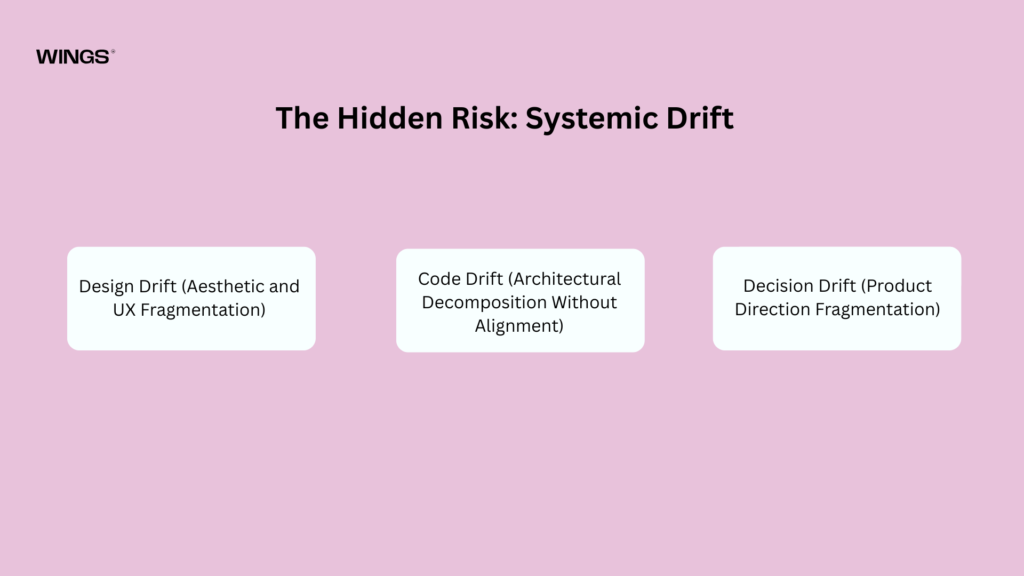
The Hidden Risk: Systemic Drift
What you’re describing, “systemic drift”, is one of the least discussed but most important failure modes in AI-accelerated product development. It’s not that AI “breaks” systems directly. It’s that it increases the rate of variation faster than organizations typically update their constraints, standards, and feedback loops.
So you end up with a widening gap between how fast things are produced and how consistently things are governed.
Let’s unpack each drift and what it really means in practice.
1. Design Drift (Aesthetic and UX Fragmentation)
Design drift happens when UI generation becomes locally optimal but globally inconsistent. With AI-assisted design systems, you might see:
- Slightly different button styles across screens
- Inconsistent spacing rules (“almost Tailwind-like” but not quite)
- Multiple visual languages creeping in (rounded vs sharp, minimal vs expressive)
- Micro-interaction inconsistency (hover, loading, transitions vary per feature)
The key issue isn’t that any single UI is “bad.” It’s that no single system is enforcing coherence across all outputs.
In traditional teams, design systems act as a “central gravity.” In AI-heavy workflows, that gravity weakens unless explicitly reinforced. A subtle but important consequence:
Users don’t perceive individual screens, they perceive the consistency of the system.
Once that breaks, even high-quality UI starts feeling unreliable or “cheap.”
Root cause: generation replaces interpretation of design rules with approximation of design intent.
2. Code Drift (Architectural Decomposition Without Alignment)
Code drift is more dangerous because it accumulates invisibly.
AI-generated code tends to:
- Solve local problems cleanly
- Reintroduce slightly different abstractions for similar problems
- Duplicate patterns instead of reusing shared modules
- Bypass existing architectural boundaries (“just add a quick service” logic)
Over time, you get:
- Multiple competing patterns for state management
- Fragmented API styles across services
- Inconsistent error handling strategies
- Subtle duplication of business logic in different layers
The real problem isn’t technical debt in the traditional sense, it’s accelerated architectural entropy. Instead of one team slowly diverging over months, you now get:
Many parallel “mini-design decisions” being made automatically in hours.
Without strict enforcement (linting, architecture rules, shared libraries, code review discipline), the system stops behaving like a coherent codebase and starts behaving like a collection of plausible implementations.
3. Decision Drift (Product Direction Fragmentation)
This is the most underestimated form.
When AI reduces the cost of ideation, you get:
- More features proposed
- More variants of the same feature explored
- More “why not both?” decisions
- Faster A/B branching of product ideas
At first, this looks like speed and creativity. But the structural risk is: The product stops converging. Instead of a strong, opinionated direction, you get:
- Multiple half-implemented strategies
- Conflicting user journeys
- Feature overlap without prioritization
- A bloated roadmap optimized for exploration, not focus
Decision drift happens when option generation outpaces decision consolidation.
In human-only systems, friction naturally limits this. AI removes that friction, so governance must replace it.
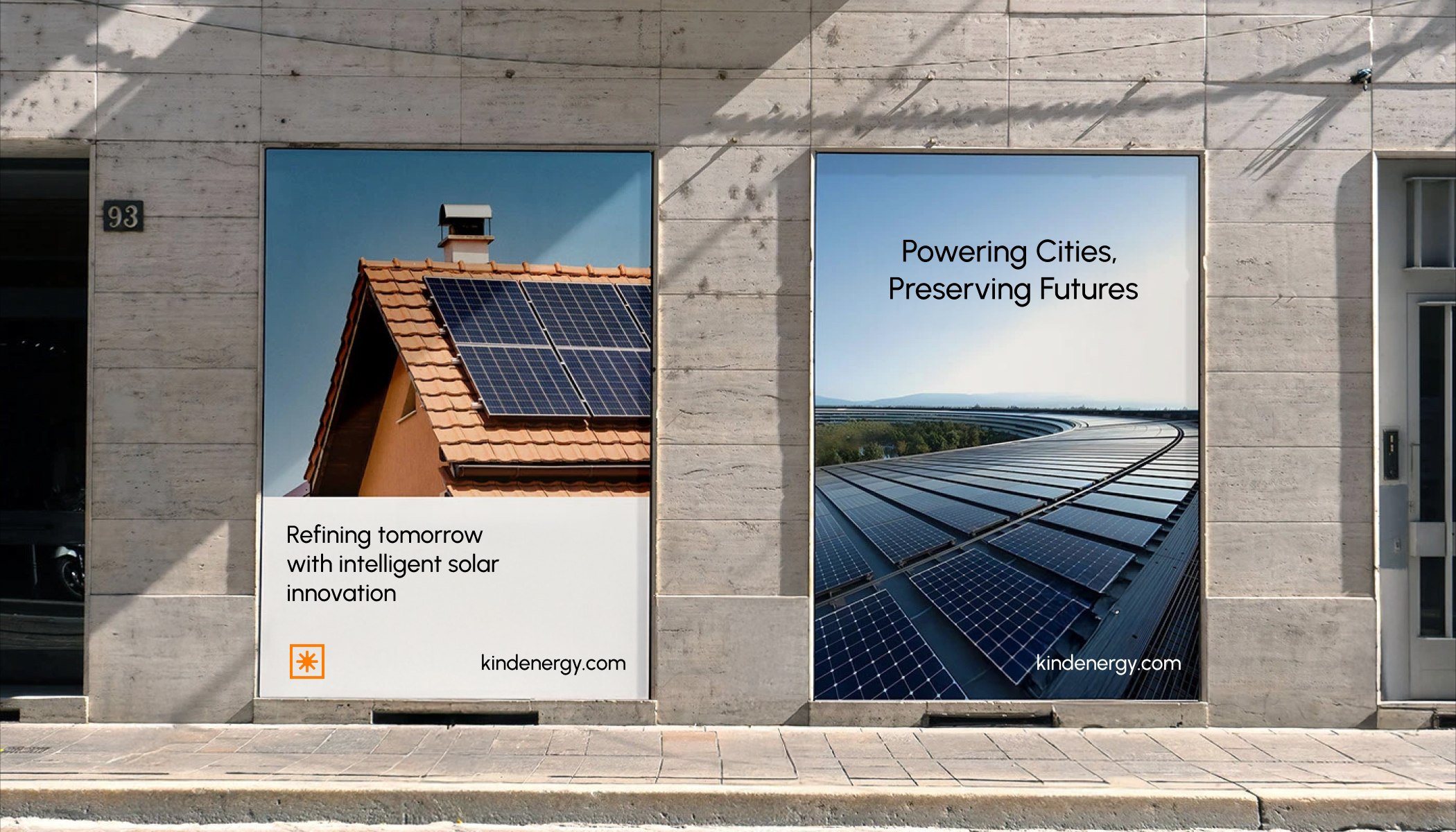
Explore the design system behind the Kind energy.
Conclusion

Vidhya Shree
Senior Visual Designer