

Attention is no longer abundant, it’s scarce, fragmented, and fiercely contested. Every scroll, tap, and pause represents a micro-decision made by users navigating an overwhelming volume of content. This is the attention economy. For brands, creators, and businesses, the challenge has fundamentally shifted. It’s no longer just about creating content, it’s about earning attention in an environment designed to filter, prioritize, and often ignore.
When someone lands on a post, video, or campaign, the window to make an impact is measured in seconds, often milliseconds. Visibility is no longer guaranteed by presence; it must be earned through clarity, relevance, and resonance. This blog is built for decision-makers, marketers, and founders who don’t just want reach, but meaningful visibility that drives engagement, recall, and real business outcomes.
Understanding the Attention Economy
The attention economy operates on a simple principle: human attention is limited, but content is infinite. While the amount of content being created continues to grow exponentially, the time and cognitive capacity people have to consume it remain fixed. This imbalance is what makes attention one of the most valuable and contested resources in the digital world. Every piece of content, whether a post, video, or ad, is competing for a fraction of a user’s focus.
Every platform, whether Instagram, LinkedIn, YouTube, or TikTok, is built around capturing and retaining that attention. Their algorithms are not neutral; they are engineered to maximize user engagement. Content that keeps people watching, interacting, or returning is rewarded with greater visibility, while content that fails to perform is quickly deprioritized.
This shifts the power dynamic. Visibility is no longer controlled solely by the creator or brand, it is influenced, filtered, and amplified by platform systems that respond to user behavior in real time. As a result, the digital environment becomes highly competitive and performance-driven:
- Content is constantly evaluated
Every post is tested the moment it is published. Platforms measure how users respond, how quickly they engage, how long they stay, and whether they interact. Content that performs well gets pushed further; content that doesn’t fades quickly. - Engagement determines distribution
Likes, comments, shares, saves, and watch time are not just metrics, they are signals. These signals tell the algorithm whether your content deserves to reach a wider audience. The stronger the engagement, the broader the distribution. - Relevance determines survival
Content must align with what the audience cares about at that moment. Even high-quality content can fail if it lacks contextual relevance. Timing, trends, and audience intent all play a role in determining whether something resonates.
In this ecosystem, visibility is not evenly distributed, it is earned. It depends on how effectively your content captures attention, sustains interest, and encourages interaction. The better your content performs against these signals, the more the platform amplifies it.
This creates a feedback loop:
Better content → higher engagement → increased reach → more visibility
But the reverse is also true:
Weak content → low engagement → limited reach → reduced visibility
The implication is clear: creating content is no longer enough. To succeed in the attention economy, brands must create content that performs, content that is immediately engaging, consistently relevant, and strategically designed to hold attention. Because in a system where everything is competing for attention, only what resonates gets seen.
Why Visibility Is the New Currency
Visibility today directly translates into opportunity. In a digital ecosystem where attention drives discovery, what gets seen is what gets considered, and what gets considered is what ultimately gets chosen. Visibility is no longer just a marketing outcome; it is a direct driver of business growth. The relationship is straightforward:
- More visibility → higher brand awareness
When your content consistently reaches your audience, familiarity begins to build. People start recognizing your name, your voice, and your presence. - Higher awareness → stronger recall
Repeated exposure creates memory. When a need arises, your brand is more likely to come to mind, not because it was the best option at that moment, but because it was the most familiar. - Stronger recall → increased conversions
Customers rarely choose from all available options, they choose from the few they remember. Visibility ensures you are part of that consideration set.
But here’s the critical shift that many brands overlook: Not all visibility is valuable. In the race for reach, it’s easy to confuse attention with impact. However, visibility without relevance does not create long-term value.
- Viral content without relevance does not build a brand
A post may generate millions of views, but if it doesn’t connect to what your brand stands for, it creates awareness without association. People remember the content, but not you. - High impressions without engagement do not create impact
Being seen is not the same as being understood or valued. If audiences scroll past without interacting, the visibility remains superficial and short-lived. - Broad reach without the right audience weakens outcomes
Reaching everyone often means resonating with no one. Visibility becomes diluted when it is not targeted or intentional.
This leads to a more important realization: The goal is not to be seen by everyone, it’s to be remembered by the right audience. Meaningful visibility is focused. It ensures that the people who matter most to your business not only see your content but connect with it, engage with it, and recall it when it counts. In the attention economy, visibility is currency, but relevance determines its value.
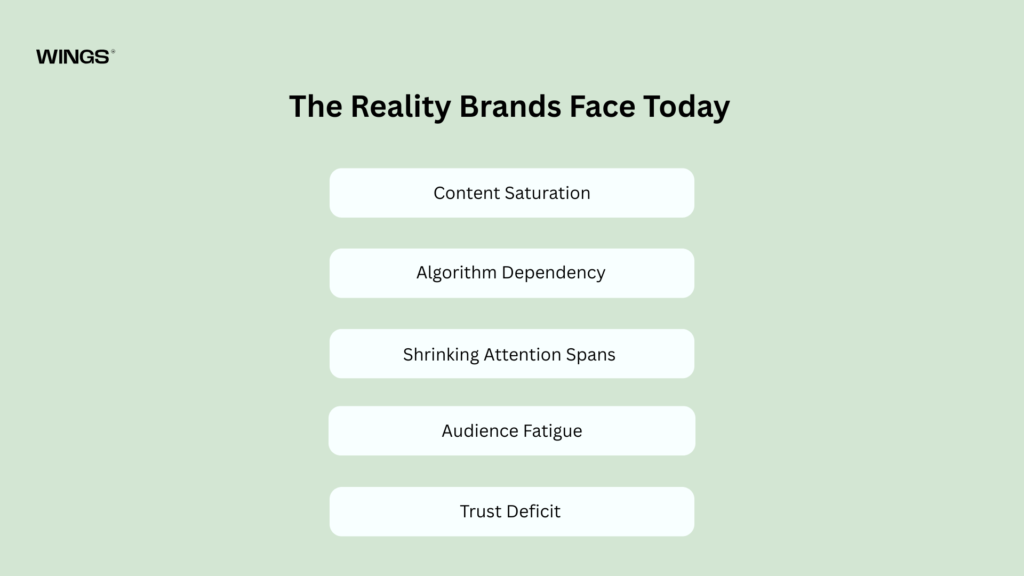
The Reality Brands Face Today
Before diving into strategy, it’s important to acknowledge the environment brands are actually operating in. Visibility challenges don’t exist in isolation, they are shaped by systemic shifts in how content is created, distributed, and consumed. Without recognizing these conditions, even the best strategies risk being ineffective or misaligned.
01. Content Saturation
The volume of content being produced today is unprecedented. Every minute, thousands of posts, videos, and campaigns are published across platforms. This creates an environment where even high-quality content struggles to stand out.
Quality alone is no longer a differentiator, it is the baseline. Without strong hooks, clear positioning, and intentional distribution, content gets lost in the noise. Visibility is not just about creating better content, but about making that content immediately noticeable.
02. Algorithm Dependency
Control over visibility has shifted significantly. It no longer rests entirely with brands or creators, platform algorithms now act as gatekeepers.These systems determine what gets seen based on engagement signals such as watch time, interactions, and relevance.
As a result, content is constantly being filtered and ranked in real time.This means brands must not only create content for their audience, but also design it to perform within algorithmic systems. Ignoring this reality limits reach, regardless of content quality.
03. Shrinking Attention Spans
User behavior has evolved. People scroll faster, process information quicker, and make decisions almost instantly.This creates a narrow window to capture attention. If content does not communicate value within the first few seconds, it is skipped, often without a second thought.
The margin for error is extremely small. Every element, from the opening line to the visual framing, must work harder to earn even a moment of attention.
04. Audience Fatigue
Audiences are exposed to repetitive formats, recycled ideas, and overused trends. What once felt fresh quickly becomes predictable. As a result, engagement declines, not necessarily because the content is poor, but because it feels familiar and uninspiring.
Users develop a natural resistance to anything that looks or sounds like what they’ve already seen multiple times.Standing out requires not just participation in trends, but thoughtful execution and originality.
05. Trust Deficit
Modern audiences are more informed, and more skeptical. They have seen exaggerated claims, polished marketing language, and surface-level content across countless brands. This has led to a decline in trust. Content that feels overly promotional, vague, or inauthentic is quickly dismissed.
Instead, users respond to clarity, honesty, and tangible value. They look for content that feels real, specific, and relevant to their needs. Understanding this environment is critical. These are not temporary challenges, they are defining characteristics of the attention economy. Without grounding strategy in this reality, brands risk creating content that is technically sound but practically invisible.
The Psychology Behind Attention
Attention is not random, it is driven by human psychology. In fast-moving digital environments, people don’t consciously decide what to engage with. Their brains rely on quick, instinctive filters to determine what is worth a moment of focus. These filters are shaped by relevance, emotion, and perceived usefulness. People stop scrolling when something:
- Feels relevant
- Triggers curiosity
- Evokes emotion
- Solves a problem
- Challenges an assumption
At its core, attention is a response to perceived value, not actual value. This distinction is critical. Your content may be insightful and high-quality, but if that value isn’t immediately clear, it won’t get a chance to be experienced.
If your content does not signal value instantly, it gets ignored, regardless of how good it actually is. In the attention economy, success depends not just on what you say, but on how quickly you make it matter.
The Pillars of Social Media Visibility
To consistently win attention, brands need more than creativity, they need structure. Visibility is not accidental; it is built through a repeatable system that aligns how content attracts, delivers, and amplifies value. At its core, effective social media visibility rests on three interconnected pillars:
01. Hook: Earning the First Second
The hook is the most critical part of your content. It determines whether someone stops scrolling or moves on instantly. In crowded feeds, users don’t discover content, they decide on it within seconds. The hook is what earns that decision. Strong hooks typically take the form of:
- A bold statement that challenges expectations
- A surprising statistic that creates instant intrigue
- A relatable problem that reflects the audience’s reality
- A visual disruption that breaks scrolling patterns
The goal is simple: create immediate curiosity or relevance.
The difference is not just wording, it’s positioning. One is generic, the other is specific and curiosity-driven. The second creates a reason to pause. A weak hook doesn’t reduce performance, it eliminates it. If attention is not captured upfront, the rest of the content never gets a chance.
02. Value: Holding Attention
Capturing attention is only the first step. The real challenge is sustaining it.Once someone engages, the content must deliver value quickly and clearly. Delayed or diluted value leads to drop-off. Value can take multiple forms:
- Insights that shift perspective
- Clarity that simplifies complexity
- Practical takeaways that can be applied immediately
- Entertainment that keeps the experience engaging
The key is alignment, your content must deliver on the promise made by the hook. If the opening creates curiosity but the content fails to satisfy it, trust is lost.
In high-performing content, value is not hidden or stretched, it is front-loaded. Users should feel within seconds that their time is being well spent. If the audience feels they are not gaining anything, they disengage, often without hesitation.
03. Retention & Engagement: Extending Reach
Even strong content has limited impact without distribution. This is where retention and engagement play a critical role. Platforms prioritize content that demonstrates user interest through measurable behavior. This includes:
- Completion rates (how much of the content is consumed)
- Watch time (how long users stay engaged)
- Interactions (likes, comments, shares, saves)
- Active participation (responses, clicks, replies)
These signals tell the algorithm that your content is valuable, prompting it to push that content to a wider audience. Engagement is not just an outcome, it is a growth mechanism.Content that encourages interaction naturally performs better. This can be achieved by:
- Asking questions
- Inviting opinions
- Creating relatable scenarios
- Prompting discussion
Without engagement, even well-crafted content remains limited in reach. With it, content gains momentum and visibility compounds.
These three pillars, Hook, Value, and Retention, do not operate independently. They reinforce each other.A strong hook brings people in. Clear value keeps them engaged. Retention and interaction push the content further. When aligned, they transform content from something that is simply posted into something that performs, scales, and sustains visibility in the attention economy.
Platform Dynamics and Algorithm Realities
Each platform operates differently, but the core principle remains the same:
Engagement drives visibility. Whether it’s Instagram, LinkedIn, YouTube, or TikTok, algorithms are designed with a single goal, to keep users on the platform for as long as possible. Content that contributes to this goal is rewarded with greater reach, while content that doesn’t is quickly deprioritized.
This means visibility is no longer just about what you post, it’s about how your content performs in real time.
Key Factors Influencing Reach
- Watch time
The longer users stay on your content, the stronger the signal that it is valuable. High watch time often leads to increased distribution. - Interaction rate
Likes, comments, shares, and saves indicate active engagement. These actions signal that users find the content worth responding to. - Content relevance
Algorithms analyze user behavior to determine what content is most relevant to them. If your content aligns with audience interests, it is more likely to be shown. - Posting consistency
Regular posting builds credibility with the algorithm. It signals that you are an active contributor, increasing the likelihood of your content being surfaced.
These factors work together to determine how far your content travels. Strong performance in one area can help, but sustained visibility comes from balancing all of them.
What This Means in Practice
- Strong openings matter more than ever
The first few seconds determine whether users stay or leave. Early drop-offs reduce reach significantly. - Retention is critical
Keeping users engaged throughout the content directly impacts how widely it is distributed. - Engagement is non-negotiable
Without interaction, content rarely scales, regardless of how well it is produced.
In this system, content is constantly being tested. Performance is not judged once, it is evaluated continuously as more users interact with it.
The Role of Consistency and Timing
Visibility is not built through a single viral post, it is built through repetition, reinforcement, and sustained presence.
Consistency
Consistency plays a foundational role in long-term visibility:
- Builds familiarity
Repeated exposure helps audiences recognize and remember your brand. - Improves algorithm trust
Platforms are more likely to distribute content from accounts that post regularly and perform consistently. - Strengthens brand recall
The more frequently users encounter your content, the more likely they are to remember you when it matters.
Consistency is not just about frequency, it’s about showing up with clarity and intent over time. It means every piece of content reinforces the same message, positioning, and value your brand stands for. Instead of posting just to stay active, each interaction should contribute to a larger, cohesive narrative. Over time, this alignment builds recognition, trust, and a stronger connection with your audience.
Timing
Even strong content can underperform if it reaches the audience at the wrong moment.
- Ensures content reaches active audiences
Posting when your audience is online increases the likelihood of immediate engagement. - Improves initial engagement
Early interactions are critical. They act as the first signal to the algorithm that your content is worth amplifying.
Timing influences momentum. A strong start often determines whether content scales or stalls. The key insight is simple: Consistency compounds, while inconsistency resets momentum. Brands that show up regularly, deliver value consistently, and align with platform dynamics don’t just gain visibility, they sustain it.
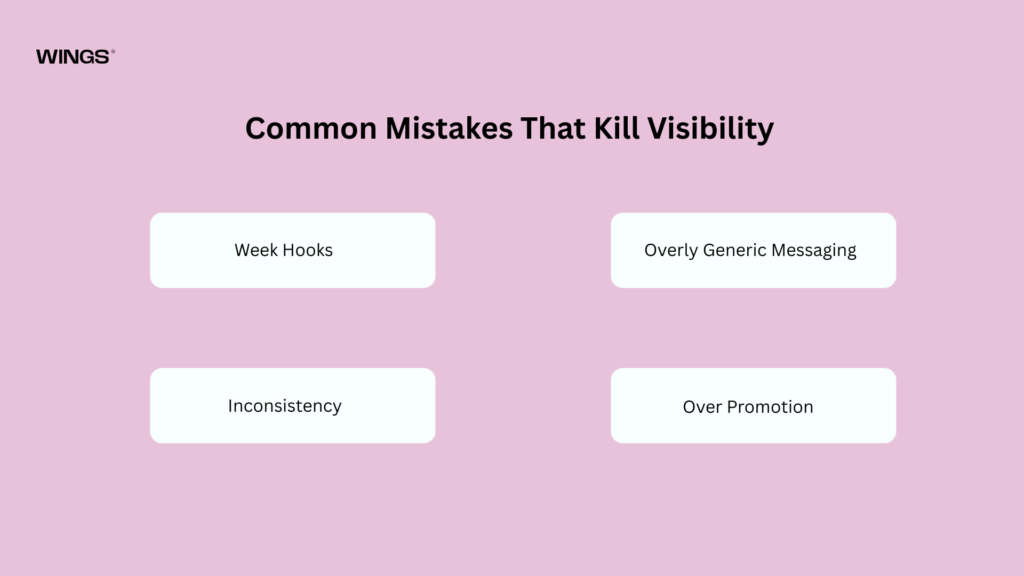
Common Mistakes That Kill Visibility
Even well intentioned content efforts fail, not because of lack of effort, but because of fundamental missteps that weaken impact from the start. In a fast moving attention economy, small mistakes can significantly reduce reach, engagement, and overall effectiveness.
01. Weak Hooks
If the first few seconds fail, the content fails. In crowded feeds, users decide instantly whether to engage or scroll past. A weak or generic opening gives them no reason to stay. Without a strong hook, even valuable content goes unseen because it never earns that initial pause.
02. Overly Generic Messaging
Content that sounds like everyone else is ignored. When messaging is vague or interchangeable, it blends into the noise. Audiences have seen the same phrases, ideas, and formats repeated across countless posts. Without specificity or a unique angle, content becomes forgettable regardless of intent or quality.
03. Inconsistency
Irregular posting breaks audience engagement patterns. Visibility is built through repetition and familiarity. When content is posted inconsistently, it disrupts audience expectations and weakens algorithm momentum. Each gap resets progress, making it harder to build sustained reach and recognition.
04. Over Promotion
Content focused only on selling reduces trust. Audiences do not engage with content that feels like constant advertising. When every post pushes a product or service, it creates resistance and fatigue. Without delivering value first, promotional content is often ignored or avoided.
Avoiding these mistakes is not about perfection, it is about awareness. When brands recognize what weakens visibility, they can shift their focus toward what actually drives it clarity, relevance, consistency, and value.
A Practical Framework to Win Attention
To make visibility actionable, brands need more than ideas, they need a structured approach that can be consistently applied. Winning attention is not a one-time effort; it’s an ongoing process of understanding, creating, testing, and refining.
Step 1: Define Your Audience Clearly
Know exactly who you are speaking to. The more specific your audience, the stronger your content will resonate. Broad targeting may increase reach, but it weakens relevance and reduces impact.
Step 2: Identify Core Content Themes
Focus on 3 to 5 key themes that align with your audience’s interests and your brand’s expertise. This creates consistency in messaging and helps build a recognizable content identity over time.
Step 3: Create Hook First Content
Start with attention, not explanation. Design your content around a strong opening that immediately captures interest. If the first few seconds fail, the rest of the content will not be seen.
Step 4: Deliver Immediate Value
Avoid long build ups or unnecessary context. Get to the point quickly and deliver insights, clarity, or solutions early. The faster users see value, the more likely they are to stay engaged.
Step 5: Optimize for Engagement
Create content that invites interaction. Ask questions, encourage opinions, and share insights that people want to respond to or pass along. Engagement is what extends reach beyond your immediate audience.
Step 6: Analyze and Iterate
Track what works and what does not. Pay attention to engagement patterns, retention, and audience response. Use these insights to refine your approach continuously rather than relying on assumptions.
This framework turns content creation from a random effort into a deliberate system. When applied consistently, it helps brands move from chasing attention to earning it predictably.
Measuring What Actually Matters
Visibility without measurement is just an assumption. In the attention economy, where content is constantly competing for limited focus, brands cannot rely on surface-level signals to understand performance. What matters is not just whether content is seen, but whether it creates meaningful engagement, sustained attention, and measurable outcomes.
To evaluate visibility effectively, brands need to shift from vanity metrics to performance indicators that reflect real audience behavior and business impact.
01. Engagement Rate
Engagement rate reflects how relevant your content is to your audience. It measures actions such as likes, comments, saves, and shares relative to reach or impressions. While simple on the surface, it is one of the strongest indicators of content resonance. High engagement suggests that:
- The content felt relevant to the audience
- The message was clear enough to trigger interaction
- The audience was motivated to respond, not just consume
Low engagement, on the other hand, often signals a mismatch between content and audience expectations, even if impressions are high. Engagement is not just a metric, it is a reflection of emotional and cognitive connection.
02. Watch Time / Retention
Watch time and retention measure how long your content holds attention once it is discovered. This is one of the most critical signals for platform algorithms and audience value alike. High retention indicates:
- The hook successfully captured attention
- The content maintained interest throughout
- The message delivered on its promise
Low retention often reveals structural issues such as weak openings, slow pacing, or unclear value delivery. In many cases, retention is more important than reach, because attention that is not sustained has no lasting impact.
03. Shareability
Shareability reflects how valuable your content feels to the audience. When people share content, they are effectively endorsing it. They are signaling that the content is useful, insightful, relatable, or worth someone else’s attention. High shareability usually indicates:
- Strong emotional resonance
- High informational value
- Clear and relatable insights
- Content that reinforces identity or beliefs
Unlike passive views, shares extend your reach beyond your existing audience, creating organic amplification loops. In many cases, shareability is one of the strongest indicators of true content impact.
04. Follower Growth
Follower growth measures long-term interest in your content and brand. While not every follower represents deep engagement, consistent growth indicates that your content is successfully converting attention into ongoing interest. Sustainable follower growth suggests:
- Your content consistently delivers value
- Your positioning is clear and recognizable
- Your audience sees long-term relevance in what you share
However, growth alone is not meaningful unless it is paired with engagement quality. A large but inactive audience has limited value in the attention economy.
05. Conversion Signals
Conversion signals connect visibility directly to business outcomes.These include actions such as:
- Website clicks
- Sign-ups or registrations
- Inquiries or leads
- Product purchases
Unlike engagement metrics, conversions reflect intent and decision-making. They show whether attention is translating into action. Strong visibility should ultimately lead to conversions, otherwise it remains a surface-level performance indicator without business impact.
Beyond Metrics: Understanding Context
Metrics in isolation can be misleading. A post with high engagement but low retention may indicate curiosity without sustained value. Similarly, high reach with low conversions may suggest visibility without relevance.
This is why context matters as much as numbers. Effective measurement requires understanding how these signals work together rather than independently.
Vanity Metrics vs Meaningful Metrics
Vanity metrics such as impressions, likes without context, or follower counts can create a false sense of success. They are easy to track but often fail to reflect real influence or business impact.
Meaningful metrics, on the other hand, answer deeper questions:
- Did the content hold attention?
- Did it create understanding or emotion?
- Did it influence behavior or decisions?
The difference is crucial. One measures exposure, the other measures effectiveness.
Ultimately, measuring what actually matters is about clarity of insight. It shifts focus from “how many saw this” to “how well did this perform in earning and sustaining attention.”
In the attention economy, visibility is only valuable when it can be understood, evaluated, and translated into meaningful outcomes.
The Future of Attention
The attention economy will only become more competitive, not less. As digital spaces continue to expand, the supply of content will grow faster than the capacity of human attention, making visibility harder to earn and easier to lose.
In this environment, attention will increasingly be shaped by systems, behavior, and trust signals rather than simple exposure or frequency. Brands will need to adapt not just to audiences, but to evolving platform logic and cultural expectations.

Explore how social media relates to the concept of dimension.
Key Trends Shaping the Future
Increased personalization
Content consumption will become deeply individualized. Two users on the same platform may experience entirely different feeds based on their behavior, interests, and past interactions. This reduces the effectiveness of broad messaging and increases the importance of precision targeting.
AI driven content recommendations
Algorithms will become more predictive, not just reactive. Instead of responding to what users engage with, platforms will increasingly anticipate what they are likely to want next. This raises the bar for relevance, as content must align with dynamic, real time behavioral patterns rather than static interests.
Higher demand for authenticity
As content becomes easier to generate and replicate, audiences will become more sensitive to what feels genuine. Over polished, repetitive, or overly promotional content will lose effectiveness. Real experiences, clear intent, and transparent communication will stand out more strongly.
Shorter content formats dominating
Attention spans will continue to shrink in practice, even if not in theory. Users will increasingly favor content that delivers value quickly, clearly, and without friction. This does not eliminate long form content, but it forces it to earn attention from the very first second.
The Strategic Shift Ahead
In this evolving landscape, success will depend less on production volume and more on communication precision and audience alignment. Three principles will define what performs best:
- Clarity will outperform complexity
Simple, direct communication will consistently outperform layered or abstract messaging. If content cannot be understood instantly, it will be ignored instantly. - Relevance will outperform reach
Reaching a smaller, highly aligned audience will generate stronger outcomes than broad visibility without connection. Precision will matter more than scale. - Trust will outperform virality
Viral moments may create temporary spikes in attention, but trust determines long term influence. Audiences will increasingly favor brands that feel consistent, credible, and dependable over time.
The Direction of Attention
The future of attention is not defined by louder messaging, but by smarter positioning. As competition intensifies and algorithms evolve, one truth becomes more important than ever: Attention is no longer captured by chance. It is earned through clarity, sustained through relevance, and secured through trust.
Conclusion
Winning in the attention economy is not about creating more content, it’s about creating better, sharper, and more relevant content that actually earns a place in the user’s mind. Visibility is not a volume game. It is a precision game where success depends on how clearly your message cuts through noise, how quickly it is understood, and how strongly it connects with what the audience already cares about. The brands that succeed are those that:
- Understand their audience deeply, going beyond basic demographics to uncover real motivations, emotional triggers, decision making patterns, and unmet needs. This depth allows them to create content that feels personal, timely, and relevant instead of generic or interchangeable
- Communicate clearly, removing friction from their messaging so that value is immediately obvious. They avoid complexity, ambiguity, and unnecessary explanation, ensuring that their ideas can be understood within seconds rather than requiring effort to decode
- Deliver value consistently, showing up repeatedly with content that reinforces trust, strengthens positioning, and provides meaningful insight or utility. Consistency builds familiarity, and familiarity builds preference over time
Because in the end, attention is earned, not given. It is the result of repeated relevance, not occasional visibility. It is built through trust, not tactics, and strengthened through clarity, not volume. And those who earn it consistently don’t just get seen, they get chosen, remembered, and preferred when decisions are actually made.

Aakash
Digital Marketing Manager