


Market saturation is no longer an exception; it is the default across most industries. As products and services increasingly converge, leaders face a core challenge: how to stand out when functional differences are minimal.
Differentiation in such environments does not come from adding features or increasing marketing noise. It requires clear, deliberate positioning choices that define who the brand serves, what it stands for, and why it matters. These choices must be consistently executed across the organization to shape customer perception.
The companies that win are not those with the most to offer, but those with the clearest and most compelling point of view.
Market Reality & Context
A saturated market today is defined by three structural characteristics: rapid feature parity, where innovations are quickly replicated; intense competition, driven by low barriers to entry; and customer fatigue, as buyers face overwhelming choice and rely on quick mental shortcuts.
01. Feature Parity
Technological diffusion has compressed innovation cycles to the point where competitive advantages are short-lived. What once differentiated a product quickly becomes an expected standard, forcing brands to compete beyond features and shift focus toward perception, experience, and positioning.
02. Hyper-competition
Lower barriers to entry have intensified competitive pressure across industries. Digital-first challengers enter rapidly, often leveraging aggressive pricing or highly focused niche strategies, making it harder for established players to defend market share through scale alone.
03. Customer Fatigue
An abundance of options has overwhelmed customers, reducing their willingness to evaluate choices in depth. As a result, decision-making shifts from rational comparison to cognitive shortcuts such as brand perception, trust, and perceived relevance.
In categories like streaming, food delivery, or D2C brands, consumers rarely evaluate every available option. Instead, they gravitate toward a small set of brands that are familiar and easily recalled at the moment of decision.
This makes mental availability the true competitive battleground, brands that are top-of-mind are far more likely to be chosen, regardless of how many alternatives exist in the market.
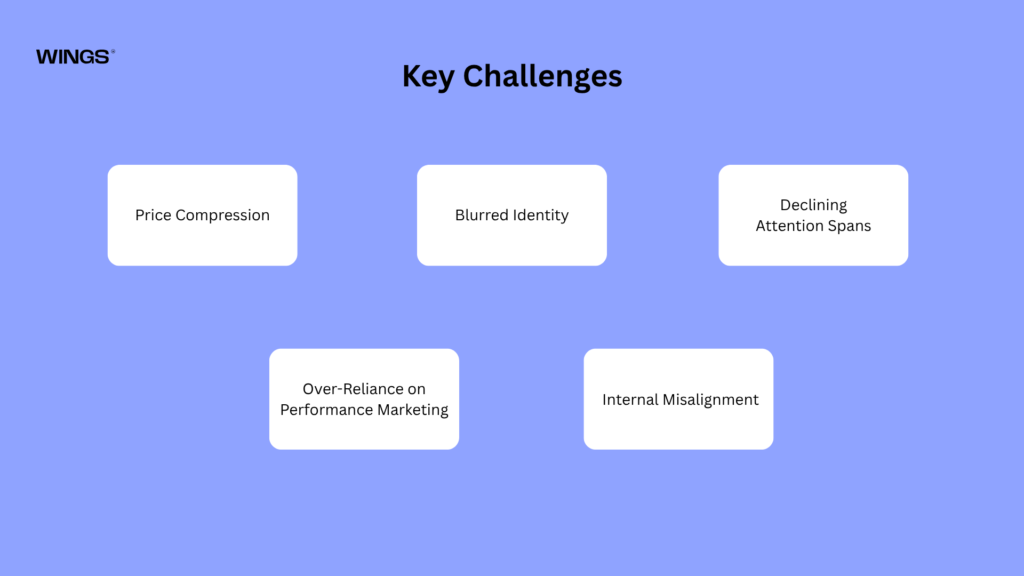
Key Challenges
01. Price Compression
In the absence of clear differentiation, pricing becomes the default competitive lever. While discounting can drive short-term volume, it steadily erodes margins and weakens perceived value. Over time, brands risk being trapped in a cycle where customers associate them primarily with low cost rather than distinct value making it increasingly difficult to command premium pricing or invest in long-term growth.
02. Blurred Identity
Many brands attempt to broaden their appeal by targeting multiple segments simultaneously. The result is often diluted messaging and a lack of clear identity. When a brand tries to stand for everything, it ultimately stands for nothing. This lack of focus reduces memorability, weakens emotional connection, and makes it harder for customers to understand why they should choose one brand over another.
03. Declining Attention Spans
Modern consumers operate in a high-noise, high-speed environment where attention is limited and fragmented. This makes it difficult to communicate complex or layered value propositions effectively. Brands must compete not just for preference, but for attention itself, requiring sharper messaging, faster clarity, and more intuitive communication of value.
04. Over-Reliance on Performance Marketing
Performance marketing channels can generate immediate results, but they often compensate for weak positioning rather than solving it. Over time, this creates a dependency on paid acquisition, increasing customer acquisition costs while failing to build brand equity or loyalty. Without strong positioning, growth becomes expensive, unsustainable, and vulnerable to competitive bidding pressures.
05. Internal Misalignment
A less visible but critical challenge is the lack of alignment within the organization. When leadership teams, product units, and marketing functions do not share a unified understanding of the brand’s positioning, execution becomes inconsistent. This leads to fragmented customer experiences, conflicting messages, and missed opportunities to reinforce a coherent brand identity. Strong positioning requires internal clarity before it can achieve external impact.
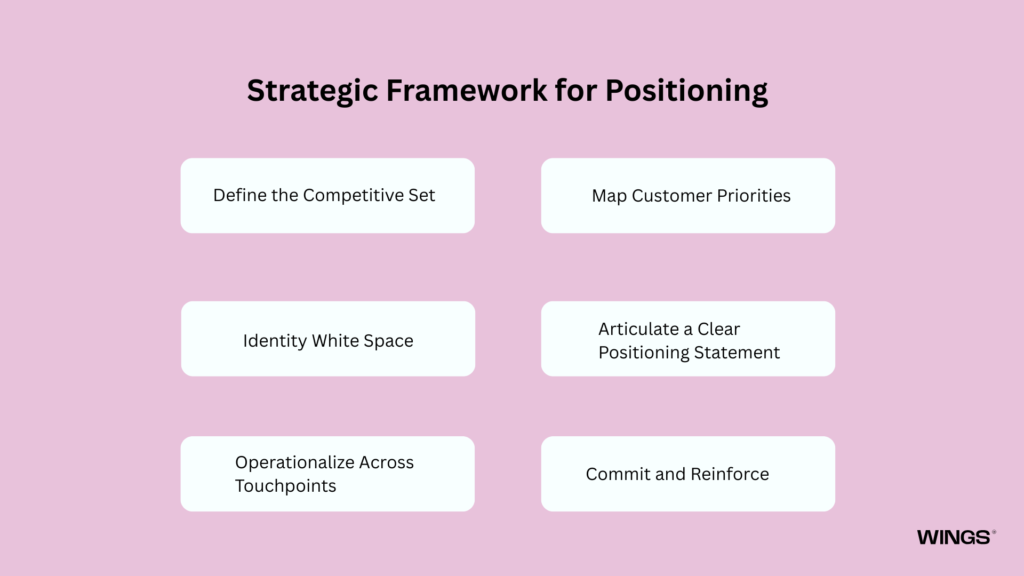
Strategic Framework for Positioning
Effective positioning is not a slogan, it is a strategic system that guides decisions across the business. It requires clarity, discipline, and consistency to translate intent into sustained market advantage. Below is a practical framework for decision makers:
Step 1: Define the Competitive Set
Positioning begins with understanding the true scope of competition. This goes beyond direct competitors to include perceived alternatives, the options customers consider when solving the same problem. These may include substitutes, adjacent categories, or even the choice to do nothing. A narrow view of competition leads to blind spots and weak differentiation.
Step 2: Map Customer Priorities
Not all value drivers are equal. Leaders must identify what actually influences customer decisions across three dimensions:
Functional value such as price, quality, convenience, and features
Emotional value such as trust, confidence, ease, and identity
Social value such as status, belonging, and signaling
In saturated markets, emotional and social drivers often outweigh functional ones. Understanding this hierarchy is critical to shaping positioning that resonates.
Step 3: Identify White Space
Differentiation emerges from identifying meaningful gaps in the market. This requires analyzing where customer needs are underserved or overlooked and where competitors are clustered around similar claims or messages.
The goal is not just to be different, but to be distinct in a way that customers care about and competitors cannot easily replicate.
Step 4: Articulate a Clear Positioning Statement
A strong positioning statement provides strategic clarity and internal alignment. It should clearly define who it is for, what problem it solves, why it is different, and why it should be believed.
This becomes the foundation for all communication and decision making.
Step 5: Operationalize Across Touchpoints
Positioning must move beyond theory into execution. It should shape product decisions, customer experience, pricing strategy, and messaging.
If positioning does not influence these areas, it remains superficial and disconnected from real business impact.
Step 6: Commit and Reinforce
Consistency is what turns positioning into perception. Repeated and aligned signals across touchpoints build recognition, trust, and memory.
Frequent shifts in positioning dilute impact and reset customer understanding. Sustained reinforcement over time is what embeds a brand in the customer’s mind.
Differentiation Levers
01. Value Proposition Innovation
In saturated markets, competing on features alone leads to diminishing returns. Leading brands shift toward outcome based differentiation, focusing on the tangible impact they create for customers. This reframes the conversation from what the product does to what the customer achieves.
For example, instead of promoting software features, high-performing brands emphasize outcomes such as time saved, risk reduced, or revenue increased. This approach strengthens perceived value and makes differentiation more meaningful.
02. Brand Storytelling
Narrative transforms a product from a utility into something customers can relate to and identify with. Strong storytelling builds emotional connection, which is often more durable than functional advantage.
Nike exemplifies this by positioning itself around aspiration, performance, and personal achievement. It does not simply sell shoes, it sells a mindset, reinforced consistently through its “Just Do It” ethos.
03. Customer Experience Design
Customer experience is one of the most defensible forms of differentiation because it is difficult to replicate in its entirety. It spans every interaction, from discovery to post purchase engagement.
Apple has built a strong competitive position by delivering a seamless and integrated experience across devices, software, and retail environments. This consistency creates a perception of quality that extends beyond individual products.
04. Niche Targeting
Focusing on a well defined segment allows brands to build depth before expanding breadth. By addressing specific needs with precision, companies can establish strong relevance and credibility within a target audience.
Notion initially concentrated on creators and startup teams, tailoring its product and messaging to their workflows. This focused approach enabled strong adoption before scaling into broader enterprise use cases.
05. Pricing Strategy as Positioning
Pricing is not just a financial decision, it is a signal that shapes perception. It communicates where a brand sits in the market and what customers should expect from it.
Premium pricing can signal exclusivity and superior quality, while disruptive pricing can communicate accessibility and scale. Tesla strategically used premium pricing in its early stages to position itself as an innovative and aspirational brand, before gradually expanding toward more accessible segments.
Together, these levers provide multiple pathways to differentiation. The most effective strategies do not rely on a single lever, but combine them in a way that reinforces a clear and cohesive positioning.
Data & Insights
Empirical evidence reinforces the strategic importance of strong positioning in saturated markets. Studies indicate that over 60 percent of consumers prefer brands that align with their personal values, highlighting the growing role of emotional and identity based differentiation in purchase decisions.
Research from McKinsey shows that companies with clearly differentiated brands can command price premiums in the range of 13 to 18 percent. This demonstrates that effective positioning does not just influence perception, it directly impacts pricing power and profitability.
Similarly, Nielsen data consistently ranks brand trust among the top three drivers of purchase across categories. In environments where functional differences are minimal, trust becomes a decisive factor in reducing perceived risk and accelerating decision making.
The implication is clear. Differentiation is not a cosmetic branding exercise, it is a measurable business lever that drives revenue, margin, and long term competitive advantage.

Explore the Branding behind the Quint.
Actionable Recommendations
01. Conduct a Positioning Audit
Start by evaluating how your brand is actually perceived in the market, not how it is intended to be perceived. This requires gathering direct customer insights and comparing them against competitor positioning. The goal is to identify whether your messaging is truly distinct or easily interchangeable with others in the category.
A rigorous audit often reveals gaps between internal assumptions and external reality, which is critical for refining strategy.
02. Narrow Your Focus
Clarity comes from focus. Define a primary audience and commit to a single, dominant value proposition that matters most to them. Attempting to address multiple segments or communicate multiple benefits simultaneously weakens impact.
Strong positioning is not about covering more ground, it is about owning a specific space in the customer’s mind.
03. Align Leadership
Positioning must be driven from the top. Ensure that leadership teams are aligned on the target market, key trade-offs, and long term direction of the brand.
Without this alignment, different functions will interpret positioning differently, leading to inconsistent execution and diluted market perception.
04. Redesign Key Touchpoints
Positioning becomes meaningful only when it is reflected in execution. Translate your strategic positioning into critical customer touchpoints such as website messaging, sales narratives, and product experience.
Every interaction should reinforce the same core idea, making the brand easier to understand and remember.
05. Measure Perception, Not Just Performance
Traditional performance metrics such as conversions and acquisition costs provide only a partial view. To assess the strength of your positioning, track perception-based indicators like brand recall, customer sentiment, and perceived differentiation.
These metrics act as leading indicators of long term growth, helping ensure that short term performance does not come at the expense of strategic clarity.
Common Mistakes to Avoid
01. We Serve Everyone
Broad targeting may seem like a path to larger market share, but in reality, it weakens positioning. When a brand tries to appeal to everyone, it loses specificity and fails to resonate deeply with any one segment. Strong brands are defined by who they choose not to serve as much as who they do.
02. Confusing Features with Differentiation
Features are often mistaken for competitive advantage, but they are rarely sustainable. Competitors can quickly replicate functionality, especially in fast-moving markets. True differentiation lies in how customers perceive value, not just in what the product does.
03. Constant Repositioning
Frequent shifts in positioning dilute brand memory and create confusion in the market. Each change resets customer understanding, making it harder to build recognition and trust over time. Effective positioning requires consistency and patience, not constant reinvention.
04. Ignoring Internal Adoption
Positioning is not just an external message, it must be understood and embraced internally. If employees, especially in sales, product, and customer-facing roles, do not clearly understand what the brand stands for, execution becomes inconsistent. Internal clarity is essential for delivering a coherent external experience.
05. Competing Only on Price
Relying primarily on price as a differentiator leads to a race to the bottom unless supported by a structural cost advantage. It weakens brand equity and limits the ability to invest in innovation or experience. Sustainable growth requires competing on perceived value, not just affordability.

Explore the Branding behind the Hungry Rhino.
Conclusion: Strategic Takeaways
In saturated markets, the fundamental question is not whether a brand is different, but whether that difference is clear, relevant, and consistently reinforced in the minds of customers. Many organizations have distinctions on paper, but only a few manage to translate them into durable market perception.
The reality is that positioning advantage does not come from complexity or abundance of messaging. It comes from disciplined simplicity and repetition over time. When markets are crowded, cognitive ease becomes a competitive advantage, customers choose what they can understand quickly and trust instinctively.
Three enduring principles define strong positioning:
- Clarity beats complexity: Simple, sharp positioning is easier to remember, communicate, and scale across teams.
- Focus beats breadth: Depth in a specific segment or value proposition creates stronger relevance than diluted mass appeal.
- Consistency beats novelty: Repetition builds memory structures, while constant change weakens brand equity.
Ultimately, the brands that lead in crowded markets are not those that attempt to outperform competitors across every dimension. They are the ones that make deliberate strategic choices, commit to a clear position, and reinforce it relentlessly across every touchpoint.
Looking forward, as markets become increasingly saturated and consumer attention becomes even more fragmented, positioning will evolve beyond a marketing function. It will become a core strategic discipline, shaping not only how a brand communicates, but how it competes, prioritizes, and creates long-term value.

Akshita Shivani Sundar
Senior Graphic Designer