


Understanding React
React is a declarative, component-based JavaScript library used to build interactive and dynamic user interfaces. Instead of directly manipulating the Document Object Model (DOM), React uses a Virtual DOM to efficiently update and render changes, improving application performance and user experience.
The core philosophy of React includes:
- Component-Based Development: Applications are built using reusable components, making code more organized and easier to maintain.
- Reusability: Components can be used multiple times across an application, reducing development effort and ensuring consistency.
- Declarative UI Design: Developers describe how the interface should look based on the application’s state, and React automatically updates the UI when data changes.
- Efficient Rendering: React uses a Virtual DOM to update only the necessary parts of a webpage, resulting in faster rendering and better performance.
These features make React an excellent choice for developing scalable, maintainable, and high-performance web applications.

Explore the Web development process behind the Importex.
Why Scalability Matters
Scalability refers to an application’s ability to handle increasing numbers of users, workloads, and data without affecting performance or reliability. As businesses grow, their applications must be capable of adapting to higher demands while maintaining a smooth user experience.
A scalable application should:
- Support growing user traffic
- Enable rapid feature development
- Maintain high performance
- Ensure code maintainability
- Facilitate team collaboration
- Reduce technical debt
Without proper scalability planning, applications can become difficult to manage, leading to slower development, increased maintenance costs, and poor user experiences. React supports scalability through its component-based architecture, efficient rendering with the Virtual DOM, and a rich ecosystem of tools for state management, routing, testing, and performance optimization.
React Architecture for Scalable Applications
Component-Based Architecture
React applications are built using components, which are independent and reusable pieces of the user interface that contain their own logic and presentation. Examples of components include navigation bars, user profiles, product cards, forms, and dashboards. Rather than creating large, complex pages, developers divide applications into smaller, manageable components.
Atomic Design Principles
Many React applications use the Atomic Design methodology to create scalable and maintainable user interfaces. This approach organizes components into a hierarchy, starting with Atoms (basic elements like buttons and input fields), Molecules (groups of related atoms), Organisms (larger UI sections), Templates (page layouts), and Pages (complete user interfaces).
State Management in Large React Applications
As React applications grow in size and complexity, managing state becomes more challenging. State refers to the data that determines how components behave and what is displayed to users. Effective state management is essential for maintaining performance, consistency, and scalability in large applications.
Local State
React provides the useState hook for managing state within individual components. Local state is ideal for handling simple UI interactions and data that do not need to be shared across multiple components.
Common use cases include:
- Form inputs
- Toggle buttons
- Modal visibility
- Simple user interactions
While local state is easy to implement and manage, it becomes less effective when multiple components need access to the same data. In such cases, developers may face issues such as prop drilling, where data must be passed through several layers of components.
Context API
The Context API allows developers to share data across a component tree without passing props manually through every level. It provides a convenient way to manage global application data that needs to be accessed by multiple components.
Common use cases include:
- User authentication
- Theme settings
- Language preferences
The Context API simplifies data sharing and reduces code complexity. However, in large applications with frequent state updates, excessive use of Context can cause unnecessary re-renders and impact performance.
Redux
Redux is one of the most widely used state management libraries for React applications. It provides a centralized store where all application state is managed in a predictable manner. Components can access and update data through actions and reducers, ensuring a structured data flow.
Key advantages of Redux include:
- Centralized state management
- Predictable data flow
- Powerful debugging tools
- Middleware support for handling asynchronous operations
Redux is particularly useful for enterprise-level applications that involve complex workflows, large datasets, and extensive user interactions. Although Redux requires additional setup, its scalability and maintainability make it a popular choice for large projects.
Zustand and Modern Alternatives
In recent years, developers have increasingly adopted lightweight state management libraries such as Zustand, Jotai, and Recoil. These solutions offer simpler APIs and require less boilerplate code than Redux while still providing efficient state management.
Benefits of these modern alternatives include:
- Easier implementation
- Reduced code complexity
- Better developer experience
- Strong performance and scalability
As a result, many modern React applications use these libraries to manage state efficiently while keeping the codebase clean and maintainable. Choosing the right state management solution depends on the application’s size, complexity, and performance requirements.
Project Structure for Scalability
A well-organized project structure is essential for building scalable React applications. As applications grow, the number of files, components, and features increases significantly. A clear folder structure helps developers locate files quickly, maintain consistency, and manage the codebase more efficiently.
A typical React project structure may look like this:
src/
│
├── components/
├── pages/
├── services/
├── hooks/
├── contexts/
├── store/
├── utils/
├── assets/
├── routes/
└── tests/
In this structure, components contain reusable UI elements, pages represent application screens, services manage API calls, hooks store custom React hooks, contexts handle shared state, store contains state management logic, utils include helper functions, assets store images and styles, routes manage navigation, and tests contain testing files.
A well-defined project structure offers several advantages:
- Easier navigation through the codebase
- Better collaboration among development teams
- Reduced code duplication
- Improved maintainability
- Faster onboarding of new developers
As projects expand from a few files to hundreds or even thousands, maintaining a clear and consistent folder structure becomes increasingly important. It helps ensure that the application remains organized, scalable, and easier to maintain over time.
Performance Optimization Techniques
Scalable React applications must remain fast and responsive even when handling large amounts of data and user interactions. Performance optimization techniques help reduce loading times, improve rendering efficiency, and enhance the overall user experience.
Virtual DOM
React uses a Virtual DOM, which is a lightweight copy of the actual DOM. When changes occur, React compares the current Virtual DOM with the previous version and updates only the elements that have changed. This process reduces expensive DOM manipulations and significantly improves rendering performance, especially in large applications with frequent UI updates.
Code Splitting
As applications grow, JavaScript bundles can become very large, increasing page load times. React supports code splitting, which allows developers to divide the application into smaller bundles that are loaded only when required.
Benefits of code splitting include:
- Faster initial page loading
- Reduced bundle sizes
- Better application performance
- Improved user experience
This technique ensures that users download only the code needed for the current page instead of the entire application.
Lazy Loading
Lazy loading is a performance optimization technique where components are loaded only when they are needed. Instead of loading all components during startup, React loads specific components when users navigate to them.
Common examples include:
- Admin panels
- Reports
- Analytics dashboards
Lazy loading reduces memory usage, speeds up initial loading times, and improves application scalability by minimizing unnecessary resource consumption.
Memoization
React provides several memoization tools, including React.memo(), useMemo(), and useCallback(), to optimize component rendering. These tools prevent unnecessary re-renders by caching values, functions, or components when their dependencies have not changed.
Benefits of memoization include:
- Reduced rendering overhead
- Improved application responsiveness
- Better performance in complex interfaces
Memoization is particularly useful in applications with large datasets or components that render frequently.
List Virtualization
Applications that display thousands of records, such as tables, product catalogs, or social media feeds, may experience performance issues if all items are rendered simultaneously. List virtualization solves this problem by rendering only the items currently visible on the screen.
Popular libraries for list virtualization include:
- React Window
- React Virtualized
By displaying only visible elements, these libraries reduce memory consumption, improve scrolling performance, and ensure a smoother user experience even when working with large datasets.
Overall, these performance optimization techniques help React applications maintain speed, efficiency, and scalability as they grow in size and complexity.
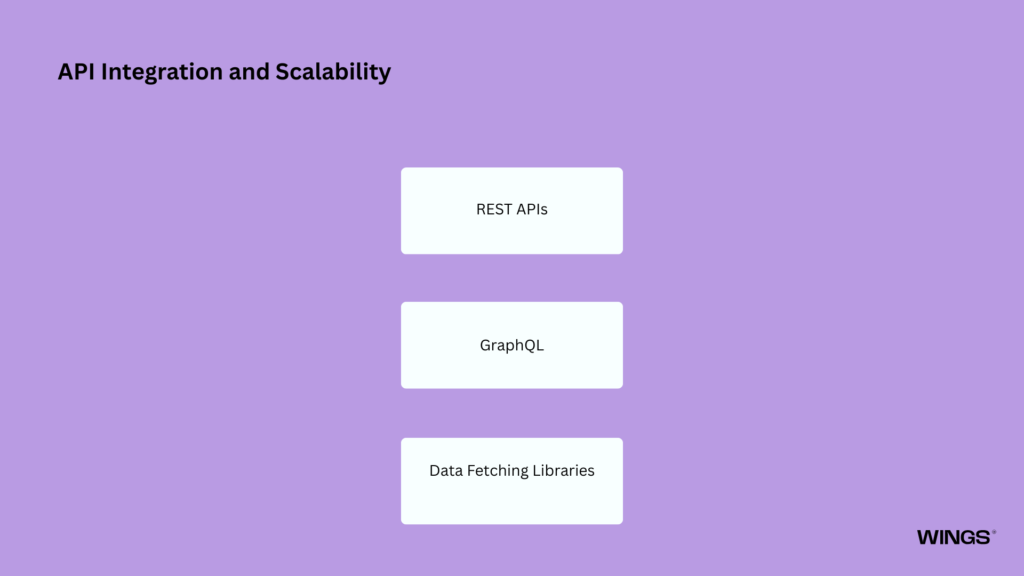
API Integration and Scalability
Most modern React applications rely on Application Programming Interfaces (APIs) to communicate with backend servers, databases, and third-party services. Efficient API integration is essential for scalability because it enables applications to handle large amounts of data while maintaining performance and responsiveness.
REST APIs
React commonly integrates with RESTful APIs to exchange data between the frontend and backend. REST uses standard HTTP methods such as GET, POST, PUT, and DELETE to perform operations on resources.
Key advantages of REST APIs include:
- Simplicity and ease of use
- Broad compatibility with different platforms
- Easy implementation and maintenance
Because of its standardized structure, REST remains one of the most widely used approaches for building scalable web applications.
GraphQL
GraphQL is an alternative API technology that provides more efficient and flexible data fetching. Unlike REST, which often returns fixed data structures, GraphQL allows clients to request only the data they need.
Benefits of GraphQL include:
- Reduced network requests
- Flexible and customized queries
- Improved performance and efficiency
- Better handling of complex data relationships
These advantages make GraphQL a popular choice for large-scale React applications that require frequent data interactions and complex backend integrations.
Data Fetching Libraries
To simplify API communication and improve performance, React developers often use data-fetching libraries such as React Query and SWR. These libraries provide advanced features that reduce the complexity of managing server data.
Key features include:
- Automatic caching of API responses
- Background data updates
- Built-in error handling
- Request deduplication to prevent unnecessary API calls
By managing data efficiently, these libraries help reduce server load, improve application responsiveness, and enhance the overall user experience. As a result, they play an important role in building scalable and high-performance React applications.
Routing in Scalable React Applications
Single Page Applications (SPAs) require efficient routing mechanisms to enable seamless navigation between different views without reloading the entire page. Effective routing improves user experience, application performance, and maintainability, especially in large-scale React applications.
React Router
React Router is the most widely used routing library for React applications. It allows developers to create dynamic and structured navigation systems while maintaining the single-page application experience.
Key features of React Router include:
- Nested Routes: Organize complex applications with hierarchical page structures.
- Dynamic Routing: Create routes based on application data and user interactions.
- Route Protection: Restrict access to specific pages based on user authentication and permissions.
- Lazy-Loaded Routes: Load pages only when needed to improve performance and reduce initial loading times.
React Router is commonly used in applications such as:
- E-commerce platforms
- Learning Management Systems (LMS)
- Enterprise dashboards
- Social networking applications
A well-designed routing structure enhances code organization, simplifies navigation management, and supports future application growth, making it an important aspect of scalable React development.
Security Considerations
Security is a critical requirement for scalable web applications. As applications handle sensitive user data and business information, developers must implement strong security measures to protect against unauthorized access and cyber threats.
Authentication
Authentication verifies the identity of users before granting access to an application. Common authentication methods used in React applications include:
- JWT (JSON Web Tokens): Securely transmit user information between the client and server.
- OAuth 2.0: Allow users to log in using third-party services such as Google or Facebook.
- Single Sign-On (SSO): Enable users to access multiple applications using one set of credentials.
Proper authentication mechanisms help ensure that only authorized users can access protected resources.
Authorization
While authentication confirms who a user is, authorization determines what actions that user can perform within the application. Role-Based Access Control (RBAC) is commonly used to manage permissions.
Examples of user roles include:
- Admin users
- Managers
- Standard users
By assigning different access levels, organizations can protect sensitive data and prevent unauthorized actions.
Preventing Vulnerabilities
Developers must also protect React applications from common web security threats, including:
- Cross-Site Scripting (XSS): Malicious scripts injected into web pages.
- Cross-Site Request Forgery (CSRF): Unauthorized actions performed on behalf of authenticated users.
- Injection Attacks: Attempts to manipulate application inputs to access or modify data.
React helps reduce certain security risks through its built-in escaping mechanisms, which automatically sanitize user-generated content before rendering it. However, developers should also follow secure coding practices, validate user input, use HTTPS, and implement proper authentication and authorization controls to ensure comprehensive application security.
Single Page Applications (SPAs) require efficient routing mechanisms.

Explore the Web development process behind the Shivam.
Testing Scalable React Applications
As React applications grow in size and complexity, testing becomes essential for ensuring reliability, stability, and maintainability. A strong testing strategy helps developers identify issues early, reduce bugs, and ensure that new features do not break existing functionality.
Unit Testing
Unit testing focuses on verifying individual components, functions, or pieces of logic in isolation. It ensures that each part of the application behaves as expected under different conditions.
Popular tools for unit testing include:
- Jest
- React Testing Library
Unit tests help developers detect errors quickly, improve code quality, and make future changes with greater confidence.
Integration Testing
Integration testing validates how different components, modules, and services work together within the application. Instead of testing individual units, it focuses on the interaction between various parts of the system.
Common examples include:
- Form submissions
- Authentication workflows
- API integrations
- Data fetching and state updates
Integration testing helps ensure that application features function correctly when combined, reducing the risk of unexpected behavior.
End-to-End Testing
End-to-End (E2E) testing simulates real user interactions to verify that the entire application works as intended. These tests cover complete user journeys, from navigating pages to performing actions and receiving results.
Common tools for E2E testing include:
- Cypress
- Playwright
End-to-end testing provides a high level of confidence by validating the application’s functionality from the user’s perspective. It helps identify issues that may not be detected through unit or integration testing alone.
Server-Side Rendering and Scalability
Large-scale web applications often require high performance, fast loading times, and strong search engine visibility. To achieve these goals, developers use Server-Side Rendering (SSR) and modern React frameworks such as Next.js.
Server-Side Rendering (SSR)
Server-Side Rendering is a technique where HTML content is generated on the server before being sent to the user’s browser. Unlike traditional client-side rendering, where the browser must download and process JavaScript before displaying content, SSR provides users with a fully rendered page immediately.
Key benefits of SSR include:
- Faster page loading times
- Better Search Engine Optimization (SEO)
- Improved user experience
- Enhanced performance on slower devices and networks
Because content is available immediately, SSR helps improve website accessibility and search engine rankings, making it particularly valuable for business and content-driven applications.
Next.js
Next.js is a popular React framework designed for building production-ready and scalable web applications. It extends React with powerful features that simplify development and improve application performance.
Key features of Next.js include:
- Server-Side Rendering (SSR)
- Static Site Generation (SSG)
- API routes for backend functionality
- Built-in performance optimization
- Automatic code splitting and routing
These capabilities enable developers to create fast, scalable, and SEO-friendly applications with less configuration and development effort.
DevOps and Deployment Strategies
Scalable React applications require reliable deployment processes to ensure smooth releases, high availability, and efficient maintenance. DevOps practices help automate development and deployment workflows, enabling teams to deliver updates quickly and consistently.
Continuous Integration and Continuous Deployment (CI/CD)
Continuous Integration (CI) and Continuous Deployment (CD) are practices that automate the software delivery process. CI/CD pipelines automatically test, build, and deploy applications whenever code changes are made.
CI/CD pipelines typically automate:
- Testing
- Building
- Deployment
Key benefits include:
- Faster software releases
- Reduced human errors
- Consistent and reliable delivery
- Improved development efficiency
By automating repetitive tasks, CI/CD allows teams to focus on developing new features while maintaining application quality.
Containerization
Containerization packages an application and its dependencies into a portable container, ensuring it runs consistently across different environments. Tools such as Docker are widely used for this purpose.
Advantages of containerization include:
- Environment consistency
- Easier deployment and management
- Improved scalability
- Better resource utilization
Containers help eliminate issues caused by differences between development, testing, and production environments, making deployments more predictable and reliable.
Cloud Deployment
Cloud platforms provide the infrastructure needed to host and scale modern React applications. Popular cloud providers include:
- Amazon Web Services
- Google Cloud
- Microsoft Azure
Cloud deployment offers several benefits, such as automatic scaling, high availability, and flexible resource management. Applications can dynamically adjust computing resources based on user demand, ensuring optimal performance during periods of high traffic.
Best Practices for Building Scalable React Applications
Building scalable React applications requires more than just choosing the right technology. Developers must follow proven best practices to ensure that applications remain maintainable, performant, and easy to extend as they grow. Adopting these practices helps teams manage increasing complexity while delivering a consistent user experience.
Some key best practices include:
- Using reusable components
- Maintaining a clean folder structure
- Implementing proper state management
- Optimizing rendering performance
- Using code splitting and lazy loading
- Writing comprehensive tests
- Following security best practices
- Adopting TypeScript for better code quality
- Monitoring application performance continuously
- Documenting architecture and coding standards
Reusable components reduce code duplication and improve consistency across the application. A well-organized folder structure makes the codebase easier to navigate and maintain, especially when multiple developers are working on the project.
Challenges in React Scalability
Although React provides many features that support scalable application development, developers may still face several challenges as applications grow in size and complexity. If not managed properly, these challenges can affect performance, maintainability, and development efficiency.
Some common scalability challenges include:
- State management complexity
- Large bundle sizes
- Frequent re-rendering
- Architectural inconsistency
- Technical debt accumulation
As applications expand, managing shared state across numerous components can become complicated, leading to increased development and maintenance efforts. Large applications may also generate bigger JavaScript bundles, which can negatively impact loading times and overall performance.
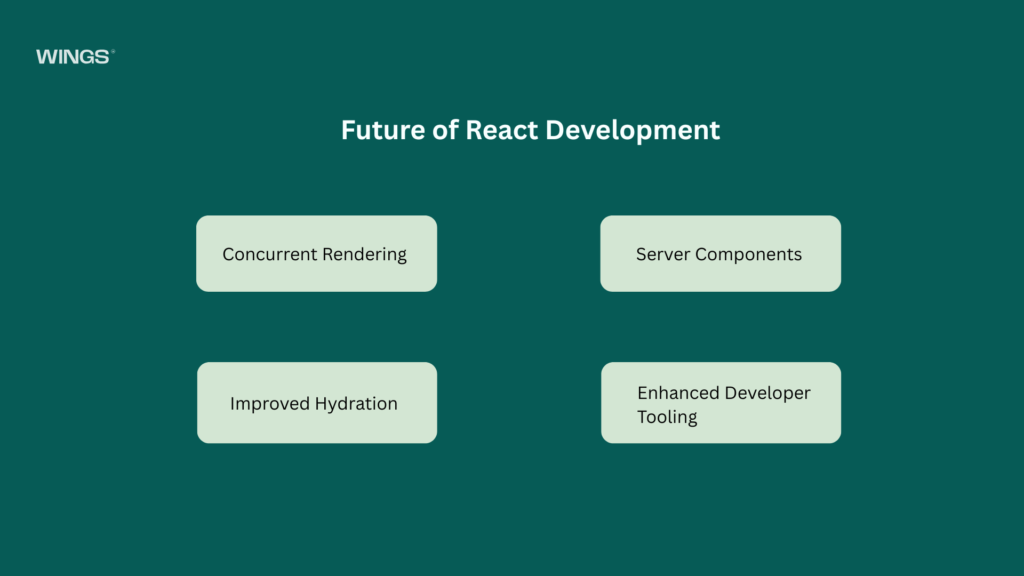
Future of React Development
React continues to evolve with new features and improvements designed to enhance scalability, performance, and developer productivity.
Some of the recent advancements in React include:
- Concurrent Rendering: Allows React to handle multiple tasks simultaneously, improving application responsiveness and user experience.
- Server Components: Enable certain components to be rendered on the server, reducing the amount of JavaScript sent to the browser and improving performance.
- Improved Hydration: Enhances the process of connecting server-rendered content with client-side functionality, resulting in faster page interactions.
- Enhanced Developer Tooling: Provides better debugging, profiling, and development features that simplify application development and maintenance.
These innovations help developers create increasingly sophisticated applications while maintaining high performance and scalability. They also improve resource utilization, reduce loading times, and support modern web development requirements.
Conclusion
React has established itself as one of the most powerful technologies for building scalable web applications. Its component-based architecture, Virtual DOM, flexible ecosystem, and strong community support make it an ideal choice for projects ranging from small startups to enterprise-scale platforms. By implementing effective state management, performance optimization techniques, modular project structures, and robust testing strategies, development teams can create applications capable of handling significant growth and evolving business requirements.

Prasanna M
WordPress Developer